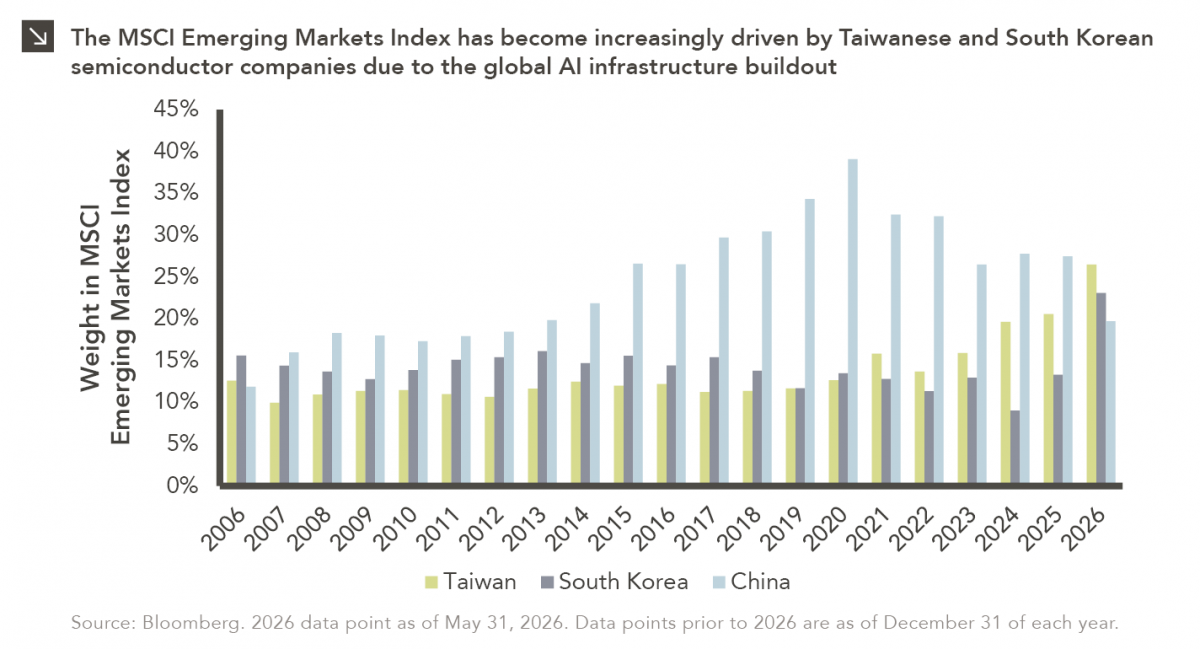
The MSCI Emerging Markets Index has undergone a significant structural transformation in recent years. For much of the past decade, China dominated the benchmark, but Taiwan now represents the largest country in the index at roughly 27%, with South Korea close behind at around 23%. After reaching nearly 40% at the end of 2020, China’s weight in the index now sits below 20%. This shift has largely been driven by the strength of Taiwan and South Korea in the semiconductor space and the global AI infrastructure buildout. For example, Taiwan Semiconductor Manufacturing Company (TSMC), the world’s leading contract chip manufacturer and a critical supplier of the advanced semiconductors used in AI accelerators, has seen its revenues, margins, and market capitalization expand significantly in the last five years. TSMC now represents nearly 15% of the MSCI Emerging Markets Index. Additionally, South Korean companies Samsung and SK Hynix have become global leaders in memory semiconductors, particularly high-bandwidth memory chips, which are essential for training and operating large AI models. Samsung and SK Hynix constitute roughly 9% and 7% of the MSCI Emerging Markets Index, respectively.
This change in index leadership carries important implications for investors. Strong performance of a relatively small group of semiconductor companies has led to an uptick in concentration within passive emerging market funds and tied benchmark performance more closely to AI-related chip demand. The lower weighting of China in the index, meanwhile, reflects both weaker relative performance for Chinese companies and the broader investor preference for markets more directly connected to AI infrastructure spending. As a result of these trends, the MSCI Emerging Markets Index increasingly reflects advanced semiconductor leadership rather than the diversified growth of emerging economies, heightening both country- and company-specific risks. For instance, geopolitical tensions involving Taiwan, supply chain disruptions, or a meaningful slowdown in AI capital expenditures could materially alter recent performance trends. This dynamic reflects a broader shift in where value creation is occurring across emerging markets and is likely to persist as long as AI-related semiconductor demand remains strong.