The Seller Becomes the Buyer

Most have traditionally viewed a successful exit for a venture-backed start-up as either an IPO or an acquisition by a larger strategic or public company. That long-standing dynamic is gradually shifting, as start-ups are now more active than ever as acquirers. Indeed, what was once a buyer landscape dominated by strategics and public corporations now increasingly includes venture-backed firms. According to PitchBook-NVCA data, VC-backed buyers accounted for more than 38% of total U.S. venture M&A activity last year, up from roughly 20% a decade ago, with 2025 marking seven consecutive years of increasing participation. Specifically, more than 387 start-ups were acquired by venture-backed companies last year, compared with 177 in 2015. Although overall exit volumes remain below 2021 peak levels, the steady rise in startup-led acquisitions reflects a structural shift toward internal consolidation within the venture ecosystem.

The drivers behind this shift are largely pragmatic, as capital remains available but far more selective. Growth equity investors are increasingly concentrated within perceived category leaders, while companies that fall slightly below that threshold face a more challenging fundraising environment. For scaling start-ups that have survived earlier rounds of capital selection, acquisitions can serve as an efficient strategic accelerant. Rather than depleting cash reserves to build adjacent features, expand geographically, or acquire customers organically, management teams can accelerate these objectives through M&A, adding revenue, product capabilities, or talent in a single transaction. At the same time, the bar for IPO readiness has risen materially in the last five years, as public investors are increasingly prioritizing profitability, operating leverage, and durable revenue growth. For venture-backed companies aiming to meet these standards, combining with a competitor or complementary platform can create scale and margin expansion more quickly than standalone execution. In some cases, consolidation represents the most rational path forward in a more disciplined capital cycle. This trend is visible at the upper end of the market as well. For instance, OpenAI completed five acquisitions across hardware design, experimentation tooling, fintech AI capabilities, and model infrastructure in 2025 alone. The fact that one of the world’s most valuable private companies is actively using M&A as a growth lever reinforces the idea that an acquisition is no longer solely a means of exit but increasingly a tool for expansion.

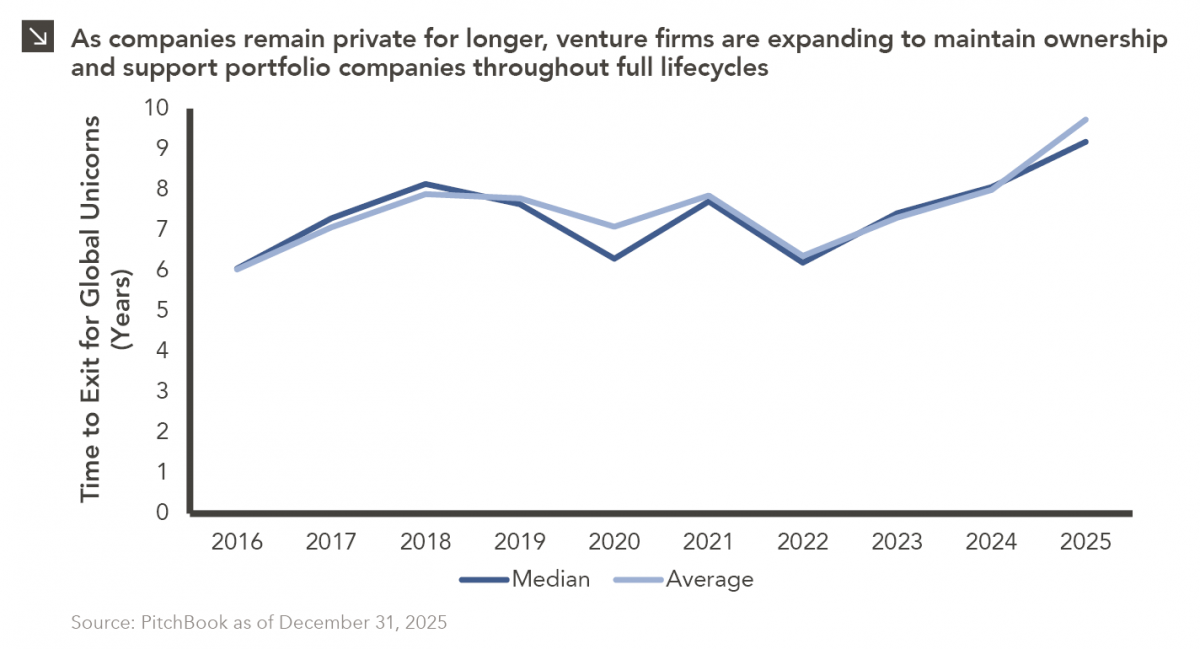
While it remains too early to declare a permanent transformation in venture markets, it is clear start-up-led consolidation is becoming more common and strategically meaningful. As companies remain private for longer and develop greater operational scale, their roles as acquirers may continue to expand.

The Passive Performance Podium

Performance is a key attribute of any investment strategy with a values-based or sustainability focus. As such, analyzing the 2025 returns of traditional indices and those of their ESG-integrated equivalents seemed like a worthwhile endeavor, especially given the 25th Winter Olympic Games currently taking place in Italy. The purpose of this assessment was to evaluate how ESG-oriented indices performed against traditional indices in the U.S. Large Cap, Emerging Markets, and Developed International equity spaces to determine the “passive performance medalists” of 2025.

Before evaluating returns, it is important to outline how ESG-oriented indices are constructed, given that a degree of tracking error is always to be expected from these benchmarks. According to MSCI, each ESG index seeks a risk and return profile that is similar to the broad market index it is designed to track, while also targeting improved sustainability characteristics and avoiding controversies. Of course, nuances exist across different flavors of sustainability indices. For instance, the “ESG Leaders” approach differs slightly from that of “ESG Focused” indices in that it overweights higher scoring ESG names against sector peers and utilizes additional screens. Key examples include the following:

  • MSCI USA Extended ESG Leaders Index: Applies exclusions related to alcohol, Arctic oil and gas production, controversial weapons, nuclear power, palm oil, thermal coal, tobacco, fossil fuel extraction, and gambling.
  • MSCI Emerging Markets ESG Focus Index and MSCI EAFE Extended ESG Focus Index: Both apply exclusions related to civilian firearms, controversial weapons, tobacco, thermal coal, and oil sands.

The time has now come to award the medals. In the U.S. Large Cap space, the ESG Leaders approach landed atop the podium in 2025, as overweight positions in best-in-class Communication Services companies proved fruitful last year. Within Emerging Markets, the MSCI EM ESG Focus Index took home gold with the highest absolute outperformance thanks to positive stock selection effects in sectors including Information Technology, Health Care, and Energy (where being underweight also contributed to excess returns). Finally, a photo finish determined the gold/silver outcome for traditional indices in the EAFE space. The MSCI EAFE ESG Index trailed the two traditional benchmarks due to its weapons-related exclusions and lower exposure to companies in construction and mining spaces, which hampered relative returns given Europe’s increased focus on defense and infrastructure.

The fact that passive ESG indices fared well outside of the EAFE space in 2025 serves as a reminder that funds that track these benchmarks may make sense for the following types of market participants:

  • Mission-aligned investors who do not see their values fully reflected in certain segments of their portfolios
  • Purpose-driven or traditional investors who may consider passive vehicles as placeholders before identifying a viable active manager

It is important to note that understanding the nuances of different ESG-focused products is crucial, as many involve exclusions, additional risk management levers, and screens that will create absolute and relative performance variability. Still, if a lesson can be learned from 2025, it is that investors can enjoy strong performance from passive equity strategies while also tilting toward securities with more sustainable characteristics.

Precious Metals Lose Their Luster… Perhaps

Precious metals have been going on a magnificent run in recent years. Specifically, gold moved from $1,898/ounce at the end of 2020 to $5,375/ounce on January 29 of this year, which represents a gain of 181%. During that same time, silver exhibited a more volatile but highly correlated return pattern, moving from $26/ounce to $116/ounce for a gain of 338%. Then came Friday, January 30. On that day, gold dropped more than 12%, its biggest intraday decline since the early 1980s. Silver plunged by a staggering 36%, a record intraday decline for the metal. The fall continued in February, with gold and silver falling to $4,661/ounce and $79/ounce, respectively. Markets have bounced back somewhat in recent days, with gold climbing by roughly 6% and 3% on Tuesday and Wednesday of last week, respectively. Silver advanced on those days as well. Despite this recent pop, many investors are asking the following question given the sharp decline in gold and silver: Have precious metals lost their luster?

To answer this question, it is worthwhile to first outline the reasons for the run-up in gold and silver over the last several years. A primary factor driving strong precious metal performance is global inflation and geopolitical instability (e.g., tensions between the U.S., Russia, China, and the Middle East) that has pushed investors to seek safety in more traditional stores of value. Tariffs and trade-related conflicts have exacerbated this flight to perceived safety. Additionally, developed economies continue to run significant budget shortfalls, leading investors to gold over bonds as governments continue to issue debt to fund deficits. Individual investors are not the only ones that are adding to their gold reserves, as central banks around the world have been purchasing record amounts of gold in recent years as part of a push toward tangible asset ownership. Finally, there have been tailwinds specific to silver, including a structural deficit, thinner trading markets, and its usage in AI infrastructure, data centers, electric vehicles, and solar panels.

After the rally came the fall on January 30, when the Trump administration tapped Kevin Warsh to lead the Federal Reserve. Traders viewed Warsh as the toughest inflation fighter among the finalists for the position, and his nomination increased expectations of U.S. dollar strengthening and weaker precious metals in dollar terms. The slide in precious metals may have been exacerbated by a gamma squeeze, in which dealers must sell positions as prices fall to maintain balanced portfolios.
Fast markets make commentary quickly obsolete, and it is possible that metals markets will exhibit additional volatility in the weeks ahead. This volatility, as well as potential storage costs and the speculative nature of the space, are drawbacks of precious metals investing, and investors should treat commodities like gold and silver with caution given these risks. Time will tell if gold and silver have indeed lost their luster.

K-Shaped Conundrum

Macroeconomic forecasting is challenging in the best of times and proved downright impossible in 2025, which saw high levels of geopolitical instability and policy uncertainty. Many economists were cautiously optimistic about the state of the global economy at the start of last year, only to revise growth forecasts sharply downward after President Trump’s tariff announcements in April. By summer, markets and economists alike were still largely convinced that a recession was imminent, but this anticipated downturn did not materialize. On the contrary, high-level GDP and consumer spending data for 2025 suggest stable (albeit slowing) economic growth. Despite steady headline figures, however, concerns remain surrounding potential softening of the domestic labor market and slowing real-wage growth. As illustrated by the chart above, these effects are distributed unevenly across income brackets, with wages rising by 3.8% for the highest-earning households over the last year, compared to only 0.8% for lower-earning households. Consumption for lower-income households has also declined in recent time, with a Moody’s survey estimating that the top 10% wealthiest U.S. households now account for roughly half of all consumer spending. Equity market performance has exacerbated this inequality, as wealthier individuals tend to have a larger percentage of their net worth invested in financial assets.

Economic bifurcation, often referred to as a “K-shaped economy,” explains why strong GDP growth can occur in tandem with deteriorating consumer confidence. This dynamic has also challenged policymakers, as institutions like the Federal Reserve have been tasked in recent years with both cooling inflation and preventing further labor market deterioration. Moreover, as lower-income households struggle to finance essential purchases, it is possible that future GDP growth will be contingent on wealthier households spending at current or higher rates. It follows that an event that leads to a pullback in spending (e.g., an equity market downturn) could be detrimental to overall growth. While predicting the trajectory of the economy is certainly a challenge, understanding these dynamics offers some insight into the indicators to monitor in 2026.

Pining for Evergreens

In recent years, access to traditionally illiquid private markets has expanded through the rapid growth of evergreen funds, which provide investors with more favorable subscription and liquidity terms than traditional closed-end vehicles. New evergreen fund launches notably increased from 30 in 2018 to 107 in 2025, with alternative credit strategies emerging as the primary driver of this growth (36 new fund launches last year). Many new funds have also come to market in the private equity, real estate, and infrastructure spaces, and these dynamics can be observed in the chart above. There are more than 500 active evergreen funds available to investors currently.

Broad adoption of the evergreen structure reflects growing demand for more illiquid assets across both institutional and retail investors. In addition to the advantageous terms mentioned above, many offer seasoned and diversified exposures, which can help mitigate the J-curve effect that is exhibited within private markets. Many evergreen funds also have lower investment minimums and less operational complexity relative to closed-end vehicles. All of these factors have contributed to the proliferation of evergreens detailed above. It is important to note, however, that there are drawbacks associated with evergreen fund investing, including potential liquidity mismatches and gating risk. Overall, while evergreen funds have broadened access to private markets through greater flexibility and lower barriers to entry, investors must balance these benefits against the structural liquidity and redemption risks inherent in illiquid asset classes.

Concentrating on Market Concentration

Last week, Alphabet joined NVIDIA, Microsoft and Apple as the only companies to ever reach a market capitalization of $4 trillion. The growth of these and other U.S. mega-cap technology companies has completely changed the composition of indices that measure the domestic equity market. Indeed, the weight of the top 10 constituents of the MSCI United States Index (which is comprised of large- and mid-cap stocks) sat at roughly 23% just three years ago. At the end of last year, however, that figure sat closer to 38%. As can be seen above, this concentration has resulted in a handful of stocks driving a significant share of overall index returns in recent periods. Interestingly, the theme of market concentration is not exclusive to domestic indices. For instance, companies in China, Taiwan, and South Korea have helped provide the materials required for the artificial intelligence boom, and the growth of these businesses has led to higher levels of concentration for the MSCI Emerging Markets index. The top 10 constituents now represent slightly less than one-third of this index, and TSMC, the largest producer of semiconductors in the world, notably comprises roughly 12% of the benchmark. Similar to trends within domestic markets, these top constituents had an outsized impact on the return of the MSCI Emerging Markets Index in 2025.

Interestingly, the MSCI EAFE Index, which is comprised of non-U.S. developed markets large- and mid-cap stocks, has not followed these same trends, with the weight of its top 10 constituents actually decreasing in recent years. While its largest holding is ASML, a supplier for the semiconductor industry, this benchmark is not nearly as heavily tilted towards the AI boom as domestic and emerging markets indices. For this reason, developed international markets could be a stronger source of diversification for investors moving forward.

I Drink Your Milkshake

The capture of Venezuelan president Nicolás Maduro is a watershed moment for a country whose natural resource economy has been managed by an interventionist, state-centric regime for nearly 30 years. Indeed, Maduro’s detention effectively ends the command-and-control model that had long governed Venezuela’s oil sector, in which the state-owned oil company PDVSA functioned largely as a political instrument rather than a commercial enterprise. Once a technically competent producer, PDVSA was hollowed out in the early 2000s as revenues were diverted to fund government spending, skilled workers were purged, and maintenance and reinvestment were neglected. As can be seen in this week’s chart, this led to a steep decline in Venezuelan production and export capacity. For global markets, the immediate significance of the ousting of Maduro lies less in the regime change itself than in the potential reopening of one of the world’s largest hydrocarbon endowments after years of sanctions and operational decay.

In the short run, Venezuelan oil exports are likely to increase modestly but unevenly. Although the nation’s output has already started to recover from its 2020 trough due to limited sanctions waivers and ad hoc deals, infrastructure constraints remain severe. Years of deferred maintenance have left pipelines, ports, and storage facilities in poor condition, while a shortage of skilled labor and reliable power continues to limit throughput. As a result, any additional barrels reaching export markets will likely come primarily via better utilization of existing fields rather than large-scale new investment, at least over the coming months. Deals that redirect crude toward the United States (particularly heavy oil suited for Gulf Coast refineries) could shift trade flows quickly, but they do not solve the deeper structural problems of the industry. Near-term export gains are therefore likely to be measured in hundreds of thousands of barrels per day rather than a return to Venezuela’s historical multi-million-barrel output.

Over a longer time horizon, the toppling of Maduro could reshape Venezuela’s oil sector more profoundly by altering its relationship with foreign capital and global commodities markets. International oil companies have long viewed Venezuela’s reserves as attractive but effectively uninvestable due to sanctions risk, opaque governance, a history of expropriation, and weak contract enforcement. A political realignment raises the possibility of a gradual normalization of commercial terms, including joint ventures, profit-sharing mechanisms, and clearer legal protections for market participants. However, analysts widely agree that rebuilding production capacity would be a long and risky process, likely requiring tens of billions of dollars and many years of stable policy. Further complicating matters is Venezuela’s exceptionally high methane intensity, which makes its crude oil among the most emissions-intensive in the world and increasingly problematic for buyers facing stricter environmental standards. Addressing these environmental liabilities would add both cost and time to any meaningful expansion of exports.

Beyond oil, Venezuela’s broader natural resource abundance adds an additional layer of significance to the recent change in leadership. Specifically, the country sits atop substantial reserves of gold and other strategic minerals, and renewed export capacity could feed into a broader bull market in commodities if supply constraints ease. It is important to remember, however, that recent events do not automatically translate into a clean political transition, and the near-term outlook for Venezuelan commodities exports remains shaped by institutional fragility, security risks and unresolved questions about who exercises authority over production, contracts, and revenues. Ultimately, Maduro’s capture creates an opening rather than a resolution, as it increases the probability that Venezuelan resources re-enter global markets at scale, but it does not eliminate the risks that have defined the country’s commodities sector for years.

Brains Over Brawn?

The development of artificial intelligence is advancing along two largely distinct paths. The first centers on generative AI powered by large language models, with the long-term objective of creating systems that can reason across domains at levels superior to those of human beings. The second focuses on embodied intelligence (i.e., robotics). In this space, the objective is not abstract reasoning but rather the deployment of capable machines that can operate effectively in the physical world. Over the last five years, capital and attention have overwhelmingly gravitated toward companies involved in generative AI, with the Bloomberg Artificial Intelligence Index up a staggering 276% in that time. Robotics, by comparison, has been widely viewed as a longer-dated theme, with the Bloomberg Robotics Index up only 77% over that same period (even less than the S&P 500 Index return of 134%). These dynamics can be observed in this week’s chart.

Going forward, there are reasons to believe that this performance trend may shift in the years ahead. For instance, human-level general intelligence could be far more distant than markets currently assume, and language models may not prove sufficient to reach it. At the same time, practical robots (e.g., warehouse automation, humanoid assistants, etc.) appear closer to commercial reality than previously believed, particularly in aging societies facing persistent labor shortages. One possible accelerant for robotics companies in the years ahead is the use of advanced simulation. By training in virtual environments, robots can acquire motor skills and coordination far more rapidly than through physical trial and error alone, potentially pulling forward adoption timelines relative to current investor expectations. Importantly, transformative impact does not require robots to achieve artificial general intelligence but rather functional capability (i.e., the ability to move objects, operate safely, and sustain useful work with sufficient battery life). Commercial momentum in robotics is already building. In 2024, for example, Agility Robotics opened a manufacturing facility in Oregon with capacity to produce up to 10,000 humanoid units annually, and Amazon has now begun testing Agility’s robots in its warehouses. Additionally, companies like Tesla are showcasing humanoid prototypes performing increasingly fluid physical tasks, and BYD has signaled interest in future household robotics. While price points remain prohibitive for mass adoption today, several structural forces are converging to improve the economics of robotics. Manufacturing costs are declining as scaling drives down prices for components like sensors and actuators, while improvements in AI models are enhancing robotic perception and control. Taken in tandem with the fact that generative AI leaders are currently investing heavily in costly, power-hungry data centers, it is fair to say that a once slower-moving, less glamorous segment of the AI ecosystem may now benefit from relative capital efficiency.

Despite these developments, markets continue to assign a significant valuation premium to generative AI over robotics, which can also be observed in the chart above. Factor analysis helps explain part of the gap, as AI-heavy indexes skew toward momentum and growth while robotics-oriented benchmarks exhibit greater exposure to value, quality, and, in some cases, even dividend income. Further, the generative AI complex is dominated by large technology platforms including Alphabet, Microsoft, and NVIDIA, whereas robotics companies tend to be more industrial in nature (e.g., automation specialists, automakers, and emerging consumer-robotics firms). This valuation disconnect suggests that investors may be overemphasizing long-term breakthroughs in cognition while underappreciating near-term progress in physical automation, especially as physical robots transition from research environments into factories, homes, and hospitals. Indeed, while much of today’s excitement centers on artificial brains, it may ultimately be robotic brawn that drives the next leg of growth within the technology sector.

Glass Half Empty

While the holiday season was once marked by bustling bars, readers may notice that nightlife isn’t what it used to be. Indeed, alcohol-oriented companies, long considered stable components of the Consumer Staples sector thanks to recession-proof attributes, are struggling to regain momentum after a post-pandemic boom. As can be seen in this week’s chart, the Bloomberg Global Alcohol Index, which tracks over 50 of the world’s top listed beer, wine and spirits producers, has exhibited a roughly 46% decline since the summer of 2021. Shares of European giants such as Diageo, Pernod Ricard, and Remy Cointreau now hover near multi-year lows, with many global peers notching similar declines.

There are likely many factors contributing to these performance headwinds for alcohol-oriented businesses, including rising costs, post-pandemic societal shifts (i.e., higher levels of solitude), and healthier lifestyle choices being pursued by consumers. Interestingly, a recent Gallup survey indicates that alcohol consumption by U.S. adults sits at a staggering 90-year low, with members of the Millennial and Gen-Z cohorts increasingly viewing drinking as less fashionable. This change in behavior is compounded by the rise of GLP-1 drug use for weight loss, as early indicators suggest that these medications are catalyzing behavioral changes that have led to a greater emphasis on health and well-being. Additionally, the options for partygoers outside of alcohol have rapidly expanded in recent years, with global consumers increasingly turning to non-alcoholic beverages and cannabis to fuel their holiday cheer. While demand for alcohol is unlikely to disappear completely, alcohol-oriented businesses will surely need to innovate and diversify to meet changing consumer preferences based on the trends described above.

The Secondary Option

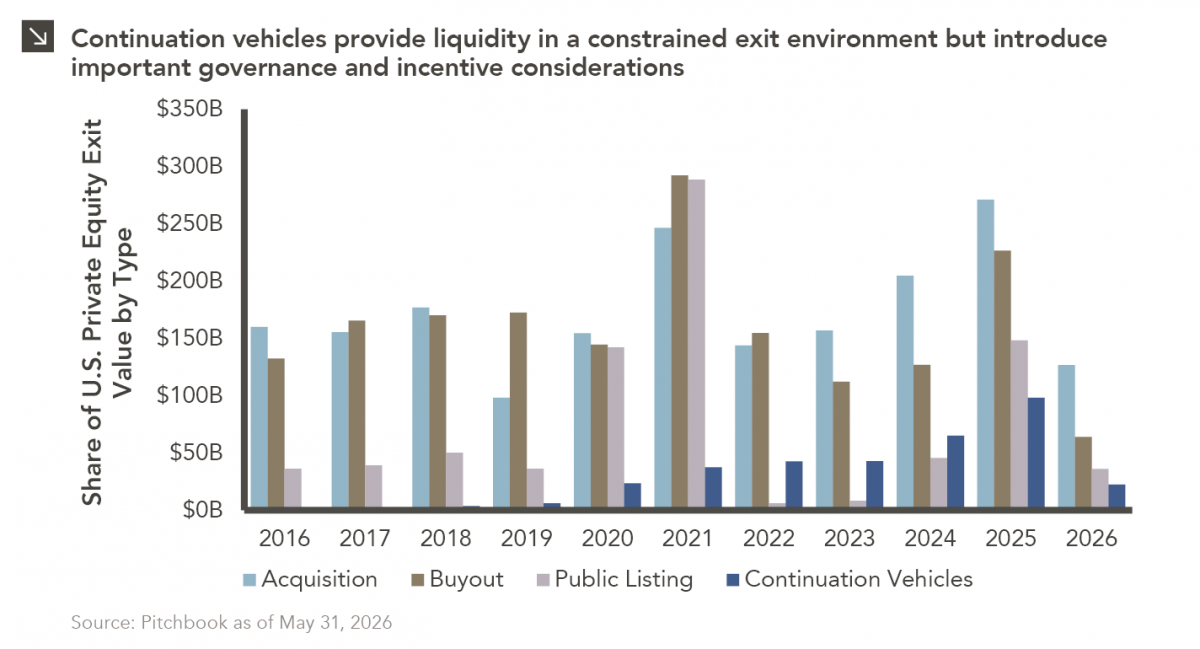
Private equity is known for being an illiquid asset class, with investments typically locked up for several years and limited options to access cash before a fund winds down. Investors have largely accepted these restrictions in exchange for the potential of higher returns, but this lack of liquidity has become a challenge more recently. For instance, DPI (distributions to paid-in capital) as a percentage of net asset value for 2024 was 12%, significantly lower than the 25-year average of 21%. As a result of these dynamics, there has been rapid growth in the private equity secondary market, which allows investors to sell their existing stakes in ongoing private equity funds. Indeed, what was once a niche option for distressed sellers is now a mainstream tool for managing portfolios, with global secondary market transactions on pace to exceed $200 billion in 2025. This figure would constitute a record high. Interestingly, more than 50% of secondary transactions in the first half of this year came in the form of Limited Partner (“LP”)-led secondaries, which occur when existing LPs sell fund interests to other investors.

The rise of LP-led secondaries is about more than investors simply “cashing out.” Specifically, LPs may tap the secondary market to rebalance portfolios when private equity exposure becomes too high, move away from underperforming funds, or free up capital to invest in new opportunities. Institutions of all types are embracing this strategy. For instance, the University of Illinois Foundation recently announced the sale of roughly $245 million of net asset value of private market assets, aiming to reduce exposure to high-risk, illiquid positions and reposition its endowment for greater long-term stability. Additionally, CalPERS announced a potential $3 billion secondary transaction earlier this year, and Yale University is currently in talks for its first-ever secondaries sale to convert older private equity holdings into liquid assets for reinvestment. These developments reflect a broader trend among institutional investors seeking flexibility and liquidity amid a challenging private equity environment. Indeed, as private equity funds continue to hold assets for longer and exit activity remains slow, the secondary market may become a standard part of portfolio management for both large institutions and smaller investors in the years ahead.