2021 Halftime Market Insights Video

This video features an in-depth analysis of the first half of 2021, reviewing general themes from the second quarter and risks and opportunities to monitor in the coming months.

Our Market Insights video series examines the primary asset classes we cover for clients including the U.S. economy, fixed income, U.S. and non-U.S. equities, hedge funds, real estate, infrastructure, private equity, and private credit, with presentations by our research analysts and directors.

Sign up for research alerts to be notified when we publish new videos here.
For more information, questions, or feedback, please send us an email.

Spreads Largely Pricing in a Full Recovery

Spreads for industries that were beat-up during the early 2020 COVID panic — energy, retail, and transportation — as well as for industries that proved more stable — financials, technology, and utilities — are now generally tighter than pre-pandemic levels in the bank loan and high yield markets. From here, spreads could tighten further as issuer fundamentals continue to improve, widen in a correction, or be volatile, blowing out and tightening back in throughout the economic recovery.

While a lot of progress has been made on the vaccination front, there is still more work to do. The fully vaccinated rate in the U.S. is currently 39%, not yet at 70% herd immunity. Globally, the fully vaccinated rate is only 5%, not even close to 70% herd immunity. While this leaves the economic recovery vulnerable, markets are forward-looking. In the bank loan and high yield markets, maturities have been pushed off, which is a positive, thanks to the large volume of issuance over the past year. Leverage levels of bank loan and high yield issuers are currently high, but due to decline, another positive, as earnings rise in the economic recovery. Use of proceeds from bank loan and high yield issuances¹ and aggressive issuance² are at benign levels, and defaults have been declining — more positive indicators. On the negative side, equity valuations are already at all-time highs and continuing to rise.

In summary, fundamentals are attractive, but valuations are not. We could potentially see spreads tighten further, but uncertainty is high, and we could also see a correction given the high valuations and frothy sentiment. While further spread tightening will be accretive to returns, it will limit short-term future price appreciation for fixed income strategies. Overall, this is a dynamic that bears watching, particularly as economic growth accelerates and the pandemic continues to fade.

Print PDF > Spreads Largely Pricing in a Full Recovery

¹ Such as towards refinancings (a sign of conservativism) versus acquisitions and LBOs (a sign of frothiness).
² Such as CCC bank loan and high yield issuance and 2nd lien bank loan issuance.


The opinions expressed herein are those of Marquette Associates, Inc. (“Marquette”), and are subject to change without notice. This material is not financial advice or an offer to purchase or sell any product. Marquette reserves the right to modify its current investment strategies and techniques based on changing market dynamics or client needs.

Q1 2021 Market Insights Video

This video features an in-depth analysis of the first quarter’s performance by Marquette’s research analysts and directors, reviewing general themes from the quarter and risks and opportunities to monitor in the coming months.

Our Market Insights series examines the primary asset classes we cover for clients including the U.S. economy, fixed income, U.S. and non-U.S. equities, hedge funds, real estate, infrastructure, private equity, and private credit, with presentations by our research analysts and directors.

Sign up for research alerts to be notified when we publish new videos here.
For more information, questions, or feedback, please send us an email.

One Year Ago, Would Anyone Have Predicted This?

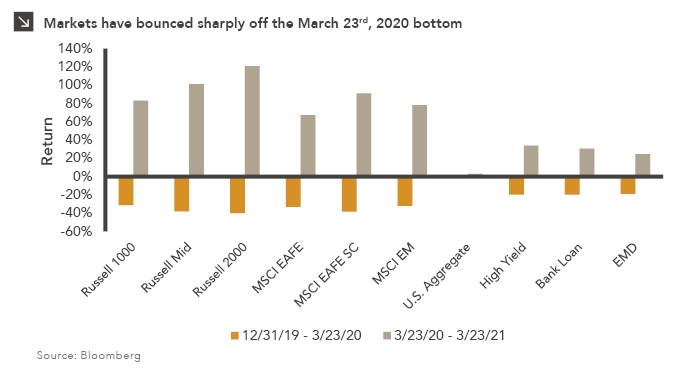
What a year it has been. Officially one year after the equity market’s bottom on March 23rd, 2020, all major indices in the chart above have at least recovered back to ending 2019 levels. The groups that were hit the hardest have also rebounded the strongest, with returns over the last year exceeding 100% for some. Small-cap equities stand out, especially in the U.S. — up 121% over the last year and up 33% over the almost 15-month period since 2019. U.S. mid-cap equities are up 101% over the last year, up 25% over the full period, and U.S. large-cap equities are up 83% over the last year for a 26% return over the full period. Small-cap stocks have also outperformed internationally — the MSCI EAFE Small Cap Index is up 91% over the last year and 18% since 2019, while the MSCI EAFE Index is up 67% over the last year and 12% for the full period. Emerging markets, some of the hardest hit by the crisis last year, have more than recovered, up 78% over the last year for a 22% return since 2019. Fixed income returns have been more muted. Investment grade bonds stayed positive in early 2020 as equity markets fell precipitously and are up another 3% since. High yield bonds, bank loans, and emerging market debt were hit harder but still held up better than equities. Each group has recovered those losses but remains in positive single-digit territory over the full period.

From here, we expect returns will likely moderate. As the vaccine roll-out continues we expect further economic re-openings and renewed growth across the globe, but it seems highly unlikely capital markets returns can continue at this pace beyond the initial recovery.

Print PDF > One Year Ago, Would Anyone Have Predicted This?


The opinions expressed herein are those of Marquette Associates, Inc. (“Marquette”), and are subject to change without notice. This material is not financial advice or an offer to purchase or sell any product. Marquette reserves the right to modify its current investment strategies and techniques based on changing market dynamics or client needs.

Prospects of Dollar Depreciation in the COVID Recovery & Impact on Asset Classes

As vaccine distribution continues in full force and the global economy’s recovery from the COVID pandemic gains momentum, investors are concerned about depreciation of the U.S. dollar and how this phenomenon might affect various asset classes within a portfolio.

In this paper, we examine the mechanics of dollar depreciation and its subsequent impact on traditional asset classes. We begin by exploring the macroeconomic factors that drive dollar strength or weakness and then examine the impact of dollar depreciation on the fixed income, U.S. equities, and non-U.S. equities asset classes both by covering the potential effects of a stronger or weaker dollar and by assessing historical performance.

Read > Prospects of Dollar Depreciation in the COVID Recovery & Impact on Asset Classes


The opinions expressed herein are those of Marquette Associates, Inc. (“Marquette”), and are subject to change without notice. This material is not financial advice or an offer to purchase or sell any product. Marquette reserves the right to modify its current investment strategies and techniques based on changing market dynamics or client needs.


2021 Market Preview

2020 was a year like no other and has left investors across the world wondering what the future looks like. Will vaccines prove effective in halting a pandemic that spread like wildfire across the globe? What will the impact of a new administration in Washington be on economies and markets? How much additional stimulus will be injected into the economy? And most broadly, will things ever get back to “normal”? While there are no easy answers to these questions, 2021 promises to be another volatile year, most especially until there has been sufficient roll-out and distribution of vaccines to contain the COVID-19 outbreak that continues to haunt economic growth across the globe.

Remarkably, 2020 ended up as a positive year for financial markets despite a massive sell-off in the equity and credit markets during February and March. Paradoxically, 2021 may be a less eventful year but at the same time a lower overall return environment, given that much of the optimism about economic re-openings and stimulus has already been priced into the markets. Nonetheless, there are a variety of factors worth monitoring over the next year which will directly impact market returns. Similar to past years, we offer our 2021 market preview newsletters for each of the primary asset classes we cover, with in-depth analysis of last year’s performance as well as trends, themes, opportunities, and risks to watch for in 2021.

We hope these materials can assist you and your committees as you plan for the coming year and beyond. We have also produced a 2021 Market Preview video if you would like to hear a high-level summary of the market previews. Should you have any questions about anything related to these materials, please feel free to reach out to any of us for further assistance. Here’s to a return to normalcy in 2021!

U.S. Economy: Are Better Days Ahead?
by Brandon Von Feldt, CFA, Research Analyst

Fixed Income: Poised for Further Recovery with Undertones of Exuberance
by Ben Mohr, CFA, Director of Fixed Income

U.S. Equities: Birth of a New Market
by Samantha T. Grant, CFA, CAIA, Assistant Vice President,
Colleen Flannery, Research Analyst, U.S. Equities, and
Evan Frazier, CAIA, Research Analyst, U.S. Equities

Non-U.S. Equities: Constructive but Cautious
by David Hernandez, CFA, Senior Research Analyst, Non-U.S. Equities, and
Nicole Johnson-Barnes, CFA, Senior Research Analyst, Global Equities

Hedge Funds: Poised for Another Record Year?
by Joe McGuane, CFA, Senior Research Analyst, Alternatives
and Jessica Noviskis, CFA, Senior Research Analyst, Hedge Funds

Real Estate: Finding the New Normal
by Will DuPree, Senior Research Analyst, Real Assets

Infrastructure: An Evolving Opportunity Set, but an Essential Allocation
by Will DuPree, Senior Research Analyst, Real Assets

Private Equity: Both Quality and Growth Shine Brightly in 2020
by Derek Schmidt, CFA, CAIA, Director of Private Equity

Private Credit: Two Steps Forward, One Step Back
by Brett Graffy, CAIA, Research Analyst

Download the combined files > Traditional and Alternatives


The opinions expressed herein are those of Marquette Associates, Inc. (“Marquette”), and are subject to change without notice. This material is not financial advice or an offer to purchase or sell any product. Marquette reserves the right to modify its current investment strategies and techniques based on changing market dynamics or client needs.
2021 Market Preview Video

This video coincides with our 2021 Market Preview newsletters and provides a high-level summary of each, including analysis of last year’s performance as well as trends, themes, opportunities, and risks to watch for in 2021.

Our Market Insights series examines the primary asset classes we cover for clients including the U.S. economy, fixed income, U.S. and non-U.S. equities, hedge funds, real estate, infrastructure, private equity, and private credit, with presentations by our research analysts and directors.

Sign up for research alerts to be notified when we publish new videos here.
For more information, questions, or feedback, please send us an email.

Can TIPS Be an Effective Inflation Hedge for Portfolios?

With the COVID vaccine’s worldwide distribution and adoption starting last week, many investors are aiming to project an inflation outlook driven by the return of furloughed workers and impending economic recovery and adjust portfolios with inflation protection in mind.

In this newsletter, we examine how key asset classes in institutional portfolios behave in rising or declining inflation environments, and ultimately determine the best asset classes that serve as inflation hedges while also providing strong total return and efficiency ratios. In particular, we investigate if TIPS (Treasury Inflation-Protected Securities) offer superior inflation protection compared to other common portfolio constituents.

Read > Can TIPS Be an Effective Inflation Hedge for Portfolios?


The opinions expressed herein are those of Marquette Associates, Inc. (“Marquette”), and are subject to change without notice. This material is not financial advice or an offer to purchase or sell any product. Marquette reserves the right to modify its current investment strategies and techniques based on changing market dynamics or client needs.

What Does the Biden Win Mean for Financial Markets?

On Saturday, November 7th, Joe Biden was declared the winner of the presidential election and will become the 46th president of the United States in January. Markets were surprisingly positive last week despite the uncertainty around results as multiple states were too close to call until all the votes had been tallied. While there is still pending litigation in certain states, it seems highly unlikely that these actions will reverse the election result. Thus, market participants have turned their attention to what the market can expect from a Biden-led White House coupled with a split Congress, while the coronavirus pandemic marches on.

In this newsletter, we tackle this question for each of the “traditional” asset classes: Fixed Income, U.S. Equities, and Non-U.S. Equities. The impact on alternative asset classes such as hedge funds, real assets, and private equity are more nuanced and will be covered in our 2021 market preview to be released in January.

Read > What Does the Biden Win Mean for Financial Markets?


The opinions expressed herein are those of Marquette Associates, Inc. (“Marquette”), and are subject to change without notice. This material is not financial advice or an offer to purchase or sell any product. Marquette reserves the right to modify its current investment strategies and techniques based on changing market dynamics or client needs.

Q3 2020 Market Insights Video

This video features an in-depth analysis of the third quarter’s performance, coinciding with our 3Q Asset Allocation Update newsletter reviewing risks and opportunities heading into the final quarter of the year.

Our Market Insights series examines the primary asset classes we cover for clients including the U.S. economy, fixed income, U.S. and non-U.S. equities, hedge funds, real estate, infrastructure, private equity, and private credit, with presentations by our research analysts and directors.

Sign up for research alerts to be notified when we publish new videos here.
For more information, questions, or feedback, please send us an email.