What’s Next for SPACs?

The ferocious appetite for Special Purpose Acquisition Companies (SPACs) continued its momentum throughout the first quarter of 2021. Investors could not get enough of this asset class as a record amount of capital flowed into the space. Through March, 2021 has already seen more SPAC IPOs than all of 2020, with over 300 new deals coming to market. Similarly, gross proceeds thus far through April are already over $100B, well past the $83B that was raised throughout 2020. The space has gotten so hot that sports celebrities like Shaquille O’Neal, Colin Kaepernick, and Alex Rodriguez have all put their names on SPACs that have recently hit the market.

Can this momentum continue? The Securities and Exchange Commission (SEC) might have something to say about it. Earlier this month, the SEC issued new accounting guidance that would classify SPAC warrants as liabilities instead of as equity instruments, as they are currently classified. Warrants are given to capital providers like hedge funds that put up the capital for SPACs before an IPO, to offer the capital provider more upside once the company goes public. SPAC IPOs have since slowed, as affected SPACs would have to restate their financials if this becomes law. With this risk on the table, investors may begin to look elsewhere to put their capital to work, dampening this SPAC market frenzy.

Print PDF > What’s Next for SPACs?


The opinions expressed herein are those of Marquette Associates, Inc. (“Marquette”), and are subject to change without notice. This material is not financial advice or an offer to purchase or sell any product. Marquette reserves the right to modify its current investment strategies and techniques based on changing market dynamics or client needs.

One Year Later, What’s Next?

Welcome to our inaugural quarterly client newsletter! As a way of introduction, I am Greg Leonberger, Director of Research here at Marquette. I have had the privilege of meeting many of you over the years, and for those that I have not worked with previously, please accept this virtual introduction; my hope is to meet many more of you in person once in-person meetings resume. As I embark on this newsletter series, the goal each quarter is relatively simple: provide you with our views on capital markets, the economy, emerging risks as well as opportunities, and hopefully stitch in a few anecdotes to make for a more engaging connection with our readers.

Highlights from this edition:

  • One year anniversary of the equity market trough in 2020
  • COVID-19: lingering uncertainty, vaccine progress, economic recovery
  • Equities update: value and small-cap outperformance, valuations, TINA
  • Fixed income: reflation trade and interest rates, spreads
  • Alternatives: opportunities in real estate, hedge funds, and private markets
  • Inflation worries: money supply and commodity prices

Read > One Year Later, What’s Next?


The opinions expressed herein are those of Marquette Associates, Inc. (“Marquette”), and are subject to change without notice. This material is not financial advice or an offer to purchase or sell any product. Marquette reserves the right to modify its current investment strategies and techniques based on changing market dynamics or client needs.

Q1 2021 Market Insights Video

This video features an in-depth analysis of the first quarter’s performance by Marquette’s research analysts and directors, reviewing general themes from the quarter and risks and opportunities to monitor in the coming months.

Our Market Insights series examines the primary asset classes we cover for clients including the U.S. economy, fixed income, U.S. and non-U.S. equities, hedge funds, real estate, infrastructure, private equity, and private credit, with presentations by our research analysts and directors.

Sign up for research alerts to be notified when we publish new videos here.
For more information, questions, or feedback, please send us an email.

Hedging Rising Inflation and Interest Rates

Rising inflation and interest rates have not been real issues for investors for several years, but both have remained popular topics of concern. While inflation does not appear to be an immediate risk given still depressed GDP and elevated unemployment, the size of the latest proposed $1.9 trillion COVID relief package has many thinking about future implications. Stimulus did not lead to inflation following the Global Financial Crisis, but there are a number of reasons, beyond the sheer size of this effort, that we could see greater inflationary pressures this time: more pent-up consumer demand, well-capitalized banks and healthy consumer balance sheets, de-globalization, and higher operational costs associated with the virus. And while the Federal Reserve has committed to maintaining its ultra-accommodative monetary policy until long-term inflation hits 2% (with shorter-term inflation allowed to rise moderately above 2% for some time), unless the Fed changes its stance on negative rates, rates can only go in one direction from here: up.

Like all things market-related, we do not recommend trying to time inflation or interest rates. In this newsletter, we analyze equity long/short hedge funds as an option for investors to potentially optimize their portfolio for this dynamic environment.

Read > Hedging Rising Inflation and Interest Rates


The opinions expressed herein are those of Marquette Associates, Inc. (“Marquette”), and are subject to change without notice. This material is not financial advice or an offer to purchase or sell any product. Marquette reserves the right to modify its current investment strategies and techniques based on changing market dynamics or client needs.
The Big Squeeze

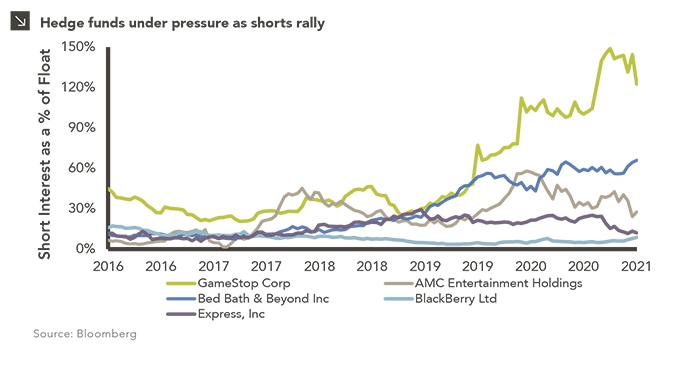
A group of small-cap stocks made big waves last week as retail day traders collaborated online to drive up certain stock prices in order to “squeeze” hedge funds with short positions. The influence of the retail investor has been building for over a year, facilitated by reduced trading fees, new brokerage platforms, and the time and money freed up by COVID lockdowns, but the Reddit-documented campaigns to manipulate GameStop and others brought forth entirely new dynamics.

Hedge funds take short positions when they expect stock prices to fall, generally for fundamental reasons. Short positions are inherently more risky than long positions — the downside is theoretically unlimited and short positions will increase in size as the stock moves against you, but prudent long/short managers understand these risks and typically run short portfolios that are more diversified, with smaller position sizes and tighter risk management parameters. Market sentiment and positioning is a key part of their analysis, especially on the short side. Stocks with high short interest have been red flags for many managers well before the term “Gamestonk” existed.

GameStop, AMC, Bed Bath & Beyond, and other stocks being irrationally bid up have fundamentally struggled for years. Outdated business models have led to earnings declines and multiple compression, and the impact of COVID has pulled forward bankruptcy concerns. At the same time, short interest has increased, and profitably — for the three years ending June 30th, 2020, the five stocks in the chart above lost on average 59% of their value. Over the last seven months, through the end of January, the worst performer of the group has almost tripled, and GameStop is up more than 7,000%, despite a largely unchanged fundamental outlook.

A number of hedge funds holding these higher short interest stocks were significantly impacted. At the center of the drama, Melvin Capital was reportedly down more than 50% for the month. While many hedge funds did not have direct exposure, the broader issue for the group and investors is the related de-grossing — long selling and short covering — as managers look to reduce exposure to the volatility. While de-grossing is not unusual (seen most recently in March 2020, September 2019, the fourth quarter of 2018), it has been especially rapid over the last week with hedge funds coming into the year with above average levels of gross and net leverage. While this has a created a tough backdrop for hedge fund alpha, especially coming off a record year in 2020, year to date losses have been modest. Through January, the average U.S. long/short fund was down just 2.3%,¹ relative to the S&P 500 -1.0%.

While Melvin Capital and others have publicly stated that they have fully closed out short positions on GameStop, the damage has been done, and these funds will likely face ongoing investor scrutiny over their risk management processes. But the majority of long/short funds should be able to make up any early year losses, with 2021 set up to be a good year for stock pickers. Prudent managers are re-underwriting their short positions, reducing exposure to potential targets and names with higher short interest, and many are patiently planning for the inevitable next leg. Stocks do not typically remain this severely disconnected from fundamentals for long, and at these valuations could present strong short opportunities.

Print PDF > The Big Squeeze

¹ Morgan Stanley Prime Brokerage


The opinions expressed herein are those of Marquette Associates, Inc. (“Marquette”), and are subject to change without notice. This material is not financial advice or an offer to purchase or sell any product. Marquette reserves the right to modify its current investment strategies and techniques based on changing market dynamics or client needs.

Fundamental Disconnect: Understanding the Nature and Impact of Recent Frenzied Trading

In recent years, most major brokerage firms have participated in a “race to the bottom” with respect to commissions on equity purchases and sales, as well as options trades. This phenomenon, in tandem with the rise in popularity of app-based trading platforms like Robinhood, has afforded retail investors greater access to capital markets. While the democratization of the investment world is beneficial in many respects, it can also lead to irrational behavior and a decoupling of asset prices and fundamentals.

In this newsletter, we analyze the recent frenzied trading activity that has grabbed the headlines, including a summary of what has happened so far and a look at the impact and implications of this behavior.

Read > Fundamental Disconnect: Understanding the Nature and Impact of Recent Frenzied Trading


The opinions expressed herein are those of Marquette Associates, Inc. (“Marquette”), and are subject to change without notice. This material is not financial advice or an offer to purchase or sell any product. Marquette reserves the right to modify its current investment strategies and techniques based on changing market dynamics or client needs.

2021 Market Preview

2020 was a year like no other and has left investors across the world wondering what the future looks like. Will vaccines prove effective in halting a pandemic that spread like wildfire across the globe? What will the impact of a new administration in Washington be on economies and markets? How much additional stimulus will be injected into the economy? And most broadly, will things ever get back to “normal”? While there are no easy answers to these questions, 2021 promises to be another volatile year, most especially until there has been sufficient roll-out and distribution of vaccines to contain the COVID-19 outbreak that continues to haunt economic growth across the globe.

Remarkably, 2020 ended up as a positive year for financial markets despite a massive sell-off in the equity and credit markets during February and March. Paradoxically, 2021 may be a less eventful year but at the same time a lower overall return environment, given that much of the optimism about economic re-openings and stimulus has already been priced into the markets. Nonetheless, there are a variety of factors worth monitoring over the next year which will directly impact market returns. Similar to past years, we offer our 2021 market preview newsletters for each of the primary asset classes we cover, with in-depth analysis of last year’s performance as well as trends, themes, opportunities, and risks to watch for in 2021.

We hope these materials can assist you and your committees as you plan for the coming year and beyond. We have also produced a 2021 Market Preview video if you would like to hear a high-level summary of the market previews. Should you have any questions about anything related to these materials, please feel free to reach out to any of us for further assistance. Here’s to a return to normalcy in 2021!

U.S. Economy: Are Better Days Ahead?
by Brandon Von Feldt, CFA, Research Analyst

Fixed Income: Poised for Further Recovery with Undertones of Exuberance
by Ben Mohr, CFA, Director of Fixed Income

U.S. Equities: Birth of a New Market
by Samantha T. Grant, CFA, CAIA, Assistant Vice President,
Colleen Flannery, Research Analyst, U.S. Equities, and
Evan Frazier, CAIA, Research Analyst, U.S. Equities

Non-U.S. Equities: Constructive but Cautious
by David Hernandez, CFA, Senior Research Analyst, Non-U.S. Equities, and
Nicole Johnson-Barnes, CFA, Senior Research Analyst, Global Equities

Hedge Funds: Poised for Another Record Year?
by Joe McGuane, CFA, Senior Research Analyst, Alternatives
and Jessica Noviskis, CFA, Senior Research Analyst, Hedge Funds

Real Estate: Finding the New Normal
by Will DuPree, Senior Research Analyst, Real Assets

Infrastructure: An Evolving Opportunity Set, but an Essential Allocation
by Will DuPree, Senior Research Analyst, Real Assets

Private Equity: Both Quality and Growth Shine Brightly in 2020
by Derek Schmidt, CFA, CAIA, Director of Private Equity

Private Credit: Two Steps Forward, One Step Back
by Brett Graffy, CAIA, Research Analyst

Download the combined files > Traditional and Alternatives


The opinions expressed herein are those of Marquette Associates, Inc. (“Marquette”), and are subject to change without notice. This material is not financial advice or an offer to purchase or sell any product. Marquette reserves the right to modify its current investment strategies and techniques based on changing market dynamics or client needs.

2021 Market Preview Video

This video coincides with our 2021 Market Preview newsletters and provides a high-level summary of each, including analysis of last year’s performance as well as trends, themes, opportunities, and risks to watch for in 2021.

Our Market Insights series examines the primary asset classes we cover for clients including the U.S. economy, fixed income, U.S. and non-U.S. equities, hedge funds, real estate, infrastructure, private equity, and private credit, with presentations by our research analysts and directors.

Sign up for research alerts to be notified when we publish new videos here.
For more information, questions, or feedback, please send us an email.

Third Quarter Review of Asset Allocation: Risks and Opportunities

The third quarter of 2020 featured a major rebound in economic data amid an intense battle for the presidency and an uncertain future for COVID-19 cases as some states are seeing higher positivity rates. GDP growth for the quarter is expected to come in at +35.2% YoY, higher than analyst expectations, which helped to propel equity markets higher during the quarter. In addition, the unemployment rate dropped to 7.9% but is expected to remain elevated until additional clarity regarding COVID-19 becomes available. Below are some highlights from the quarter:

  • Biden is favored over Trump in the election race, as mail-in ballots and virtual town halls instead of debates have proven that this election will be unlike any before it.
  • The country has widely reopened, though concerns in some larger states of increased positivity rates have caused some rollbacks ahead of the winter season.
  • A vaccine is in the works and anticipated to be ready by April 2021, with widespread vaccinations likely around mid-2021.
  • Schools have moved to a hybrid model of in-person and online classes, causing logistical problems for parents as many balance jobs and at-home learning.

The election is sure to bring additional volatility through the end of the year. Biden and Trump have vastly different tax plans and a Democratic sweep could drive a sell-off in equity markets. Economic data is still pending through 3Q, though most forecasts show large rebounds in data as states reopened from COVID-19 closures. Big questions regarding vaccines and if the winter will see a resurgence in coronavirus cases remain. We analyze what all of this means for each asset class in the remainder of this newsletter.

Read > Third Quarter Review of Asset Allocation: Risks and Opportunities


The opinions expressed herein are those of Marquette Associates, Inc. (“Marquette”), and are subject to change without notice. This material is not financial advice or an offer to purchase or sell any product. Marquette reserves the right to modify its current investment strategies and techniques based on changing market dynamics or client needs.

Q3 2020 Market Insights Video

This video features an in-depth analysis of the third quarter’s performance, coinciding with our 3Q Asset Allocation Update newsletter reviewing risks and opportunities heading into the final quarter of the year.

Our Market Insights series examines the primary asset classes we cover for clients including the U.S. economy, fixed income, U.S. and non-U.S. equities, hedge funds, real estate, infrastructure, private equity, and private credit, with presentations by our research analysts and directors.

Sign up for research alerts to be notified when we publish new videos here.
For more information, questions, or feedback, please send us an email.