Don’t Fight the Flows

While not as commonly dissected as earnings and multiples, liquidity is a key driver of equity markets. An influx of liquidity set up both the tech and real estate bubbles, which burst as that capital dried up, leading to severe market corrections in the early 2000s and in 2008. The easy credit environment that followed the Global Financial Crisis facilitated one of the longest and strongest bull markets in U.S. history. An unprecedented amount of stimulus injected into the financial system amid the COVID pandemic led to the sharpest stock market upturn on record. And now in 2023, amid an increase in liquidity and despite heightened macro uncertainties, a hawkish Fed, and a banking crisis, the S&P 500 is up 14%¹ nearing the end of the second quarter while the CBOE Volatility Index (VIX) has retreated to below-average levels.

Read > Don’t Fight the Flows

¹Through June 27, 2023


The opinions expressed herein are those of Marquette Associates, Inc. (“Marquette”), and are subject to change without notice. This material is not financial advice or an offer to purchase or sell any product. Marquette reserves the right to modify its current investment strategies and techniques based on changing market dynamics or client needs.

Out of Office: Where Real Estate Markets Stand Today

Commercial real estate is increasingly being dubbed the next shoe to drop as markets assess the fallout from the regional banking turmoil. Amid higher rates and tighter credit conditions, private real estate is now facing the same repricing dynamics that hit the equity and bond markets last year, and while further write downs are expected, the headlines are likely overblown. Fundamental and financing issues are largely concentrated within the office sector — which will likely see a correction over a longer time period but be manageable for most core real estate funds — while other sectors, including industrial and multifamily, are actually set to benefit over the next few years.

This newsletter analyzes the current commercial real estate investment landscape including valuations, fundamentals, debt markets, and private real estate returns.

Read > Out of Office: Where Real Estate Markets Stand Today


The opinions expressed herein are those of Marquette Associates, Inc. (“Marquette”), and are subject to change without notice. This material is not financial advice or an offer to purchase or sell any product. Marquette reserves the right to modify its current investment strategies and techniques based on changing market dynamics or client needs.

1Q 2023 Market Insights Video

This video is a recording of a live webinar held April 20 by Marquette’s research team, featuring in-depth analysis of the first quarter of 2023 and themes we’ll be monitoring in the coming months.

Our Market Insights series examines the primary asset classes we cover for clients including the U.S. economy, fixed income, U.S. and non-U.S. equities, hedge funds, real estate, infrastructure, private equity, and private credit, with presentations by our research analysts and directors.

Sign up for research alerts to be invited to future webinars and notified when we publish new videos.
For more information, questions, or feedback, please send us an email.

Here to Stay? Fixed Income Opportunities Persist Despite First Quarter Volatility

Going into 2023, one of the primary headlines was the return of “income” to the fixed income asset class. Largely as a result of Fed policy in 2022, yields increased significantly over the course of the year, thus finally offering meaningful income to bond investors. At long last, fixed income could provide all three of its staples to portfolios: diversification, liquidity, AND income. With the Federal Reserve committed to further hikes during the first half of the year, expectations were that the opportunity set would last well into the year.

However, bank failures and the associated fear of contagion have been known to not only fuel volatility in equity and credit markets but send investors to the safety of Treasuries. This dynamic naturally drives prices higher and yields lower as investors look to insulate their portfolios from large drawdowns. That said, the Silicon Valley Bank shutdown coupled with other nervousness around regional banks and then the eventual absorption of Credit Suisse by UBS has not had a significant impact on the outlook for fixed income as of quarter end. After trading inside of 2% since 2020, the yield on the Bloomberg aggregate index closed the first quarter at 4.40%, slightly lower than the December 31, 2022 figure of 4.68% but well ahead of its near-zero value in the years leading up to 2022.

This newsletter analyzes recent market dynamics and the current environment and outlook for fixed income.

Read > Here to Stay? Fixed Income Opportunities Persist Despite First Quarter Volatility


The opinions expressed herein are those of Marquette Associates, Inc. (“Marquette”), and are subject to change without notice. This material is not financial advice or an offer to purchase or sell any product. Marquette reserves the right to modify its current investment strategies and techniques based on changing market dynamics or client needs.

The Link Between MiGs and Treasury Curves

In the movie Top Gun, Charlie asks Maverick, “Well if you were directly above him, how could you see him?” Maverick’s response left Charlie in a state of shock: “I was inverted.” That same sense of shock hit bond investors as the Treasury curve inversion breached 100bps on March 7. Treasury curves are normally upward sloping with shorter maturity notes having lower interest rates than longer maturity bonds. The spread between 2-year Treasuries and 10-year Treasuries is a commonly cited statistic to describe the shape of the Treasury curve, with the 2-year note sensitive to Fed policy and the 10-year note driven by economic growth and inflation.

Treasury curves generally flatten when the fed funds rate rises, via a rise in the 2-year yield, and steepen when the fed funds rate falls, via a lower 2-year yield. A flattened Treasury curve typically steepens as higher rates drive up unemployment and push the economy toward recession, leading the Fed to cut rates. Though less likely, a flat curve could also steepen via rising back-end rates, which would require strong global growth forecasts with natural levels of inflation and unemployment.

The Fed first started to raise rates in 2016 after holding near zero following the Global Financial Crisis. The curve started to flatten and the spread between twos and tens approached zero. The Fed eased off its slow hiking cycle in 2019 and the curve started steepening. In 2020 as COVID hit, the Fed quickly took the fed funds rate to zero and pushed the curve to 50bps. The curve further steepened as back-end rates moved higher with inflation, to a peak of 158bps in 2021. With heightened inflation proving to be more sustainable than initially expected, the curve started to flatten as the market anticipated rate hikes. As the Fed continued to raise rates throughout 2022, the curve moved from flat to inverted, hitting -56bps by year-end.

While 2023 has seen the magnitude of rate hikes slow, the Fed has reiterated that it would maintain its restrictive policy stance until inflation was tamed. After a hot jobs number and an unexpected pickup in PCE inflation, the curve hit its most inverted — -109bps on March 8. Days later, two regional U.S. bank failures (Silicon Valley Bank and Signature Bank), the collapse of Credit Suisse, and the subsequent change in tone from Fed Chairman Powell at the FOMC’s March meeting led to expectations that the hiking cycle is near its end, causing the Treasury curve to steepen. The curve hit -40bps before returning to -60bps to end the first quarter. So far, the curve steepening has followed typical patterns — the 2-year fell by 68bps in March, while the 10-year was down 38bps.

The shape of the Treasury curve varies over time. Market forces are more impactful further out on the curve, but short-term rates are heavily impacted by Fed policy. The curve flattened and then inverted as the Fed raised rates. While no one has a crystal ball, the most likely outcome from here is that the curve will steepen once the Fed starts cutting rates, causing the 2-year to follow.

Print PDF > The Link Between MiGs and Treasury Curves


The opinions expressed herein are those of Marquette Associates, Inc. (“Marquette”), and are subject to change without notice. This material is not financial advice or an offer to purchase or sell any product. Marquette reserves the right to modify its current investment strategies and techniques based on changing market dynamics or client needs.

Central Bankers Unite

Over the weekend it was announced that UBS will buy beleaguered Credit Suisse for $3.2 billion after a drastic plunge in Credit Suisse’s share price. The terms of the deal will see Credit Suisse shareholders receive 1 UBS share for every 22.48 Credit Suisse shares held. The Swiss National Bank has pledged a loan of up to 100 billion Swiss francs ($108 billion) to support the takeover and shore up any liquidity and the Swiss government announced that it would provide more than 9 billion francs to backstop some of the losses that UBS may incur as a result of the merger. Until the completion of the deal, expected by the end of 2023, Credit Suisse and UBS will operate as separate businesses and are conducting business as usual.

The shotgun deal, which follows turmoil in the U.S. banking system over the last few weeks, was brokered by Swiss authorities to prevent serious damage to the Swiss and international financial markets. Banking concerns have pushed global central bank authorities to coordinate a response to maintain sufficient liquidity in the global financial system. The U.S. Federal Reserve, Bank of Canada, Bank of England, European Central Bank, and Swiss National Bank have agreed to use standing U.S. dollar swap line arrangements to enhance liquidity. Separately, on March 22, the U.S. central bank will announce its next policy decision. Markets will be closely watching not only the action taken but Chairman Powell’s comments on the strength of the U.S. economy and global financial system given the recent banking turmoil.

Print PDF > Central Bankers Unite


The opinions expressed herein are those of Marquette Associates, Inc. (“Marquette”), and are subject to change without notice. This material is not financial advice or an offer to purchase or sell any product. Marquette reserves the right to modify its current investment strategies and techniques based on changing market dynamics or client needs.
Bank Failures: Past and Present

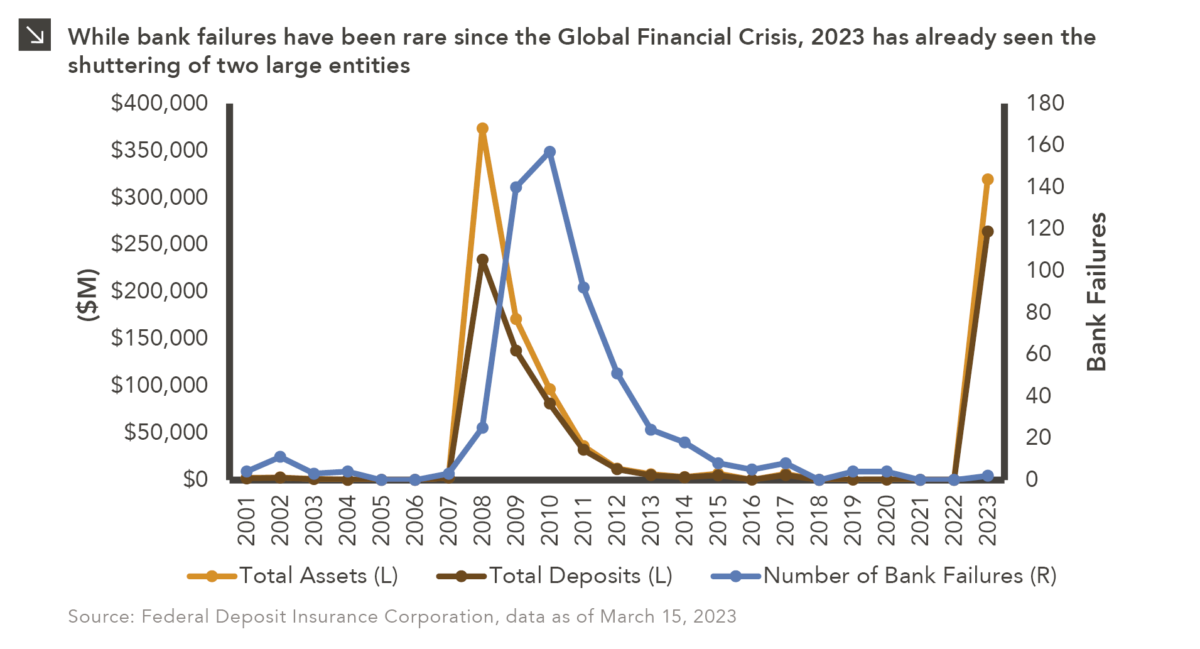
Recent developments within the banking industry have revived difficult memories of the Global Financial Crisis (GFC). As many will recall, hundreds of financial institutions failed during that period, including Washington Mutual (WaMu), a savings and loan organization with approximately $307 billion in assets at the time of its collapse. The Federal Deposit Insurance Corporation (FDIC) ultimately sold the banking subsidiaries of WaMu to JP Morgan for $1.9 billion, marking the largest U.S. bank failure in history. In total, 25 banks with combined assets of more than $373 billion closed their doors in 2008, with additional failures in 2009 (140 banks) and 2010 (157 banks). In response to the widespread impact of the GFC, the federal government enacted many new laws and regulations pertaining to the financial sector, which resulted in greater industry oversight and more robust stress tests of bank operations. While additional failures have occurred since the GFC, most banks have been healthy and resilient in the last decade, including during the COVID-19 pandemic. All told, a total of just eight banks with a combined $678 million in assets failed from 2018–2022.

Needless to say, dynamics within the domestic banking industry have shifted in the last several days. After a run on its deposits, Silicon Valley Bank, which had once been the 16th largest bank in the United States, failed and was placed into receivership of the FDIC on March 10. Silicon Valley Bank is now the second-largest bank to fail in American history, with approximately $209 billion in total assets and $175 billion in deposits at the time of its collapse. Signature Bank was the next domino to fall over the weekend, again due in part to a run on its deposits, and now stands as the third-largest U.S. bank failure ever ($110 billion in assets and $88.6 billion in deposits). While these two cases represent the only bank failures thus far in 2023, many regional banks have seen their share prices drop significantly amid fears of contagion.

It is important to remember that while GFC-inspired regulations were designed specifically to mitigate the fallout from these types of events, the situation related to recent bank failures is fluid and could have ongoing impacts on global markets and central bank interest rate policy. Marquette will continue to monitor dynamics within the banking industry and provide updates and counsel to clients accordingly.

Print PDF > Bank Failures: Past and Present


The opinions expressed herein are those of Marquette Associates, Inc. (“Marquette”), and are subject to change without notice. This material is not financial advice or an offer to purchase or sell any product. Marquette reserves the right to modify its current investment strategies and techniques based on changing market dynamics or client needs.

Update on Silicon Valley Bank and the Impact on Markets

Silicon Valley Bank (SVB), the 16th largest bank in the U.S. by assets as of year-end 2022, was shuttered by regulators last Friday, March 10. This is the country’s first material bank insolvency since the Global Financial Crisis (GFC) and the second-largest bank failure in U.S. history, behind only the government takeover of Washington Mutual in 2008. The bank’s collapse came as a surprise to markets — both S&P and Moody’s had an investment-grade rating (BBB) on the borrower and equity markets showed few signs of foreseen stress. Additionally, earlier last week, smaller Silvergate Bank announced it would voluntarily liquidate, and over the weekend, Signature Bank was seized by New York regulators, marking the U.S.’s third-largest bank failure.

Over the weekend, the Treasury, Federal Reserve, and FDIC came together to shore up confidence in the U.S. banking system. Via joint statement, the consortium announced that all depositors at SVB and Signature Bank would be made whole, easing concerns that deposits over the FDIC-insured limit of $250,000 would be at risk, and introduced a new $25 billion bank funding program, the Bank Term Funding Program, to make additional funds available to banks at more favorable terms, to hopefully prevent a repeat of the events that led to SVB’s demise. Both initiatives will come at no cost to the U.S. taxpayer. While the measures should help corporations, consumers, and markets breathe a sigh of relief — there was fear over the weekend that SVB clients would not be able to pay employees, which could lead to a downward economic spiral — concerns about possible systemic risk and broader implications for the economy remain.

This newsletter summarizes the impact of SVB’s failure on the markets, including potential for contagion, SVB exposure across asset classes, and expectations regarding Fed tightening from here.

Read > Update on Silicon Valley Bank and the Impact on Markets


The opinions expressed herein are those of Marquette Associates, Inc. (“Marquette”), and are subject to change without notice. This material is not financial advice or an offer to purchase or sell any product. Marquette reserves the right to modify its current investment strategies and techniques based on changing market dynamics or client needs.

De-risking at a Lower Price

In 2023, managing uncertainty and risk is top of mind as markets continue to grapple with inflation, a potential recession, and ongoing geopolitical conflict. Increasing allocations to investment-grade fixed income may be one way investors can better position their portfolios to navigate the current environment.

The chart above illustrates return outcomes for two portfolios based on a Monte Carlo simulation of portfolio returns over a forward-looking ten-year investment horizon. As a baseline, the 60-40 portfolio consists of a 60% allocation to U.S. equities (the S&P 500) and a 40% allocation to investment-grade fixed income (the Bloomberg U.S. Aggregate). Alternatively, the 50-50 portfolio shifts an incremental 10% from equities to IG fixed income. Benefitting from today’s elevated yields and lower volatility inherent to fixed income, the 50-50 portfolio projects a greater concentration of outcomes centered around the 7% target rate of return with less volatility than the 60-40 baseline portfolio. Although the expected return decreased slightly, portfolio risk decreased by roughly 1.5 percentage points, creating a more favorable risk-adjusted return. As described in Marquette’s latest white paper, The 60/40 Portfolio Revisited: Back from the Dead?, the rise in yields in 2022 has made fixed income a more attractive investment relative to prior years and reduced the expected return differential between stocks and bonds. For many investors, the 60/40 portfolio seems poised to meet their long-term risk and return goals, but for those looking to remove additional risk from their portfolios, the new yield environment makes further de-risking more of an option than it has been over the past decade.

Print PDF > De-risking at a Lower Price
Disclosure > Hypothetical Performance


The opinions expressed herein are those of Marquette Associates, Inc. (“Marquette”), and are subject to change without notice. This material is not financial advice or an offer to purchase or sell any product. Marquette reserves the right to modify its current investment strategies and techniques based on changing market dynamics or client needs.

The Short Rebate: A Headwind Becomes a Tailwind

Investor focus over the last year has centered on the Federal Reserve and rising interest rates. Since March 2022, the federal funds rate has increased 450 basis points, with further rate hikes expected in the next six months. While the Fed’s intent is to lower inflation and create price stability, higher rates have widespread implications for the economy and markets. While many have focused on the challenges for investors, hedge funds, particularly those that have the ability to short stocks and bonds, are also set to benefit from the increase in rates.

To establish a short position, a hedge fund must first borrow the security from other asset owners, providing cash collateral to the security lender to protect against potential default. During the borrowing period, the hedge fund that borrowed the stock must pay the lender any dividends or interest received, but is also entitled to receive back any interest that accrues on the required collateral. The return earned on the collateral, known as the short rebate or stock loan rebate, can meaningfully contribute to a hedge fund’s return, particularly for funds with meaningful short portfolio allocations.

For the past 15 years, the short rebate, estimated as the federal funds rate less a fee charged for borrowing a security (typically between 25 and 75 basis points), had been less than the dividend yield on the S&P 500, equating to a headwind to returns for short sellers. However, with short rebates now firmly in positive territory, hedge funds can benefit from higher expected returns in a segment of their portfolio that has been challenged since the Global Financial Crisis. While overall hedge fund returns will still be dependent on manager security selection and exposure management, the short rebate flipping from a headwind to a tailwind is just one of the reasons that the go-forward environment should be more favorable than it has been for relative hedge fund outperformance.

Print PDF > The Short Rebate: A Headwind Becomes a Tailwind


The opinions expressed herein are those of Marquette Associates, Inc. (“Marquette”), and are subject to change without notice. This material is not financial advice or an offer to purchase or sell any product. Marquette reserves the right to modify its current investment strategies and techniques based on changing market dynamics or client needs.