Can TIPS Be an Effective Inflation Hedge for Portfolios?

With the COVID vaccine’s worldwide distribution and adoption starting last week, many investors are aiming to project an inflation outlook driven by the return of furloughed workers and impending economic recovery and adjust portfolios with inflation protection in mind.

In this newsletter, we examine how key asset classes in institutional portfolios behave in rising or declining inflation environments, and ultimately determine the best asset classes that serve as inflation hedges while also providing strong total return and efficiency ratios. In particular, we investigate if TIPS (Treasury Inflation-Protected Securities) offer superior inflation protection compared to other common portfolio constituents.

Read > Can TIPS Be an Effective Inflation Hedge for Portfolios?


The opinions expressed herein are those of Marquette Associates, Inc. (“Marquette”), and are subject to change without notice. This material is not financial advice or an offer to purchase or sell any product. Marquette reserves the right to modify its current investment strategies and techniques based on changing market dynamics or client needs.

Market Recovery: Superpower Showdown

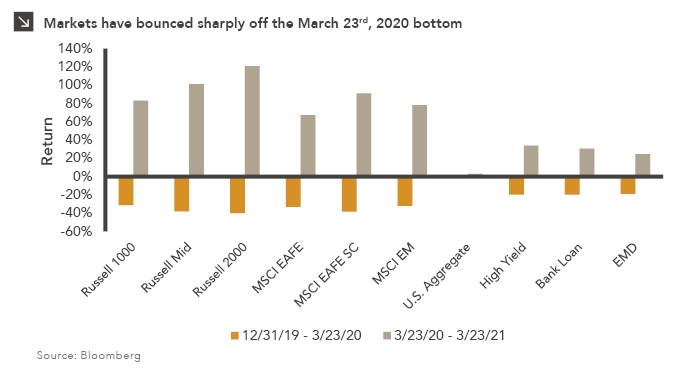
Despite the enormous challenges of 2020, financial markets have rebounded. While baffling at face value, the contrast between market performance and the widespread suffering due to COVID-19 is more understandable in the context of markets as a representation of human ingenuity and resiliency. These two traits are perhaps most recognized in the world’s foremost economic superpowers: The United States and the People’s Republic of China. During the third week of March, both countries saw market drawdowns near 30%; most other equity indices across the world saw similar drops. Since the global market bottom, countries have been racing to make up these losses and charge ahead to new highs. As of December 11th, America’s recovery has been nearly a third stronger than China’s. Globally, the recovery has fallen in between these two world powers.

A dollar invested in American public equities on March 23rd would have grown to $1.72 as of last Friday, December 11th, as represented by the Russell 3000 (representing approximately 98% of the investable U.S. equity market¹). Over this same time span, a dollar invested in China would have driven an increase to $1.54, as represented by the MSCI China Index. This broad market index captures 85% of China’s equity universe and includes the variety of share classes available to both strictly domestic Chinese investors as well as foreign investors.² However, America’s strength in capital markets recovery does not reflect the country’s relative success in managing the virus. In the U.S., the fight drags on, while much of China has returned to business as usual.³ Broadly, capital markets as measured by the All Country World Index (ACWI) — which contains 85% of the global equity markets, including 23 developed countries and 26 developing countries² — has rebounded at a clip between that of the U.S. and China. The good news for investors is that equity markets — regardless of home country — have rebounded from the extreme drops seen in March and April.

As detailed in our previous Chart of the Week, “Main Street Won’t Look Like Wall Street for a While,” the real-world experience of many Americans is one of continued economic hardship. While this desperate situation may soon be addressed with additional stimulus, Americans and people around the globe can also find hope in the fact that markets are forward-looking and humans, by nature, are resilient and resourceful. As a testament to this, one needs to look no further than the rollout of the highly anticipated and historic COVID-19 vaccine, which saw its first doses administered in the U.S on Monday.⁴ The extreme market volatility and large sell-off early in the year and subsequent recovery have further underscored why a long-term investment perspective rooted in a fundamental confidence in continual technological and economic progress is the most effective mindset an investor can have.

Print PDF > Market Recovery: Superpower Showdown

¹ FTSE Russell
² MSCI
³ China is back to normal — the US and Europe are not. Here’s how it succeeded
First Covid-19 Vaccine Given to U.S. Public


The opinions expressed herein are those of Marquette Associates, Inc. (“Marquette”), and are subject to change without notice. This material is not financial advice or an offer to purchase or sell any product. Marquette reserves the right to modify its current investment strategies and techniques based on changing market dynamics or client needs.

What Does the Biden Win Mean for Financial Markets?

On Saturday, November 7th, Joe Biden was declared the winner of the presidential election and will become the 46th president of the United States in January. Markets were surprisingly positive last week despite the uncertainty around results as multiple states were too close to call until all the votes had been tallied. While there is still pending litigation in certain states, it seems highly unlikely that these actions will reverse the election result. Thus, market participants have turned their attention to what the market can expect from a Biden-led White House coupled with a split Congress, while the coronavirus pandemic marches on.

In this newsletter, we tackle this question for each of the “traditional” asset classes: Fixed Income, U.S. Equities, and Non-U.S. Equities. The impact on alternative asset classes such as hedge funds, real assets, and private equity are more nuanced and will be covered in our 2021 market preview to be released in January.

Read > What Does the Biden Win Mean for Financial Markets?


The opinions expressed herein are those of Marquette Associates, Inc. (“Marquette”), and are subject to change without notice. This material is not financial advice or an offer to purchase or sell any product. Marquette reserves the right to modify its current investment strategies and techniques based on changing market dynamics or client needs.
Equities Falter Amid Uncertainty

October has been a tale of two months for equity market participants. While the first half of the month saw solid performance from risk assets, major equity indices have struggled in recent days as investors continue to grapple with political, economic, and public health uncertainty.

In this newsletter, we put the recent volatility and pullback into context, with an update on the resurgence of new coronavirus cases and global responses to the pandemic and a look at expectations for the coming months.

Read > Equities Falter Amid Uncertainty


The opinions expressed herein are those of Marquette Associates, Inc. (“Marquette”), and are subject to change without notice. This material is not financial advice or an offer to purchase or sell any product. Marquette reserves the right to modify its current investment strategies and techniques based on changing market dynamics or client needs.

Third Quarter Review of Asset Allocation: Risks and Opportunities

The third quarter of 2020 featured a major rebound in economic data amid an intense battle for the presidency and an uncertain future for COVID-19 cases as some states are seeing higher positivity rates. GDP growth for the quarter is expected to come in at +35.2% YoY, higher than analyst expectations, which helped to propel equity markets higher during the quarter. In addition, the unemployment rate dropped to 7.9% but is expected to remain elevated until additional clarity regarding COVID-19 becomes available. Below are some highlights from the quarter:

  • Biden is favored over Trump in the election race, as mail-in ballots and virtual town halls instead of debates have proven that this election will be unlike any before it.
  • The country has widely reopened, though concerns in some larger states of increased positivity rates have caused some rollbacks ahead of the winter season.
  • A vaccine is in the works and anticipated to be ready by April 2021, with widespread vaccinations likely around mid-2021.
  • Schools have moved to a hybrid model of in-person and online classes, causing logistical problems for parents as many balance jobs and at-home learning.

The election is sure to bring additional volatility through the end of the year. Biden and Trump have vastly different tax plans and a Democratic sweep could drive a sell-off in equity markets. Economic data is still pending through 3Q, though most forecasts show large rebounds in data as states reopened from COVID-19 closures. Big questions regarding vaccines and if the winter will see a resurgence in coronavirus cases remain. We analyze what all of this means for each asset class in the remainder of this newsletter.

Read > Third Quarter Review of Asset Allocation: Risks and Opportunities


The opinions expressed herein are those of Marquette Associates, Inc. (“Marquette”), and are subject to change without notice. This material is not financial advice or an offer to purchase or sell any product. Marquette reserves the right to modify its current investment strategies and techniques based on changing market dynamics or client needs.

Q3 2020 Market Insights Video

This video features an in-depth analysis of the third quarter’s performance, coinciding with our 3Q Asset Allocation Update newsletter reviewing risks and opportunities heading into the final quarter of the year.

Our Market Insights series examines the primary asset classes we cover for clients including the U.S. economy, fixed income, U.S. and non-U.S. equities, hedge funds, real estate, infrastructure, private equity, and private credit, with presentations by our research analysts and directors.

Sign up for research alerts to be notified when we publish new videos here.
For more information, questions, or feedback, please send us an email.

The Changing Landscape in EM Equity

Over the last ten years, the landscape for emerging market equities (EM) has changed. In the first decade of the century, BRIC investing was popular with an emphasis on materials and energy. Since then, the benchmark exposure to Brazil and Russia has halved, sector exposures have changed, and many new companies have entered the index. The number of stocks in the benchmark has nearly doubled, moving from 754 in 2010 to 1,385 in 2020.

This newsletter will review some of the most significant changes to the EM investing arena and what that means for client portfolios.

Read > The Changing Landscape in EM Equity


The opinions expressed herein are those of Marquette Associates, Inc. (“Marquette”), and are subject to change without notice. This material is not financial advice or an offer to purchase or sell any product. Marquette reserves the right to modify its current investment strategies and techniques based on changing market dynamics or client needs.

2020 Halftime Market Insights Video

This video features an in-depth analysis of the second quarter’s performance and coincides with our 2Q Asset Allocation Update newsletter, reviewing risks and opportunities heading into the second half of the year.

Our Market Insights series examines the primary asset classes we cover for clients including the U.S. economy, fixed income, U.S. and non-U.S. equities, hedge funds, real estate, infrastructure, private equity, and private credit, with presentations by our research analysts and directors.

Sign up for research alerts to be notified when we publish new videos here. For more information, questions, or feedback, please send us an email.

Second Quarter Review of Asset Allocation: Risks and Opportunities

The second quarter of 2020 proved to be as eventful as the first, with slow economic results being largely ignored as markets rallied. GDP growth for the quarter is expected to come in at -35.5% YoY, though 3Q GDP projections indicate a significant rebound is expected as the country begins to reopen to “the new normal.” In addition, the unemployment rate came in at 11.1%, down from the April peak above 14%. Below are some highlights from the quarter:

  • Countries around the globe began reopening businesses amid fears of a second wave of COVID-19 infections.
  • Daily infections reached a new high in the United States at more than 50,000 per day, causing some states to roll back their reopening plans.
  • Weekly initial claims for unemployment insurance have continued to trend downwards.
  • Additional fiscal and monetary stimulus are expected in the second half of the year, bolstering markets.

COVID-19 has proven to be a potentially long-lasting concern as it remains to be seen whether we are in for a V-shaped or U-shaped recovery. Economic data is improving slowly, though markets have seemed to shrug off some of the negative news as the S&P 500 moved into positive territory over the one-year period. Though it may have fallen into the background due to COVID-19, 2020 is a presidential election year. Uncertainty surrounding the election will undoubtedly have an impact on forward-looking expectations. In this newsletter, we analyze what all of this means for each asset class.

Read > Second Quarter Review of Asset Allocation: Risks and Opportunities


The opinions expressed herein are those of Marquette Associates, Inc. (“Marquette”), and are subject to change without notice. This material is not financial advice or an offer to purchase or sell any product. Marquette reserves the right to modify its current investment strategies and techniques based on changing market dynamics or client needs.

Q1 2020 Market Insights Video

This video features an in-depth analysis of the first quarter’s performance with a special focus looking forward from the coronavirus pandemic and resulting economic and market impacts.

Our Market Insights series examines the primary asset classes we cover for clients including the U.S. economy, fixed income, U.S. and non-U.S. equities, hedge funds, real estate, infrastructure, private equity, and private credit, with presentations by our research analysts and directors. For more information, questions, or feedback, please send us an email.