2025 Market Preview Video

This video is a recording of a live webinar held January 16 by Marquette’s research team analyzing 2024 across the economy and various asset classes as well as themes we’ll be monitoring in 2025.

Our Market Insights series examines the primary asset classes we cover for clients including the U.S. economy, fixed income, U.S. and non-U.S. equities, hedge funds, real estate, infrastructure, private equity, and private credit, with presentations by our research analysts and directors.

Featuring:
Greg Leonberger, FSA, EA, MAAA, FCA, Partner, Director of Research
Frank Valle, CFA, CAIA, Associate Director of Fixed Income
James Torgerson, Research Analyst
Catherine Hillier, Senior Research Analyst
David Hernandez, CFA, Director of Traditional Manager Search
Evan Frazier, CFA, CAIA, Senior Research Analyst
Dennis Yu, Research Analyst
Michael Carlton, Research Analyst
Chad Sheaffer, CFA, CAIA Senior Research Analyst

Sign up for research alerts to be invited to future webinars and notified when we publish new videos.

If you have any questions, please send our team an email.

First-Time Buyer Beware

Over the last 20 years, U.S. homeowners’ total home equity value has risen by more than 150% to roughly $35 trillion. This meteoric rise in home prices has helped many Americans build wealth but has been hazardous for a particular demographic: first-time homebuyers. These higher prices, along with high mortgage rates (the average 30-year fixed-rate loan is around 7.0% as of this writing) and reluctant sellers, have combined to keep potential first-time buyers largely out of the housing market. In 2024, a record low 24% of U.S. home purchases were made by first-time buyers; this figure is down from 50% in 2010. The median age of first-time buyers has also increased to 38, significantly higher than a historical average that is nearly 10 years younger.

With no signs of U.S. housing prices falling, many prospective buyers will be forced to continue to rent. This dynamic should sustain tailwinds for multifamily housing rentals, to which investors can gain exposure via core ODCE funds. Indeed, as of the end of the third quarter, multifamily housing constituted nearly 30% of the NFI-ODCE index. These trends in home affordability have also led institutional investors to increasingly move into the single-family housing market. While some cities have seen a glut of multifamily supply in recent years as investor capital has poured in, broader fundamentals remain sound.

Presidents, Real Estate, and Consistency

With the 2024 presidential election in the books, investors have now turned their focus to what the incoming Republican administration might mean for the performance of various asset classes. As it relates to the real estate space, the Trump victory did lead to a subsequent swing in both mortgage rate levels and the prices of housing-related equities, which are highly rate-sensitive. To that point, the average rate on a 30-year fixed mortgage climbed 9 basis points yesterday to more than 7.1% and housing stocks dropped, with home builders and materials companies like Lennar, D.R. Horton, and Home Depot down more than 3% during yesterday’s trading session.

While it is too early to forecast the impact that the new administration will have on commercial real estate specifically, readers should note that returns of the NCREIF Property Index, which tracks private real estate owned by institutional investors, have been nearly identical across Democratic and Republican administrations throughout history. Specifically, the index has posted an average annual return of roughly 8.7% under each party dating back to the 1970s. This consistency suggests that real estate performance is more closely aligned with economic cycles, long-term fundamentals, demographics, and property demand than it is with the political landscape.

3Q 2024 Market Insights

This video is a recording of a live webinar held October 23 by Marquette’s research team analyzing the third quarter of 2024 across the economy and various asset classes and themes we’ll be monitoring over the remainder of the year.

Our quarterly Market Insights series examines the primary asset classes we cover for clients including the U.S. economy, fixed income, U.S. and non-U.S. equities, hedge funds, real assets, and private markets, with commentary by our research analysts and directors.

Sign up for research alerts to be invited to future webinars and notified when we publish new videos.

If you have any questions, please send our team an email.

2024 Halftime Market Insights

This video is a recording of a live webinar held July 23 by Marquette’s research team analyzing the first half of 2024 across the economy and various asset classes and themes we’ll be monitoring over the remainder of the year.

Our quarterly Market Insights series examines the primary asset classes we cover for clients including the U.S. economy, fixed income, U.S. and non-U.S. equities, hedge funds, real assets, and private markets, with commentary by our research analysts and directors.

Sign up for research alerts to be invited to future webinars and notified when we publish new videos.

If you have any questions, please send our team an email.

1Q 2024 Market Insights Video

This video is a recording of a live webinar held April 25 by Marquette’s research team analyzing the first quarter of 2024 across the economy and various asset classes and themes we’ll be monitoring in the coming months.

Our quarterly Market Insights series examines the primary asset classes we cover for clients including the U.S. economy, fixed income, U.S. and non-U.S. equities, hedge funds, real assets, and private markets, with commentary by our research analysts and directors.

Sign up for research alerts to be invited to future webinars and notified when we publish new videos. If you have any questions, please send us an email.

The Banks’ Real Estate Problem

First quarter earnings season is getting started, with the largest banks reporting first. In the wake of last year’s regional banking crisis and the potential new normal of higher-for-longer interest rates, all eyes are on the health of the U.S. financial system. With commercial real estate (CRE) still searching for its bottom, losses related to CRE exposures are of particular concern for the banking industry. There is $5.7 trillion in commercial real estate debt outstanding and small to mid-size banks hold a disproportionate amount of it, putting the group at higher risk. Regional lender New York Community Bancorp (NYCB) — with the fifth largest concentration of CRE loans, as shown above — garnered headlines earlier this year after reporting a sizeable fourth quarter loss and disclosing material weakness in the way it reviewed its loan portfolio, prompting a $1 billion emergency investment. While NYCB’s outsized exposure to rent-controlled multi-family property loans may limit contagion to the broader banking sector, risks remain. As consumers respond to the higher rate environment, bank funding costs increase, eating into the higher lending profits the sector has enjoyed. Combined with losses and provisions tied to the troubled real estate sector, banks may limit lending, which flows through to the consumer and economy. As the macro backdrop remains in flux and the consumer continues to adjust to a higher-for-longer environment, any bank weakness could become more of a threat and bears watching as earnings season continues.

2024 Market Preview Video

This video is a recording of a live webinar held January 25 by Marquette’s research team analyzing 2023 across the economy and various asset classes as well as what trends and themes we’ll be monitoring in the year ahead.

Our quarterly Market Insights series examines the primary asset classes we cover for clients including the U.S. economy, fixed income, U.S. and non-U.S. equities, hedge funds, real assets, and private markets, with commentary by our research analysts and directors.

Sign up for research alerts to be invited to future webinars and notified when we publish new videos. If you have any questions, please send us an email.

2024 Market Preview: A 40 Degree Day

A former colleague once described his brother-in-law to me as a “40 degree day.” The puzzled look on my face revealed my unfamiliarity with the term, so he went on to ask me: “When does anyone get upset about a 40 degree day?” I laughed and shook my head — it was genius, the perfect way to describe something more forgettable than memorable…not especially good or bad, just average.

Given what markets have been through over the last four years — COVID, outsized returns both good and bad, record inflation, sky-rocketing interest rates, geopolitical conflict, and elevated volatility — I know I’m not alone in hoping that 2024 market returns will resemble a 40 degree day. Indeed, an “average” year of returns across markets will equate to positive portfolio performance for most asset allocations and allow investors to satisfy their risk and return goals.

Of course, there are potential stumbling blocks to a “normal” year. In particular, we will closely watch the Fed pivot and the disparity between expected and actual rate cuts, geopolitical conflicts, and the U.S. presidential election.

With that as background, we offer our annual outlook across asset classes, highlighting trends and themes for the year ahead. Happy reading and here’s to a year of normalcy!

Lost in Transaction

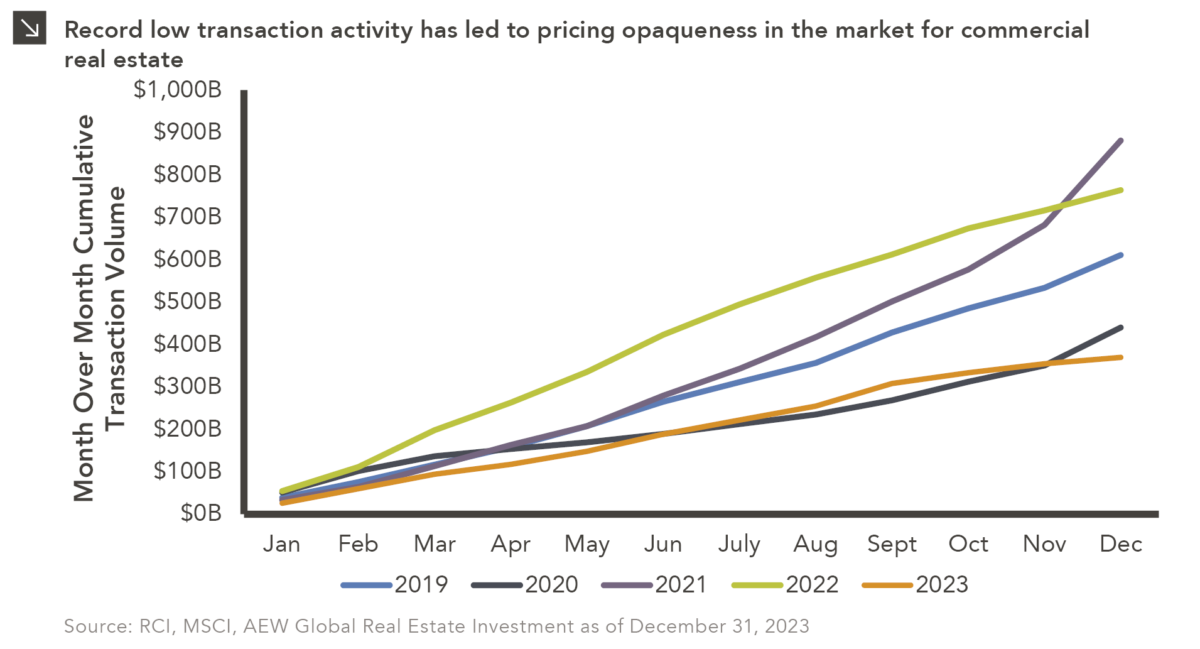
The 10-year Treasury yield notably displayed significant movements throughout 2023. Specifically, it was largely range-bound over the summer (between 3.5%–3.8%), then shot up to around 5.0% in October before falling back down to under 4.0% before year-end. It currently hovers slightly above 4.1%. Thanks in large part to these movements in yields, the real estate market seized up and very few transactions occurred in the fourth quarter of last year. As a result, the full calendar year of 2023 exhibited the lowest transaction volume in the last five years. Limited transactions in the market provide a hurdle for real estate managers and third-party appraisers to accurately determine asset values. As such, the pace of contraction for the private real estate index NCREIF-ODCE has been choppy, with the latest quarter responsible for nearly one-third of the benchmark’s gross return correction of -16.4% since late 2022.

Quarterly returns for the underlying index managers have been volatile in recent time as well. Based on a sample of 18 of the 25 ODCE index funds, the average spread of gross returns over the last five quarters has been nearly 6 percentage points. For context, the longer-term spread is closer to 4 percentage points. Additionally, each fund in that sample has underperformed the ODCE benchmark in at least one of the last six quarters. These figures underscore the notion that recent marks have displayed an elevated degree of dispersion and noise.

Even with the considerable drop in valuations, real estate fundamentals remain relatively healthy outside of the office space. Most do not believe assets are broken, and rent growth still exists within the multifamily, industrial, and self-storage sectors (albeit at lower levels than in prior years). As it relates to the road ahead, real estate investors should remain patient as market dynamics play out. To that point, it may take several quarters for buyers to come off the sidelines, after which more transactions can occur and ultimately be reflected in valuations. Marquette will continue to monitor the real estate landscape while emphasizing the importance of prudence and a long-term perspective.