Where’s the Blowout?

A typical real estate cycle has four phases: recovery, expansion, hypersupply, and recession. Typically, the recession phase is marked by rising cap rates (a real estate valuation measure, calculated as the ratio of net operating income to market value), which then compress over the growth phases of the cycle as property values rise. However, the current cycle, which began shortly after the onset of the COVID-19 pandemic, has been atypical. Although we experienced a period of economic contraction, cap rates did not rise as they have in previous recessions. Two contributing factors may have been lower interest rate expectations in 2020 and the impact of government stimulus measures that helped occupiers navigate weaker market conditions. Now with cap rates at historic lows and interest rates expected to rise through 2021, real estate investors are asking whether a “blowout” (an increase in cap rates) is on the horizon.

Historically, cap rates have been driven by the interaction of (1) changes in U.S. government bond yields, (2) the real estate risk premium (the cap rate spread above U.S. treasuries), and (3) the expected-long term growth of rental income (net operating income (NOI)). In previous cycles, cap rate compression was in part driven by favorable liquidity conditions and falling treasury yields. Today, yields are rising, with 10-year rates already up meaningfully off the mid-2020 bottom. With NPI cap rates essentially flat, this means the real estate risk premium has compressed. Accordingly, rent growth is becoming a bigger driver of capital appreciation and more important to investors. Over the short term, we expect investors will favor properties with the highest rent or NOI growth potential and rotate out of properties where growth is more limited. This should benefit industrial warehouse and apartment properties in select markets to the detriment of more challenged retail and potentially office properties. As a result of this asset rotation, the cap rates of properties in high demand may continue to compress, while cap rates of more challenged properties may see the “blowout” the broader real estate market has so far avoided.

Print PDF > Where’s the Blowout?

Sources utilized: Cornerstone Real Estate Advisors, “Cap rates and RE cycles,” and Principal Real Estate Investors, “Interest rates are rising, should real estate be concerned?


The opinions expressed herein are those of Marquette Associates, Inc. (“Marquette”), and are subject to change without notice. This material is not financial advice or an offer to purchase or sell any product. Marquette reserves the right to modify its current investment strategies and techniques based on changing market dynamics or client needs.

Will Skyrocketing Money Supply Boost Inflation?

As the economic recovery continues, investors are rightly concerned with inflation, especially given the recent surge in M2 money supply,¹ as shown in the purple line in the left chart. M2 has soared amid unprecedented levels of monetary and fiscal stimulus infusing markets and households with cash. While an economy awash with cash may lead to concerns about runaway inflation, certain key economic recovery dynamics point to a less drastic trajectory and potentially more muted, transitory inflation.

Juxtaposing M2 with core PCE inflation,² shown as the green line in the left chart, we see that the two have not always been perfectly correlated. While an increase in the M2 rate has typically led to an increase in the core PCE rate, there are imperfections in the relationship. Inflation so far in the economic rebound has stayed low as the surge in M2 has been offset by a drastic decline in the velocity of money,³ shown as the orange line in the right chart. The velocity of money dropped off last year as money supply surged while consumer spending was down during the pandemic, though velocity has generally been in decline since 2000 amid the longer-term trends of aging demographics, greater debt, and weaker physical investment prospects relative to financial investment prospects. The increased money supply has so far not led to increased transactions, GDP per dollar spent, or inflation. The gray line in the right chart depicts M2’s annual rate of change normalized by annual GDP, showing that M2 increases from the 1990s, 2000s, and 2010s have been relatively stable as a proportion of overall GDP. In this context, while the surge over the last year is still evident, it is much less extreme.

From here, as the economy continues to reopen, consumer spending on goods and services is expected to raise demand for input materials. This, along with COVID-related supply shortages, may boost inflation temporarily. However, we expect supply chains will normalize and supply overall will adjust, reducing inflationary pressures. More importantly, in order for a pickup in inflation to be sustained over the longer term, economic participants would have to boost real asset purchases over financial asset purchases, counter to trends over the last 20 years. As the Fed eventually tapers its bond purchases and increases rates, the markets will be expected to absorb at least some of the greater money supply. M2 is ultimately expected to shrink relative to GDP as the economy rebounds, with velocity expected to correct upwards.

In summary, we generally expect a more muted and transitory rise in inflation, holding all else equal. Core PCE may rise from the 1.5% at the end of 2020 to a range of 2.0–2.5% for 2021, encompassing the Fed’s projected 2.2%, but could then revert back down close to the Fed’s long-term target of 2.0%, especially with the Fed’s eventual bond purchase tapering and rate hikes.⁴ Once the initial recovery is over and the economy trends back to normal, we could see factors like aging demographics and the trend towards services and tech over old economy sectors bring on more deflationary pressures. Post-recovery, the evidence points to more normal inflationary levels, again holding all else equal.

Print PDF > Will Skyrocketing Money Supply Boost Inflation?


¹ M2 money supply is the total value of money — in the form of currency in circulation, demand deposits, and assets that can be quickly converted into cash — that is available in the U.S. economy. M2 is a closely-monitored indicator of money supply as well as future inflation and used by the Federal Reserve to adjust monetary policy. M1 includes cash as well as checking deposits, whereas M2 includes M1 plus savings deposits, other time deposits, and money market securities.
² Core PCE represents inflation in the form of personal consumption expenditures prices excluding food and energy prices. Used as the key inflation metric by the Federal Reserve, it removes the volatility from movements in food and energy to provide more reliable underlying inflation trends.
³ The velocity of money represents the rate that money is exchanged in the economy as well as the amount of GDP generated for every dollar spent. It is calculated as the GDP in billions of dollars divided by the M2 money supply in billions of dollars. If velocity rises, larger and more transactions are happening between participants in the economy. Conversely, if velocity falls, smaller and fewer transactions are happening between participants in the economy.
⁴ Presently, consensus expectations are for the Fed to taper its bond purchases and to hike rates only when the economy has fully recovered back to normal, likely beyond 2021 as part of concluding the monetary stimulus that has been necessary during the pandemic. 


The opinions expressed herein are those of Marquette Associates, Inc. (“Marquette”), and are subject to change without notice. This material is not financial advice or an offer to purchase or sell any product. Marquette reserves the right to modify its current investment strategies and techniques based on changing market dynamics or client needs.

Signs of a Market Bottom: One Year Later

This month marked the somber one-year anniversary of the World Health Organization declaring COVID-19 a global pandemic. In addition to the immeasurable human suffering the disease has caused, the toll on both the financial markets and broader economy has also proven historic in magnitude. After the unprecedented market volatility in March 2020, two questions on many investors’ minds were if a market bottom had been reached and if a recession was underway. The S&P 500 hit an all-time high on February 19th, 2020, and subsequently experienced a fast and furious COVID-induced sell-off resulting in its March 23rd bear market trough. Although at that time, investors could not be certain this was the bottom as economic uncertainty remained high while the pandemic was still in its early stages. To help reason through the two questions noted above, we wrote “Signs of a Market Bottom?” which analyzed four broad categories in an attempt to identify markers of a trough: Technical Data, Valuation Data, Economic Indicators, and COVID-19 Data. This information was examined in the context of bear markets that coincided with recessions, which is an important distinction because one can exist without the other. Our analysis indicated that all but valuation data were useful in identifying a market trough.

Given that it has been over a year since the rapid peak–trough-bull market start, the purpose of this paper is to revisit the four aforementioned categories to see which, in hindsight, were relevant in identifying the 2020 market bottom.

Read > Signs of a Market Bottom: One Year Later


The opinions expressed herein are those of Marquette Associates, Inc. (“Marquette”), and are subject to change without notice. This material is not financial advice or an offer to purchase or sell any product. Marquette reserves the right to modify its current investment strategies and techniques based on changing market dynamics or client needs.

Driving Toward a Green Future

Innovation and structural change were hallmarks of 2020 as the spread of COVID-19 accelerated technological advancements across many areas of the global economy. The electric vehicle (“EV”) space is one area of innovation that has especially captured the attention of global investors. While battery-powered and alternative energy vehicles have been available in some form since the early 19th century, it was not until significant developments in rechargeable lithium-ion battery technology were made in the 1970s that meaningful capital began to flow to the space. Since then, interest in EV technology has ebbed and flowed with oil prices, but the recent global push toward green energy has revitalized enthusiasm in the space.

For the three years ended 2019, the NYSE FactSet Global Autonomous Driving and Electric Vehicle Index, which tracks developed and emerging market companies that specialize in self-driving and EV innovation, underperformed the broader MSCI ACWI Index — up an annualized 8.8% versus the ACWI up 10.2%. Since then, over the 14 months from the start of 2020 through February 2021, the Global Autonomous Driving and Electric Vehicle Index is up 63.1% versus the MSCI ACWI Index up 16.3%.

To dive deeper into the different components of the electric vehicle landscape, we look at the newly-created Bloomberg Intelligence Electric Vehicle Basket, a group of 60 global companies expected to benefit from and contribute to the success of EV development. These 60 companies, equal-weighted, have outperformed the MSCI ACWI by 10.3% over the trailing three months ended February 28th. Of the four unique sub-groups,¹ Raw Materials has outperformed by the widest margin, returning 46.3% since December. This cohort includes a diverse group of specialty chemical and mining companies that produce the inputs for a variety of industries, many of which, including those tangential to EVs, have seen increased demand over the last few months. The Battery and EV Component groups have also outperformed the broader MSCI ACWI Index. EV Vehicle Manufacturer stocks have struggled more recently amid profitability concerns given the cost of inputs and headwinds to EV adoption, particularly in the U.S. Despite the push from lawmakers, still limited charging infrastructure and a lack of consistency in charging connectors across manufacturers are issues for consumers. While we expect these and other points of friction will be resolved and EV market share will continue to grow over the next several decades, in the near term, market momentum can push innovation themes ahead of expected earnings or scalability. Investors should exercise caution when allocating to a burgeoning segment of the market and always maintain portfolio diversification.

Print PDF > Driving Toward a Green Future

¹A fifth Bloomberg exposure, EV Charging, included only one company and was included in the EV Components categorization for this analysis.


The opinions expressed herein are those of Marquette Associates, Inc. (“Marquette”), and are subject to change without notice. This material is not financial advice or an offer to purchase or sell any product. Marquette reserves the right to modify its current investment strategies and techniques based on changing market dynamics or client needs.
Commodities: Cycle or Cyclical?

A commodities supercycle is generally defined as a sustained period of broad-based above-trend movement. In the first quarter of 2020, almost a decade of commodities price weakness was capped off with a more than 20% drop, and since then, prices have rebounded more than 40% to levels last seen in 2018, inspiring headlines debating whether this is the start of the next supercycle. Proponents argue reopening demand, a potential uptick in global growth and inflation, and a weaker U.S. dollar, among other factors, point to yes. Skeptics contend that an initial demand normalization complicated by temporary supply disruptions does not a supercycle make, at least yet. Commodity price movements can be especially volatile given lumpy physical market characteristics. Oil prices moving into sharply negative territory last April demonstrate exactly that. Whether this latest move is cyclical and temporary or structural and sustainable is still to be determined.

In this newsletter, we explore a few of the key factors that could support or suppress a sustained commodities bull market.

Read > Commodities: Cycle or Cyclical?


The opinions expressed herein are those of Marquette Associates, Inc. (“Marquette”), and are subject to change without notice. This material is not financial advice or an offer to purchase or sell any product. Marquette reserves the right to modify its current investment strategies and techniques based on changing market dynamics or client needs.

What Does the Latest Stimulus Mean for the Economy and Fixed Income Markets?

President Joe Biden signed the $1.9 trillion pandemic relief package yesterday amidst rising inflation and interest rates since the beginning of the year as the markets price in future growth. With Fed Chair Jerome Powell’s recent reaffirmation of the central bank’s accommodative monetary stimulus, continued vaccine rollout, a drop in COVID-19 cases and deaths, and Biden’s statement that the U.S. will have enough vaccines for every adult by the end of May, a key question on many investors’ minds is, “How much more inflation and rising interest rates could we expect in the road ahead?” This edition of Marquette Perspectives will attempt to answer that question by examining this relief aid in connection with vaccination progress and the economic recovery.

Read > What Does the Latest Stimulus Mean for the Economy and Fixed Income Markets?


The opinions expressed herein are those of Marquette Associates, Inc. (“Marquette”), and are subject to change without notice. This material is not financial advice or an offer to purchase or sell any product. Marquette reserves the right to modify its current investment strategies and techniques based on changing market dynamics or client needs.

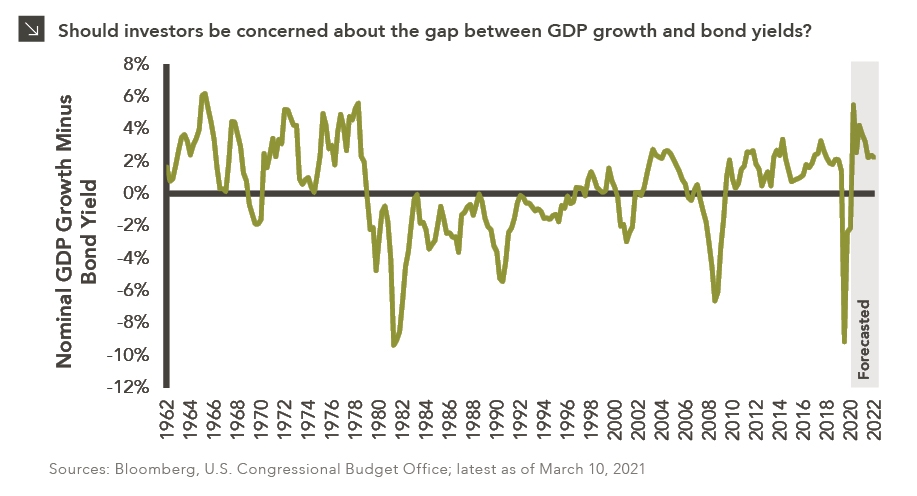
GDP Growth Hits Highs vs. Bond Yields

The gap between U.S. GDP growth and bond yields is expected to rise to the highest level since the 1970s amid unprecedented amounts of fiscal and monetary stimulus and an accelerating vaccination roll-out. The chart depicts nominal U.S. GDP growth rates year-over-year less the 10-year U.S. Treasury yield over the last 60 years. Beyond 2020, we profile the U.S. Congressional Budget Office (“CBO”) forecasted nominal GDP growth rate for 2021 and 2022, minus the forecasted 10-year U.S. Treasury yield from the Treasury forwards market, which projects a 25 basis point rise each year over the next four years.

The quarterly GDP growth rate is much more volatile than bond yields. It can decline precipitously in a recession much faster than bond yields as well as rebound much faster than bond yields in a recovery. The ratio has spiked down several times in the past: during the early 1980s and early 1990s recessions, following the dot-com bust of 2000 and the housing bust of 2008, and most recently after the COVID panic of March 2020. This is because the GDP growth rate reflects actual economic growth, measured year-over-year quarterly, while bond yields reflect the market’s anticipation of economic growth over a longer time period. While this gap is expected to reach its highest level in roughly 50 years as the economy rebounds from the depths of COVID, it is then expected to moderate back to pre-pandemic levels, as the CBO forecasts GDP growth to normalize throughout 2021 and 2022 after the initial recovery. Therefore, despite the spike in this ratio it is not a fundamental concern for investors and is not suggestive of a coming market downturn.

Print PDF > GDP Growth Hits Highs vs. Bond Yields


The opinions expressed herein are those of Marquette Associates, Inc. (“Marquette”), and are subject to change without notice. This material is not financial advice or an offer to purchase or sell any product. Marquette reserves the right to modify its current investment strategies and techniques based on changing market dynamics or client needs.

Fear is the Return-Killer

Frank Herbert’s science fiction novel Dune contains a litany which states that “fear is the mind-killer.” Indeed, anxieties brought on by periods of turmoil can cause individuals to forsake rational thinking and act impulsively, usually to their own detriment. This phenomenon often manifests itself in equity markets, particularly when investors choose to curtail or altogether abandon equity allocations amid (or in expectation of) steep declines in the prices of risky assets. These impetuous actions stem from various emotional biases held by market participants including loss-aversion, which describes the asymmetrical response many individuals feel with respect to gains and losses (i.e., investors derive more pain from a loss than pleasure from a gain of equal value).

The aim of this newsletter is to demonstrate that, save for a modicum of intangible psychological comfort, sales of risky assets motivated by fear and panic provide investors no value, and can ultimately have disastrous impacts on the long-term returns of a portfolio.

Read > Fear is the Return-Killer


The opinions expressed herein are those of Marquette Associates, Inc. (“Marquette”), and are subject to change without notice. This material is not financial advice or an offer to purchase or sell any product. Marquette reserves the right to modify its current investment strategies and techniques based on changing market dynamics or client needs.

Small-Cap: Much Ado About Quality

2020 was a year in which some small-cap asset managers flourished while most struggled to adapt to the changing tides of an unprecedented global pandemic. Active managers will not soon forget the difficulty of investing in 2020, but the dynamics that predicated the market may go overlooked.

In this newsletter, we seek to address the underperformance of small-cap active managers over the last several years, focusing on factor fallout and the definition of quality. We will specifically look to address how the rise of thematic versus fundamental investing came to the forefront in 2020.

Read > Small-Cap: Much Ado About Quality


The opinions expressed herein are those of Marquette Associates, Inc. (“Marquette”), and are subject to change without notice. This material is not financial advice or an offer to purchase or sell any product. Marquette reserves the right to modify its current investment strategies and techniques based on changing market dynamics or client needs.

Into the Weeds on Cannabis Stocks

In recent years, successful marijuana legalization efforts in the United States have led to increased investor interest in the prospects of upstart cannabis-oriented businesses. Indeed, the development of a new industry often precipitates unique opportunities for market participants, as well as uncertainty of which investors should be cognizant.

The aim of this newsletter is to examine at a high level the emergence of publicly traded cannabis stocks vis-à-vis the broader equity landscape and the risks these securities may pose.

Read > Into the Weeds on Cannabis Stocks


The opinions expressed herein are those of Marquette Associates, Inc. (“Marquette”), and are subject to change without notice. This material is not financial advice or an offer to purchase or sell any product. Marquette reserves the right to modify its current investment strategies and techniques based on changing market dynamics or client needs.