Dividends and Buybacks are Flat… Just Like the Market

Following the recession, dividends and stock repurchases had a significant run, growing about 28% per year, reaching a new record of $241 billion in March 2014. While dividends continue to grow, buybacks have fallen in the last 18 months, leaving the combined total mostly flat. Not surprisingly, the market has also been relatively flat over the last year and a half.

Following the recession, dividends and stock repurchases had a significant run, growing about 28% per year, reaching a new record of $241 billion in March 2014. While dividends continue to grow, buybacks have fallen in the last 18 months, leaving the combined total mostly flat. Not surprisingly, the market has also been relatively flat over the last year and a half.

Stock buybacks reduce the amount of shares outstanding for a company which causes earnings per share (EPS) to increase since the same amount of earnings over fewer shares outstanding creates a higher EPS value. EPS is a metric used in the determination of stock price, so a higher EPS value provides support for the stock price to appreciate in the near term. 

A significant source of funding for stock buybacks in recent years came from the ability to borrow at short-term rates near zero. As interest rates continue to rise, companies will be less inclined to fund buybacks in this manner. While buybacks are estimated to be higher for the first quarter of 2016, going forward they could be scaled back significantly, which would be a further drag on equity returns.

Moving Currencies

Currencies are a popular topic in investment circles today, as their impact on total returns can be meaningful for investors. While many investment funds do not hedge currency exposure at the portfolio level due to the costs involved and the expectation of mean reversion over time, certain market participants are very active in the foreign exchange markets and seek to capitalize on price movements among currencies, which can be volatile in the short-term.

Currencies are a popular topic in investment circles today, as their impact on total returns can be meaningful for investors. While many investment funds do not hedge currency exposure at the portfolio level due to the costs involved and the expectation of mean reversion over time, certain market participants are very active in the foreign exchange markets and seek to capitalize on price movements among currencies, which can be volatile in the short-term. In this Chart of the Week, we look at carry trades, the fundamental strategy of market participants who speculate on currency movements. At its essence, a carry trade is borrowing money in a low-yielding currency and investing it in a high-yielding currency. At the close of the trade, the investor pockets the difference between the interest received on the higher yielding currency and the interest paid on the lower yielding currency (net of transaction costs).

This chart shows a collection of the top- and bottom-performing carry trades of 2015 and compares their returns with the year-to-date results of 2016. As the chart shows, speculating against the dollar generated severe losses for most currencies last year, as the dollar rallied throughout 2015. Many of the carry trades that lost against the U.S. dollar have seen positive gains through early March, but can the performance of these trades persist? On one hand, holding the U.S. dollar should remain beneficial as the currency is likely to show continued, albeit modest, strength vs. other major global currencies. Reasons for this include expectations of tightening by the Fed and diverging central bank policies. Even if the Fed does not raise rates for the rest of this year, it is unlikely that it would cut rates, so the supportive case for the U.S. dollar remains. The Euro, another major global currency, is contending with monetary easing from the European Central Bank. Furthermore, concerns over Euro-area growth and political tensions present a headwind for the currency.

On the other hand, emerging market currencies have shown strength thus far in 2016, as the turnaround in industrial metals prices elevated many commodity currencies, including the Brazilian real (BRL) and the Malaysian ringgit (MYR). Concerns over long-standing debt disputes in Argentina led to increased volatility for the Argentine peso (ARS) in recent years. The 2015 election of new President Mauricio Macri led to optimism over a deal with Argentina’s creditors, and the country reached an agreement with bondholders in early March. However, the country’s plan to raise new levels of debt in April caused a sharp downturn in its currency.

With the persistence of diverging central bank policies and the prospect of negative interest rates in many parts of the world, the outlook for many carry trades will continue to see meaningful impacts from macroeconomic volatility not only on a global level, but also on a country- and region-specific level.

Note: ARS=Argentine Peso; ISK=Iceland Krona; INR=Indian Rupee; BHD=Bahraini Dinar; JPY=Japanese Yen; EUR=Euro; DKK=Danish Krone; TRY=Turkish Lira; CLP=Chilean Peso; MXN=Mexican Peso; NOK=Norwegian Krone; CAD=Canadian Dollar; MYR=Malaysian Ringgit; ZAR=South African Rand; COP=Colombian Peso; BRL=Brazilian Real.

Do Election Results Predict Equity Market Performance?

During election seasons we are frequently asked about what will happen to the market if a particular candidate or party wins, or whether certain years of the presidential cycle are better for investors.  

During election seasons we are frequently asked about what will happen to the market if a particular candidate or party wins, or whether certain years of the presidential cycle are better for investors. While there are numerous opinions about how differing public policies can affect the economy and financial markets — which goes well beyond the scope of this Chart of the Week — we can observe some trends from history. Since 1926, the first year of a presidential term on average is the weakest, while the third year generally performs well. The election year itself tends to be fairly average. Additionally, the market has generally performed better while a Democrat was sitting president, with an average return of 15% compared to 8.6% for Republican presidents.

While these trends seem interesting, it would be imprudent to make any market predictions based on this data. The historical data is extremely limited and undoubtedly a case of random patterns in a small data set rather than a legitimate correlation. For instance, an investor who only invested in the stock market when the NFC won the super bowl would significantly outperform one that invested when the AFC won (14.6% compared to 8.2%). Similar results can also be seen when investing in only odd years, or years that end with a certain digit (3, 5, etc). In order to be statistically significant, one would need over 2,000 election year data points to achieve a meaningful significance level. While there may or may not be particular reasons behind these realized returns patterns, from a statistical standpoint it would be unwise to base any investment decisions off of them.

Is the U.S. on the Brink of a Recession?

The combination of rising high yield spreads and falling equity markets has led many investors to question if the U.S. is headed for a recession. This week’s chart examines the probability of a recession using the yield curve as a leading indicator of future economic activity.

The combination of rising high yield spreads and falling equity markets has led many investors to question if the U.S. is headed for a recession. This week’s chart examines the probability of a recession using the yield curve as a leading indicator of future economic activity. The Federal Reserve Bank of New York publishes a model that calculates the probability based on the difference (spread) between the 10-year and 3-month Treasury yields. As the spread narrows, the probability of a recession increases. Conversely, as the spread widens, the probability decreases. As the chart shows, this model has historically been a good predictor of future recessions. Based on January’s data there is only a 4.6% chance of a recession twelve months from now. Like all models, there are no guarantees that the predictive power will continue into the future, but this provides investors another tool to formulate future expectations.

2016 Market Preview

January 2016

Similar to previous years, we offer our annual market preview newsletter. Each year presents new challenges to our clients, and 2016 is off to a volatile start with equity markets down significantly, oil dropping below $30, the Fed poised to further increase interest rates, and fears of a China slowdown rippling through the markets. However, other headlines will emerge as the year goes on, and it is critical to understand how asset classes will react to each new development and what such reactions will mean to investors. The following articles contain insightful analysis and key themes to monitor over the coming year, themes which will underlie the actual performance of the asset classes covered.

Download PDF

Is the Labor Market Approaching Full Employment?

On January 8th, the U.S. Bureau of Labor Statistics released the unemployment rate for December 2015 and additionally on January 12th released the Job Opening and Labor Turnover (JOLT) report for November 2015. This week’s chart focuses on these two reports and the strength of the U.S. labor market as we enter 2016.

On January 8th, the U.S. Bureau of Labor Statistics released the unemployment rate for December 2015 and additionally on January 12th released the Job Opening and Labor Turnover (JOLT) report for November 2015. This week’s chart focuses on these two reports and the strength of the U.S. labor market as we enter 2016. As the chart shows, unemployment has changed little over the past six months, ending at 5.0% for December. Furthermore, the amount of open jobs has also held steady over the same period, ending at approximately 5.4M openings as of November 2015.

The high number of open jobs could very well signal that the currently available workforce is unable to satisfy the requirements of these jobs and the economy is reaching (or already at) full employment. If the labor market is truly at full employment, we would expect to see several new dynamics emerge. First, upward pressure on wages could emerge as employers will have to offer more to potential workers for them to change jobs. Wage growth has been one of the slowest factors in the economic recovery, increasing only 1.55% during the first eleven months of 2015. Another outcome is that the jobs available require specific skills or education, thus meaning those unemployed could pursue such qualifications to obtain one of these open jobs. As job seekers choose to pursue additional training or education, they would likely drop out of the labor force, therefore further depressing the participation rate and potentially decreasing the unemployment rate through the “denominator effect.” A final outcome is that as the New Year starts and firms obtain fresh budgets, they will continue to hire, hence adding additional jobs to the labor market. While these outcomes described are not all-inclusive they do provide some insight into the current outlook for the labor market, and help explain why the Federal Reserve had sufficient confidence in the labor market to initiate the rate hike in December.

Why is Portfolio Diversification Important?

This week’s Chart of the Week shows what is commonly referred to as a “Periodic Table of Investment Returns”. It is a table showing historic calendar year returns for various asset classes ranked in order of performance from best to worst. One of the key takeaways from this table is that 2015 was a particularly challenging year for investment returns.

This week’s Chart of the Week shows what is commonly referred to as a “Periodic Table of Investment Returns.” It is a table showing historic calendar year returns for various asset classes ranked in order of performance from best to worst. One of the key takeaways from this table is that 2015 was a particularly challenging year for investment returns. With the exception of real estate, there were no major asset classes that posted double-digit gains in 2015, and except for emerging market equities, there were no major asset classes that posted double-digit losses for the year. In an environment where most asset classes posted low single-digit returns for the year (either positive or negative), it was extremely difficult for diversified portfolios to achieve their target rates of return in 2015.

The other key takeaway from this table is the importance of diversification within a portfolio. As seen in the table, there has been very little consistency in the best and worst performing asset class from year to year. In fact, since 2007 just about every asset class that was the best performing asset class for a year was also the worst performing asset class for a year during this time frame. Just because an asset class performs well in one year it will not necessarily perform well the next, and just because an asset class performs poorly in one year it will not necessarily perform poorly again the next. This illustrates the importance of adhering to strategic asset allocation targets and rebalancing portfolios back to targets over time.

1Represents YTD return as of 9/30/15.  4Q 2015 returns are not yet available.
2Represents YTD return as of 11/30/15.  December 2015 returns are not yet available.

Asset Class Benchmark
Large Cap Russell 1000
Mid Cap Russell Mid Cap
Small Cap Russell 2000
Core Fixed Barclays US Agg Bond
High Yield Barclays US Corporate High Yield
Bank Loans Credit Suisse Leveraged Loan
Developed Lg Cap MSCI EAFE
Developed Sm Cap MSCI EAFE Small Cap
Emerging Markets MSCI EM
Real Estate NFI
Hedge Funds HFRI FOF: Diversified Index
Private Equity Cambridge All PE

Is It Finally Going to Happen Next Week?

In testimony before the House Financial Services Committee on November 4, Federal Reserve Chairwoman Janet Yellen remarked that a rate hike was still a “live possibility” in December, should economic data remain supportive.

In testimony before the House Financial Services Committee on November 4, Federal Reserve Chairwoman Janet Yellen remarked that a rate hike was still a “live possibility” in December, should economic data remain supportive. Prior to that comment, the market was unsure of any policy change at the Fed’s December meeting, with the Fed Fund’s Futures market implying a  50% probability of a rake hike. After Yellen’s comments, the probability of a hike in December jumped to nearly 70%, and currently sits at 80%, thanks to strong payroll reports over the last two months and further hawkish comments from FOMC members.

Despite this guesswork, Yellen and other members of the FOMC have stressed that the timing of the first rate hike in over nine years is less important that the pace of successive increases. While the futures market hasn’t been an overly reliable predictor of the future path of the Fed Funds rate, it is worth noting that the market appears to accept the Fed’s pledge to enact future increases in a slow and steady manner. Assuming a 0.25% increase on December 16 as a near certainty, the futures market doesn’t imply any meaningful probability of the next increase until the March 2016 meeting, with the most likely landing spot of the Fed Funds rate to be between 0.75% and 1.00% at the end of 2016. While a Fed Funds rate of 1.00% would be a notable shift from the Fed’s post-crisis zero interest rate policy, it would still be seen as highly accommodative in a historical context, and supportive of future economic growth.

How Soon Should We Expect the Next Recession?

What has become known as the Great Recession officially came to an end in June 2009. Since then, GDP has expanded to new real highs, we are approaching full employment, and the U.S. dollar is the strongest it has been in the past decade. Though various issues remain within the economy, overall things seem to be going well.

What has become known as the Great Recession officially came to an end in June 2009. Since then, GDP has expanded to new real highs, we are approaching full employment, and the U.S. dollar is the strongest it has been in the past decade. Though various issues remain within the economy, overall things seem to be going well.

The question on many people’s minds is how long can this last? Currently, we are 78 months out from the trough of the recession. Of the recessions since WWII, on average the period from the end of one recession to the start of the next lasts 58 months, suggesting we may be due. However, the last three recovery/expansion phases lasted longer than this and during the 1990s this period lasted 120 months leading up to the Tech Bubble.

Additionally, recessions do not occur simply with the passage of time; generally, there has to be a catalyst for the drop. Potential current areas of concern include slower wage growth, lower productivity, and the Fed tightening monetary policy.  However, the worst shocks to the economy are often unexpected; very few people predicted the housing crash. At this point though, there don’t seem to be any major red flags. The IMF’s most recent World Economic Outlook predicted only a 16% chance of the U.S. entering a recession through the first half of 2016. Also, with the last recession the worst since the Great Depression, it is plausible that the next crisis could be delayed as a result of people exhibiting more caution as it relates to spending and speculation. Ultimately, it is impossible to accurately predict when a recession will occur, so while the U.S. could enter a recession at anytime, we may still have several more years of expansion ahead of us.

How Much Longer Will Growth Outperform Value?

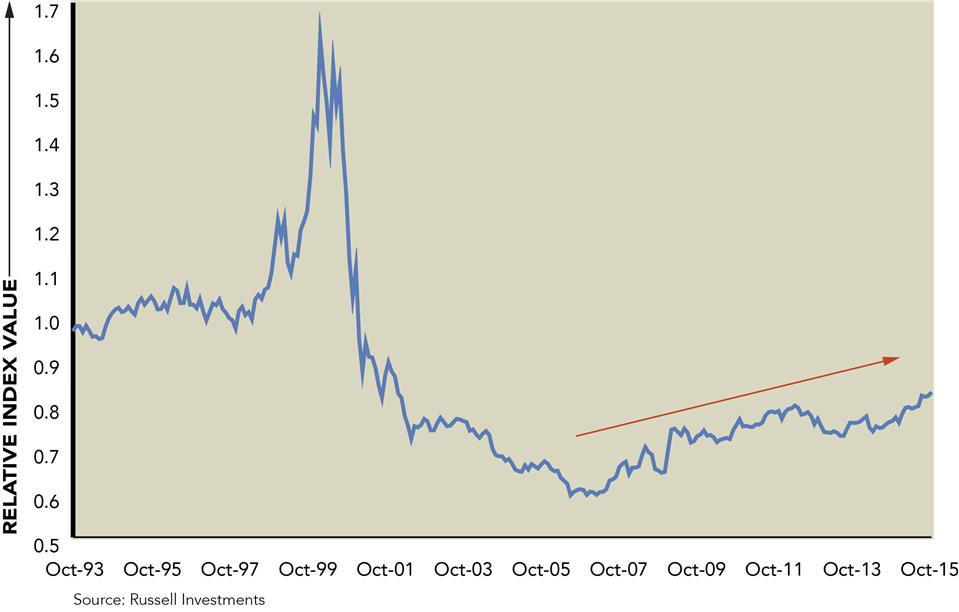
This week’s Chart of the Week examines the relative performance of growth versus value. The above chart shows the price level of the Russell 3000 Growth index relative to the Russell 3000 Value index. Growth is outperforming value when the line is in an uptrend and value is outperforming growth when the line is trending downward.

This week’s Chart of the Week examines the relative performance of growth versus value. The above chart shows the price level of the Russell 3000 Growth index relative to the Russell 3000 Value index. Growth is outperforming value when the line is in an uptrend and value is outperforming growth when the line is trending downward.

Investors may have noticed the recent outperformance of growth versus value year-to-date across small-, mid-, and large-cap. When viewed over a longer time horizon though, growth has outperformed value for almost ten years. The outperformance of growth prior to the tech bubble was much greater in magnitude; however, the current multi-year period of growth outperformance is the longest since the early 1980s.

One explanation for the current leadership of growth over value may simply be how these indices are constructed. Value indices feature a much larger allocation to the Financial and Energy sectors (representing approximately 43% of the Russell 3000 Value index as of 9/30/2015). When examining performance since the October 2007 market peak, Financials and Energy have lagged other sectors, posting cumulative returns of -20.8% and +3.1%, respectively. Areas such as Technology, Health Care, and Consumer Discretionary are among the best performing sectors since the October 2007 market peak and carry higher weightings within growth indices.

Over the long term, there will be periods when value is in favor and periods when growth is in favor. The duration of the current growth cycle calls into question how much longer growth’s outperformance will persist. Ultimately, it is extremely difficult to predict when the relative performance will shift, and yet another reminder that it is imperative to be diversified across the various size and style boxes of the U.S. equity market.