An October to Forget?

Stock markets around the globe “corrected” in October, experiencing a sudden and broad-based drop. The sell-off was somewhat unusual as there was no glaring fundamental event that triggered the market drop, but rather a confluence of events that all seemed to come to the forefront of investors’ minds simultaneously. These concerns, coming on the heels of a strong third quarter for stocks that left the market looking modestly overvalued, led to an unpleasant month of returns.

Download PDF >

The opinions expressed herein are those of Marquette Associates, Inc. (“Marquette”), and are subject to change without notice. This material is not financial advice or an offer to purchase or sell any product. Marquette reserves the right to modify its current investment strategies and techniques based on changing market dynamics or client needs.

Market Anomaly or the Beginning of the End?

So far, October has been a forgettable month for equity performance. Internet and technology companies — once the darling of this rally — have been among the hardest hit, as many investors appear to be taking profits as signs of slower earnings and economic growth have started to appear. Meanwhile, industrial companies have also been hit hard, as trade war rhetoric continues to grow between China and Washington, and China’s GDP growth was its weakest since the financial crisis. Through Wednesday, the materials, energy, industrials, and technology sectors all are in correction territory, with the following losses:

  • Materials: -13.0%
  • Energy: -12.5%
  • Industrials: -11.6%
  • Technology: -10.8%

Not surprisingly, volatility — as measured by the VIX index — has skyrocketed as equities have sold off.

More generally, October’s sell-off has been related to the health of the global economy; investors appear concerned about rising U.S. interest rates, a strong U.S. dollar, slowing global growth and trade wars. Only time will tell if October is part of a larger sell-off in global markets and the end of a nine-year bull market in the U.S., or just an anomaly. Going forward, investors will dissect third quarter earnings and be focused on company guidance going into 2019. If growth prospects for 2019 look tepid, many expect this sell-off to continue into year-end and the VIX to remain elevated.

Print PDF

The opinions expressed herein are those of Marquette Associates, Inc. (“Marquette”), and are subject to change without notice. This material is not financial advice or an offer to purchase or sell any product. Marquette reserves the right to modify its current investment strategies and techniques based on changing market dynamics or client needs.

Are Small-Cap Equity Opportunities Disappearing?

In 1996, there were more than 8,000 companies listed on U.S. stock exchanges. Today, that figure is less than half. This sharp decline can be largely attributed to the disappearance of many small-cap stocks within the U.S. equity market. Small companies are staying private longer due to rigorous regulatory requirements and prohibitive costs associated with going public. As a result, true small-cap exposure is becoming harder and harder for investors to obtain in traditional equity markets.

Given the strong returns of small-cap equities, many investors have made significant allocations to small-cap equity funds. The inefficient nature and relatively large universe of smaller stocks has historically provided a wide opportunity for investments in companies that are commonly overlooked or underfollowed. When looking at the number of small-cap companies in the Russell 2000 and Russell 3000 index over the past decade, it reaffirms there are fewer attractive small-cap opportunities within the U.S. equity market for investors.

In 2008, the number of small-cap companies (market cap less than $500M) in the Russell 2000 index (small-cap benchmark) were 1,307. Just a decade later, that number has fallen 54% to just 603 companies. A similar trend can be seen in the Russell 3000 index (total market benchmark) with small-cap companies declining from 46% of the index in 2008 to just 20% of the index in 2018.

While attractive small-cap opportunities still exist in the U.S. equity market, true small-cap exposure is becoming more difficult for investors to obtain within their portfolios. If this trend persists, we expect investor capital to continue to seek out private market alternatives for this small-cap exposure.

Print PDF

The opinions expressed herein are those of Marquette Associates, Inc. (“Marquette”), and are subject to change without notice. This material is not financial advice or an offer to purchase or sell any product. Marquette reserves the right to modify its current investment strategies and techniques based on changing market dynamics or client needs.

New Communication Services Sector

Effective after market close on September 21, 2018, S&P Dow Jones Indices and MSCI Inc. will implement a significant revision to the Global Industry Classification Standards (GICS) structure. The telecommunication services sector is scheduled to undergo an expansion that will include several companies currently housed within the consumer discretionary and information technology sectors. The newly broadened telecommunication services sector will be renamed communication services and will contain two broad industry groups: telecommunication services and media & entertainment. The media industry group, previously categorized under consumer discretionary, will move to the communication services sector and be renamed media & entertainment. The reclassified media & entertainment industry group will contain a variety of industries engaged in modern media and entertainment channels. The purpose of this GICS structure change is to broadly include companies within one sector that facilitate communication and offer related content and information through various platforms. The change is an acknowledgement of consolidation occurring and overlapping services provided today within the media, telecommunications, and internet industries.

Download PDF >

The opinions expressed herein are those of Marquette Associates, Inc. (“Marquette”), and are subject to change without notice. This material is not financial advice or an offer to purchase or sell any product. Marquette reserves the right to modify its current investment strategies and techniques based on changing market dynamics or client needs.
Tech Sector Bubble?

Our Chart of the Week examines the concentration in market cap over time among the five largest stocks in the S&P 500 relative to the total market cap of the index. With growth outperforming value in the current market cycle, it’s not surprising to see the largest stocks by market cap today populated entirely by growth stocks. The strong performance among FAANG stocks (Facebook, Apple, Amazon, Netflix, and Google/Alphabet) have propelled the weighting of these securities within market cap weighted indices over recent years and caused market participants to question how long this historic run can last and if we are currently in a technology sector bubble. With names such as Facebook and Netflix pulling back earlier in the year and Apple hitting a $1 trillion market cap milestone last week, fears of a technology bubble have only continued.

As of June 2018, the largest five stocks in the S&P 500 occupied 15.9% of the total market cap of the index. This concentration is high relative to the current market cycle, but it is important to note that we are still below the March 2000 high of 18.5%. Additionally, the largest five stocks in the S&P 500 have occupied greater than 20% of the total S&P 500 market cap in prior periods such as during the 1970’s.

The technology sector does trade at a premium to the broader market today. However, the sector generates high return on equity, strong earnings growth, and multiple expansion is not as excessive as during the dot-com peak. While the recent rise in technology stock weighting as a percentage of total market cap warrants monitoring, today’s concentration is not without precedence.

Print PDF

The opinions expressed herein are those of Marquette Associates, Inc. (“Marquette”), and are subject to change without notice. This material is not financial advice or an offer to purchase or sell any product. Marquette reserves the right to modify its current investment strategies and techniques based on changing market dynamics or client needs.

Is it Value’s Turn?

This week we examine factor performance from the Russell 1000, with a focus on the dynamic between growth and value stocks. For the month of July, value finally pulled ahead of growth as a contributor to performance. This is a shift from recent behavior as growth leads on a trailing 7-year basis. Typically, growth and value have operated in a cyclical relationship so value’s shift from detractor in 2Q to a positive contributor in July could signal a reversal in relative performance between the two styles.

Financials, particularly banks, did well in July by posting strong earnings; these tend to be value stocks and contributed to the relative outperformance. While tech has been a very strong performer year to date, some of the FANG stocks, namely Facebook and Netflix, hit potholes in July. Facebook encountered more trust and brand issues surrounding privacy and Netflix battled disappointing subscriber growth. These specific company pullbacks likely hurt the growth factor.

Growth has outperformed value since 2011 and the rolling 10-year outperformance is at a high point, now bumping up against two standard deviations from its long-term average. This paired with value’s recent edge above growth may indicate that growth’s outperformance versus value could be coming to an end.

Print PDF

The opinions expressed herein are those of Marquette Associates, Inc. (“Marquette”), and are subject to change without notice. This material is not financial advice or an offer to purchase or sell any product. Marquette reserves the right to modify its current investment strategies and techniques based on changing market dynamics or client needs.

A “Halftime” Review of Asset Allocation for 2018

As of June 30th, the Russell 3000 index was up only 3.2%, a far cry from its 10-year annualized return of almost 9%; the MSCI ACWI ex-U.S. ­— a broad proxy for international stocks — has been even more disappointing, down 3.8% compared to its 2017 return of 27%. Furthermore, most bond strategies are negative for the year, thus dispelling the notion of diversification. However, the year is only halfway complete and as we have seen repeatedly in the capital markets, fortunes can change rapidly and unpredictably. In an effort to formulate explanations and expectations, the following newsletter investigates the disappointing performance from the first half of the year, as well as potential outcomes for the remainder of 2018.

Download PDF >

The opinions expressed herein are those of Marquette Associates, Inc. (“Marquette”), and are subject to change without notice. This material is not financial advice or an offer to purchase or sell any product. Marquette reserves the right to modify its current investment strategies and techniques based on changing market dynamics or client needs.

Goodbye Telecommunications Services Sector and Hello Communications Services Sector!

On November 15, 2017, S&P Dow Jones Indices, a leading provider of financial market indices, and MSCI Inc., a leading provider of research-based indices and analytics, conducted their annual review of the Global Industry Classification Standard (GICS). As a result, the pair decided to broaden and rename the Telecommunications Services sector to the Communications Services sector. The thought process is that over the past several years consumers and businesses have fundamentally transformed the way in which they communicate and access content.

In some ways, this trend started when Comcast, a cable company, announced its intention to purchase a stake of NBC Universal, a television network and content provider, in 2007. The latest example of the convergence between communications and media is the on-going asset fight between Fox, Comcast, and Disney for Sky PLC, a European satellite broadcaster. Moving away from traditional communications and media companies, firms like Alphabet through its Google search engine and YouTube, Facebook through its ever-expanding social media platform, and Netflix through its direct-to-consumer streaming content, have changed the way the world communicates and accesses content. The lines have officially blurred and S&P along with MSCI decided to take action.

What impact will this have on investors?

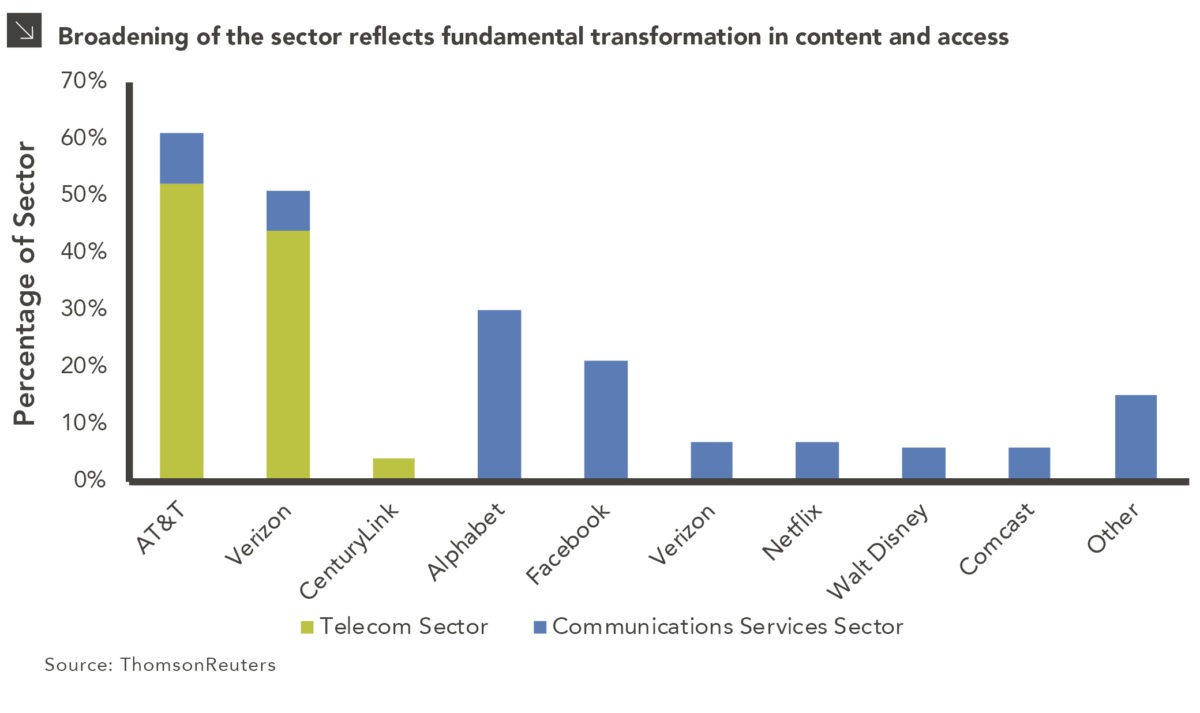
On September 21, 2018, the Telecommunications Services sector, the smallest sector at a 2% weight in the S&P 500 will quintuple in size to become the fourth largest sector in the index at the expense of the Information Technology and Consumer Discretionary sectors. This change is much larger than GICS’s creation of the Real Estate sector in 2016, which affected approximately 3% of the index’s market cap. Sleepy firms like AT&T, Verizon and CenturyLink will be grouped in the same sector as Alphabet, Facebook, and Netflix, just to name a few. Most notably, a sector classified as 100% value will be primarily growth-oriented.

The composition change is shown in the above chart; the formerly dominant names of AT&T, Verizon, and CenturyLink of the Telecom sector (shown in green) will now occupy a much smaller percentage of the new Communications Services sector, as shown by the considerably smaller blue boxes in the graph.

Luckily, most investment managers select stocks based on their investment merits and not their GICS sector classification. An investment manager that owns Alphabet (Google), which is currently classified as an Information Technology stock, on September 21st will continue to hold it on September 22nd. Much like the creation of the Real Estate sector in 2016, there is no action needed on the part of investors. We will continue to monitor new developments as S&P and MSCI finalize the change over the coming months.

Print PDF

The opinions expressed herein are those of Marquette Associates, Inc. (“Marquette”), and are subject to change without notice. This material is not financial advice or an offer to purchase or sell any product. Marquette reserves the right to modify its current investment strategies and techniques based on changing market dynamics or client needs.

Equities Show Underlying Weakness

After hitting an all-time closing high on January 26th, the S&P 500 officially entered correction territory over the span of nine trading days with a 10% pullback. Since the February 8th low, price levels for the S&P 500 have shown signs of stabilization but have yet to fully recover. Through May 8th, the S&P 500’s year-to-date return was +0.55%. This headline number, however, masks the dispersion of returns among sectors and individual stocks so far this year. Despite the index being slightly positive year-to-date, many individual stocks within the index are in negative territory.

This week’s chart shows the S&P 500 price level along with the percentage of S&P 500 stocks trading above their 200-day moving averages. The 200-day moving average is a popular technical indicator used to gauge price trends in equity markets. This same indicator can also be applied to individual securities within an index to assess the level of participation or breadth.

The chart above highlights the narrow participation of securities within the S&P 500 since the prior all-time closing high. 83% of stocks in the S&P 500 were trading above their 200-day moving averages as of January 26th. This number fell to 56% by May 8th, indicating that price levels are being supported by a smaller percentage of individual stocks within the index. For example, the popular mega-cap acronym FAANG (Facebook, Apple, Amazon, Netflix, and Google/Alphabet) has been a key driver for equity returns this year. These five stocks account for over 11% of the S&P 500’s total weight and as a group have generated an average year-to-date return of +20%. While higher market cap stocks have supported overall equity returns year-to-date, such narrow market participation creates concerns should sentiment change among these stocks.

Print PDF


The opinions expressed herein are those of Marquette Associates, Inc. (“Marquette”), and are subject to change without notice. This material is not financial advice or an offer to purchase or sell any product. Marquette reserves the right to modify its current investment strategies and techniques based on changing market dynamics or client needs.

Turn Up the Vol-ume

Volatility is a normal and healthy component of any market. While 2017 lacked typical market volatility, 2018 has experienced its share and entered back into a more reactive and “normal” environment. In the first quarter alone, 2018 had almost triple the amount of +/- 1% days than the entire year of 2017. Although a reversal of 2017’s complacent behavior, this market movement is in line with recent history.

Another pivotal trend is the VIX premium over the V2X; the VIX reflects U.S. market volatility while the V2X is an equivalent measure of European markets. Typically, the VIX trades below the V2X (a negative premium), which reflects the average lower volatility of U.S. vs European markets. The first quarter of 2018 marks the first time this monthly average has peaked above 0 in quite some time. This is not exactly surprising given the economic policy uncertainty and rising rate environment in the U.S.

Volatility is back, and though this is a change of pace from 2017, is well within the bounds of normalcy and is likely to continue throughout 2018.

Print PDF


The opinions expressed herein are those of Marquette Associates, Inc. (“Marquette”), and are subject to change without notice. This material is not financial advice or an offer to purchase or sell any product. Marquette reserves the right to modify its current investment strategies and techniques based on changing market dynamics or client needs.