When Do Rising Rates Matter the Most?

The first quarter of 2021 saw the 10-year Treasury yield nearly double, which had a profoundly negative impact on growth-oriented and higher-valuation stocks. Generally, higher interest rates are expected to lead to lower equity returns and vice versa, all else equal. While the pace of change in the 10-year during the first quarter was enough to rattle investors, data from the last decade does not support an overall negative correlation between the movement in interest rates and equity returns. Since the Global Financial Crisis (“GFC”), monthly returns of the S&P 500 Index and monthly changes in the 10-year Treasury yield have exhibited correlations ranging from modestly negative to strongly positive. This is in stark contrast to the correlations from previous decades, when equity returns and interest rate movements tended to be strongly inversely related, as conventional wisdom would suggest. Roughly 75% of the monthly correlation observations from 1970 to the beginning of the Global Financial Crisis were negative, compared to less than 14% from the GFC to the present day. While many variables likely contributed to this disconnect, the absolute level of interest rates may be the most important factor.

Though it is difficult to precisely quantify the impact, the extremely low yield environment of the past decade has clearly been a boon to stock prices. During periods of low rates, investors tend to shun conservative assets like bonds and turn to equities for yield, otherwise known as the “TINA” effect (i.e., market participants believe “there is no alternative” to stocks in low-rate climates). This phenomenon manifests itself in the form of the equity risk premium (the S&P 500 earnings yield less the 10-year Treasury yield), which has indicated the relative attractiveness of equities for nearly two decades. Low rates also benefit stock price valuations, calculated as expected future cash flows of companies pulled forward to the present day using a discount factor based on the risk-free interest rate. When yields are low, the denominators in those present value calculations are also low, leading to higher valuations. So, despite rates ticking up during various periods in the last decade, stock prices largely continued to rise as rates stayed extremely low on an absolute and historical basis. It is also worth noting that during exogenous shocks like the GFC and COVID-19, both yields and equity prices saw dramatic decreases, contributing to the positive correlation over the last several years.

At higher absolute levels of interest rates, however, the data show a stronger negative correlation between yield changes and equity price movements. The idea that the absolute level of interest rates helps determine the extent to which movements in yields impact equities begs the question: Is there an inflection point at which increases in rates are more likely to lead to diminished equity returns? While there are many factors at play, a quadratic regression on the correlations observed from 1970 through today implies that negative correlations begin at a 10-year Treasury yield of around 5.8%. For investors, this may help allay concerns about the impact of future rate hikes, with the 10-year still below 2%. That said, the era of easy money that has persisted for more than a decade may be drawing to a close, and investors should consider the implications of increasingly restrictive monetary policy going forward.

Print PDF > When Do Rising Rates Matter the Most?


The opinions expressed herein are those of Marquette Associates, Inc. (“Marquette”), and are subject to change without notice. This material is not financial advice or an offer to purchase or sell any product. Marquette reserves the right to modify its current investment strategies and techniques based on changing market dynamics or client needs.

One Year Later, What’s Next?

Welcome to our inaugural quarterly client newsletter! As a way of introduction, I am Greg Leonberger, Director of Research here at Marquette. I have had the privilege of meeting many of you over the years, and for those that I have not worked with previously, please accept this virtual introduction; my hope is to meet many more of you in person once in-person meetings resume. As I embark on this newsletter series, the goal each quarter is relatively simple: provide you with our views on capital markets, the economy, emerging risks as well as opportunities, and hopefully stitch in a few anecdotes to make for a more engaging connection with our readers.

Highlights from this edition:

  • One year anniversary of the equity market trough in 2020
  • COVID-19: lingering uncertainty, vaccine progress, economic recovery
  • Equities update: value and small-cap outperformance, valuations, TINA
  • Fixed income: reflation trade and interest rates, spreads
  • Alternatives: opportunities in real estate, hedge funds, and private markets
  • Inflation worries: money supply and commodity prices

Read > One Year Later, What’s Next?


The opinions expressed herein are those of Marquette Associates, Inc. (“Marquette”), and are subject to change without notice. This material is not financial advice or an offer to purchase or sell any product. Marquette reserves the right to modify its current investment strategies and techniques based on changing market dynamics or client needs.

Q1 2021 Market Insights Video

This video features an in-depth analysis of the first quarter’s performance by Marquette’s research analysts and directors, reviewing general themes from the quarter and risks and opportunities to monitor in the coming months.

Our Market Insights series examines the primary asset classes we cover for clients including the U.S. economy, fixed income, U.S. and non-U.S. equities, hedge funds, real estate, infrastructure, private equity, and private credit, with presentations by our research analysts and directors.

Sign up for research alerts to be notified when we publish new videos here.
For more information, questions, or feedback, please send us an email.

Where’s the Blowout?

A typical real estate cycle has four phases: recovery, expansion, hypersupply, and recession. Typically, the recession phase is marked by rising cap rates (a real estate valuation measure, calculated as the ratio of net operating income to market value), which then compress over the growth phases of the cycle as property values rise. However, the current cycle, which began shortly after the onset of the COVID-19 pandemic, has been atypical. Although we experienced a period of economic contraction, cap rates did not rise as they have in previous recessions. Two contributing factors may have been lower interest rate expectations in 2020 and the impact of government stimulus measures that helped occupiers navigate weaker market conditions. Now with cap rates at historic lows and interest rates expected to rise through 2021, real estate investors are asking whether a “blowout” (an increase in cap rates) is on the horizon.

Historically, cap rates have been driven by the interaction of (1) changes in U.S. government bond yields, (2) the real estate risk premium (the cap rate spread above U.S. treasuries), and (3) the expected-long term growth of rental income (net operating income (NOI)). In previous cycles, cap rate compression was in part driven by favorable liquidity conditions and falling treasury yields. Today, yields are rising, with 10-year rates already up meaningfully off the mid-2020 bottom. With NPI cap rates essentially flat, this means the real estate risk premium has compressed. Accordingly, rent growth is becoming a bigger driver of capital appreciation and more important to investors. Over the short term, we expect investors will favor properties with the highest rent or NOI growth potential and rotate out of properties where growth is more limited. This should benefit industrial warehouse and apartment properties in select markets to the detriment of more challenged retail and potentially office properties. As a result of this asset rotation, the cap rates of properties in high demand may continue to compress, while cap rates of more challenged properties may see the “blowout” the broader real estate market has so far avoided.

Print PDF > Where’s the Blowout?

Sources utilized: Cornerstone Real Estate Advisors, “Cap rates and RE cycles,” and Principal Real Estate Investors, “Interest rates are rising, should real estate be concerned?


The opinions expressed herein are those of Marquette Associates, Inc. (“Marquette”), and are subject to change without notice. This material is not financial advice or an offer to purchase or sell any product. Marquette reserves the right to modify its current investment strategies and techniques based on changing market dynamics or client needs.

Retirement Basics Video Series

This video series is intended for plan sponsors and fiduciaries and covers a variety of topics related to creating and managing effective defined contribution investment programs. Co-presented by members of our consulting and research teams, these videos present the basics of retirement plans for trustees and investment staff in an educational format meant to provide guidance and insights on best practices and trends in the industry.

The series includes:

  • Fiduciary Checklist, an overview of the roles and responsibilities of fiduciaries including planning, oversight, communication, and documentation;
  • Defined Contribution Topics & Trends, industry trends and recent developments and guidance from the Department of Labor;
  • Investment Lineup Best Practices, considerations and guidance for selecting investment lineup offerings for retirement plans;
  • Target Date Funds, a deep dive into TDFs, from structure and glidepaths to why target date funds have become so popular; and
  • Stable Value Funds, an overview of stable value, exploring structure, important considerations, and recent litigation.

View each episode in the player below — use the upper-right list icon to access a specific presentation.

For more information, questions, or feedback, please send us an email.

One Year Ago, Would Anyone Have Predicted This?

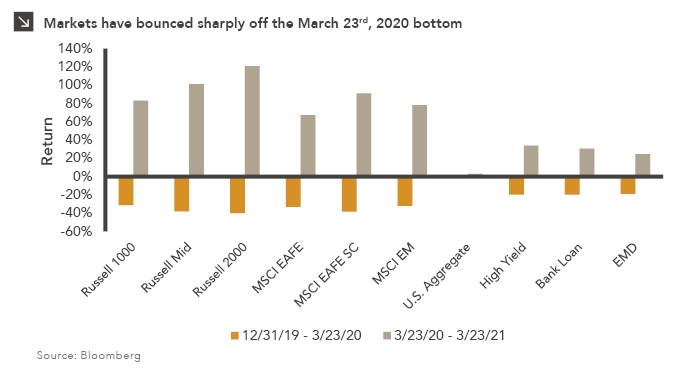
What a year it has been. Officially one year after the equity market’s bottom on March 23rd, 2020, all major indices in the chart above have at least recovered back to ending 2019 levels. The groups that were hit the hardest have also rebounded the strongest, with returns over the last year exceeding 100% for some. Small-cap equities stand out, especially in the U.S. — up 121% over the last year and up 33% over the almost 15-month period since 2019. U.S. mid-cap equities are up 101% over the last year, up 25% over the full period, and U.S. large-cap equities are up 83% over the last year for a 26% return over the full period. Small-cap stocks have also outperformed internationally — the MSCI EAFE Small Cap Index is up 91% over the last year and 18% since 2019, while the MSCI EAFE Index is up 67% over the last year and 12% for the full period. Emerging markets, some of the hardest hit by the crisis last year, have more than recovered, up 78% over the last year for a 22% return since 2019. Fixed income returns have been more muted. Investment grade bonds stayed positive in early 2020 as equity markets fell precipitously and are up another 3% since. High yield bonds, bank loans, and emerging market debt were hit harder but still held up better than equities. Each group has recovered those losses but remains in positive single-digit territory over the full period.

From here, we expect returns will likely moderate. As the vaccine roll-out continues we expect further economic re-openings and renewed growth across the globe, but it seems highly unlikely capital markets returns can continue at this pace beyond the initial recovery.

Print PDF > One Year Ago, Would Anyone Have Predicted This?


The opinions expressed herein are those of Marquette Associates, Inc. (“Marquette”), and are subject to change without notice. This material is not financial advice or an offer to purchase or sell any product. Marquette reserves the right to modify its current investment strategies and techniques based on changing market dynamics or client needs.

What Does the Latest Stimulus Mean for the Economy and Fixed Income Markets?

President Joe Biden signed the $1.9 trillion pandemic relief package yesterday amidst rising inflation and interest rates since the beginning of the year as the markets price in future growth. With Fed Chair Jerome Powell’s recent reaffirmation of the central bank’s accommodative monetary stimulus, continued vaccine rollout, a drop in COVID-19 cases and deaths, and Biden’s statement that the U.S. will have enough vaccines for every adult by the end of May, a key question on many investors’ minds is, “How much more inflation and rising interest rates could we expect in the road ahead?” This edition of Marquette Perspectives will attempt to answer that question by examining this relief aid in connection with vaccination progress and the economic recovery.

Read > What Does the Latest Stimulus Mean for the Economy and Fixed Income Markets?


The opinions expressed herein are those of Marquette Associates, Inc. (“Marquette”), and are subject to change without notice. This material is not financial advice or an offer to purchase or sell any product. Marquette reserves the right to modify its current investment strategies and techniques based on changing market dynamics or client needs.

GDP Growth Hits Highs vs. Bond Yields

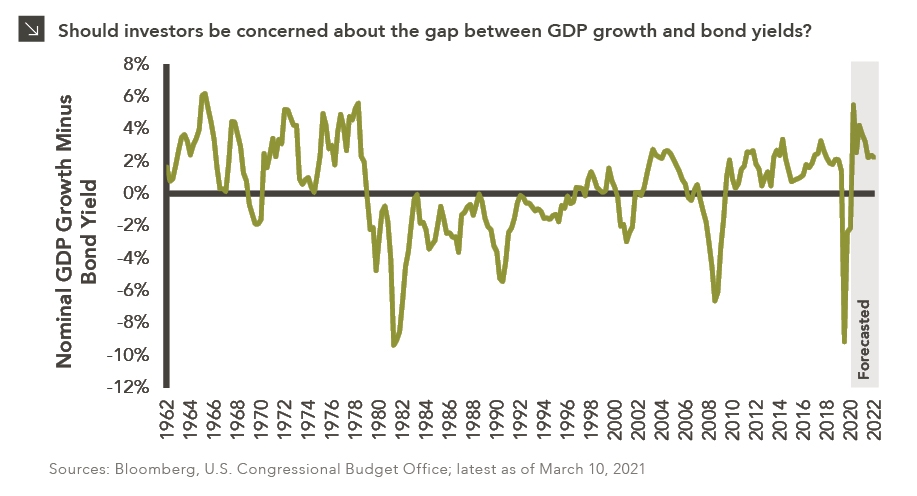
The gap between U.S. GDP growth and bond yields is expected to rise to the highest level since the 1970s amid unprecedented amounts of fiscal and monetary stimulus and an accelerating vaccination roll-out. The chart depicts nominal U.S. GDP growth rates year-over-year less the 10-year U.S. Treasury yield over the last 60 years. Beyond 2020, we profile the U.S. Congressional Budget Office (“CBO”) forecasted nominal GDP growth rate for 2021 and 2022, minus the forecasted 10-year U.S. Treasury yield from the Treasury forwards market, which projects a 25 basis point rise each year over the next four years.

The quarterly GDP growth rate is much more volatile than bond yields. It can decline precipitously in a recession much faster than bond yields as well as rebound much faster than bond yields in a recovery. The ratio has spiked down several times in the past: during the early 1980s and early 1990s recessions, following the dot-com bust of 2000 and the housing bust of 2008, and most recently after the COVID panic of March 2020. This is because the GDP growth rate reflects actual economic growth, measured year-over-year quarterly, while bond yields reflect the market’s anticipation of economic growth over a longer time period. While this gap is expected to reach its highest level in roughly 50 years as the economy rebounds from the depths of COVID, it is then expected to moderate back to pre-pandemic levels, as the CBO forecasts GDP growth to normalize throughout 2021 and 2022 after the initial recovery. Therefore, despite the spike in this ratio it is not a fundamental concern for investors and is not suggestive of a coming market downturn.

Print PDF > GDP Growth Hits Highs vs. Bond Yields


The opinions expressed herein are those of Marquette Associates, Inc. (“Marquette”), and are subject to change without notice. This material is not financial advice or an offer to purchase or sell any product. Marquette reserves the right to modify its current investment strategies and techniques based on changing market dynamics or client needs.

Hedging Rising Inflation and Interest Rates

Rising inflation and interest rates have not been real issues for investors for several years, but both have remained popular topics of concern. While inflation does not appear to be an immediate risk given still depressed GDP and elevated unemployment, the size of the latest proposed $1.9 trillion COVID relief package has many thinking about future implications. Stimulus did not lead to inflation following the Global Financial Crisis, but there are a number of reasons, beyond the sheer size of this effort, that we could see greater inflationary pressures this time: more pent-up consumer demand, well-capitalized banks and healthy consumer balance sheets, de-globalization, and higher operational costs associated with the virus. And while the Federal Reserve has committed to maintaining its ultra-accommodative monetary policy until long-term inflation hits 2% (with shorter-term inflation allowed to rise moderately above 2% for some time), unless the Fed changes its stance on negative rates, rates can only go in one direction from here: up.

Like all things market-related, we do not recommend trying to time inflation or interest rates. In this newsletter, we analyze equity long/short hedge funds as an option for investors to potentially optimize their portfolio for this dynamic environment.

Read > Hedging Rising Inflation and Interest Rates


The opinions expressed herein are those of Marquette Associates, Inc. (“Marquette”), and are subject to change without notice. This material is not financial advice or an offer to purchase or sell any product. Marquette reserves the right to modify its current investment strategies and techniques based on changing market dynamics or client needs.

Federal Debt Rises but Federal Interest Expense Drops

Due to the unprecedented fiscal and monetary stimulus that the federal government has provided the U.S. economy during the COVID-19 pandemic, our federal debt has been rising precipitously. As we can see from this week’s chart, the federal debt as a percentage of GDP (left chart, purple bars) skyrocketed in 2020. In the meantime, interest rates have declined, shown using the bellwether 10-year U.S. Treasury yield (left chart, orange line). Rates have declined because of haven asset-seeking from investors, driving up Treasury prices and driving down yields, as well as from developed market foreign investors seeking relatively higher yields here versus low to negative yields in their markets.

Because of the decline in rates over 2020, the federal gross interest expense on U.S. Treasury securities (right chart, purple bars) has been declining. The federal gross interest expense rate (right chart, green line), based on dividing the federal gross interest expense dollar amount by the total federal debt outstanding dollar amount, has been declining along with the 10-year U.S. Treasury yield (right chart, orange line), but there has been a lag. This lag comes from newly issued, on-the-run bonds having lower yields versus existing bonds that are off-the-run, on which the Treasury is paying interest. These two charts emphasize that despite the rise in federal debt, our government is benefitting from a decline in the interest costs due to lower interest rates. This should help mitigate the total costs of supporting the U.S. economy as we recover from the COVID pandemic.

Print PDF > Federal Debt Rises Federal Interest Expense Drops


The opinions expressed herein are those of Marquette Associates, Inc. (“Marquette”), and are subject to change without notice. This material is not financial advice or an offer to purchase or sell any product. Marquette reserves the right to modify its current investment strategies and techniques based on changing market dynamics or client needs.