Prospects of Dollar Depreciation in the COVID Recovery & Impact on Asset Classes

As vaccine distribution continues in full force and the global economy’s recovery from the COVID pandemic gains momentum, investors are concerned about depreciation of the U.S. dollar and how this phenomenon might affect various asset classes within a portfolio.

In this paper, we examine the mechanics of dollar depreciation and its subsequent impact on traditional asset classes. We begin by exploring the macroeconomic factors that drive dollar strength or weakness and then examine the impact of dollar depreciation on the fixed income, U.S. equities, and non-U.S. equities asset classes both by covering the potential effects of a stronger or weaker dollar and by assessing historical performance.

Read > Prospects of Dollar Depreciation in the COVID Recovery & Impact on Asset Classes


The opinions expressed herein are those of Marquette Associates, Inc. (“Marquette”), and are subject to change without notice. This material is not financial advice or an offer to purchase or sell any product. Marquette reserves the right to modify its current investment strategies and techniques based on changing market dynamics or client needs.


Should Investors Be Concerned About Stagflation?

The coronavirus pandemic has disrupted everyday life and caused a devastating impact on the global economy. At the peak of the outbreak, the U.S. unemployment rate reached 11.1% and real GDP growth fell by 9.0%, which marked the second worst economic crisis since the Great Depression. On the bright side, the COVID relief programs and expansionary economic policies projected an air of optimism; as of January 2021, the unemployment rate came down to 6.3% and real GDP growth has started to recover since cratering during the first half of 2020. However, these figures are still at concerning levels, and an emerging fear is that the magnitude of economic stimulus may create a surge in inflation, in spite of middling economic growth. This week’s chart examines the nature of stagflation and how the markets perform under this condition.

The term “stagflation” comes from “stagnation” and “inflation” and can be identified as a period of slow economic growth, high unemployment, and high inflation. An example of stagflation was in the 1970s as shown in the chart. The inflation and unemployment rates (blue and orange lines) stayed in a 10–15% range when the economic growth (purple line) was slow or negative. The typical cause of stagflation is an external shock that breaks the inverse relationship between the inflation and unemployment rate; the high inflation usually indicates that the demand for goods and services is high, the economy is expanding and unemployment is low. In this case, the supply shock of oil was the main contributing factor for driving prices higher, discouraging consumption, and resulting in a recession. Stagflation is not only detrimental to the economy but also difficult to address. For example, contractionary policies such as increasing interest rates to reduce inflation may make unemployment even worse.

As shown at the bottom of the chart, the U.S. stock, international stock, bond, real estate, and commodity markets held up well during stagflation in the 1970s. The S&P GSCI commodity index returned 54.3% per year and the other markets returned 25% to 28% per year. The international stock market outperformed the U.S. stock market. The commodity market performed best but highly fluctuated with a 0.72 correlation with inflation.

The economic crisis from the pandemic coupled with the aid to boost the economy may seem like a recipe for stagflation. However, impending stagflation is unlikely. The current inflation of 1.3% is well below the central bank’s 2% target, oil prices are stable, the personal consumption expenditure is down but has recovered to 96% of its pre-pandemic level, vaccines are becoming more accessible and IMF projections are generally positive (dotted lines). As the economy further re-opens later this year, the threat of stagflation should dissipate as attention turns toward renewed economic growth.

Print PDF > Should Investors Be Concerned About Stagflation?


The opinions expressed herein are those of Marquette Associates, Inc. (“Marquette”), and are subject to change without notice. This material is not financial advice or an offer to purchase or sell any product. Marquette reserves the right to modify its current investment strategies and techniques based on changing market dynamics or client needs.

2021 Market Preview

2020 was a year like no other and has left investors across the world wondering what the future looks like. Will vaccines prove effective in halting a pandemic that spread like wildfire across the globe? What will the impact of a new administration in Washington be on economies and markets? How much additional stimulus will be injected into the economy? And most broadly, will things ever get back to “normal”? While there are no easy answers to these questions, 2021 promises to be another volatile year, most especially until there has been sufficient roll-out and distribution of vaccines to contain the COVID-19 outbreak that continues to haunt economic growth across the globe.

Remarkably, 2020 ended up as a positive year for financial markets despite a massive sell-off in the equity and credit markets during February and March. Paradoxically, 2021 may be a less eventful year but at the same time a lower overall return environment, given that much of the optimism about economic re-openings and stimulus has already been priced into the markets. Nonetheless, there are a variety of factors worth monitoring over the next year which will directly impact market returns. Similar to past years, we offer our 2021 market preview newsletters for each of the primary asset classes we cover, with in-depth analysis of last year’s performance as well as trends, themes, opportunities, and risks to watch for in 2021.

We hope these materials can assist you and your committees as you plan for the coming year and beyond. We have also produced a 2021 Market Preview video if you would like to hear a high-level summary of the market previews. Should you have any questions about anything related to these materials, please feel free to reach out to any of us for further assistance. Here’s to a return to normalcy in 2021!

U.S. Economy: Are Better Days Ahead?
by Brandon Von Feldt, CFA, Research Analyst

Fixed Income: Poised for Further Recovery with Undertones of Exuberance
by Ben Mohr, CFA, Director of Fixed Income

U.S. Equities: Birth of a New Market
by Samantha T. Grant, CFA, CAIA, Assistant Vice President,
Colleen Flannery, Research Analyst, U.S. Equities, and
Evan Frazier, CAIA, Research Analyst, U.S. Equities

Non-U.S. Equities: Constructive but Cautious
by David Hernandez, CFA, Senior Research Analyst, Non-U.S. Equities, and
Nicole Johnson-Barnes, CFA, Senior Research Analyst, Global Equities

Hedge Funds: Poised for Another Record Year?
by Joe McGuane, CFA, Senior Research Analyst, Alternatives
and Jessica Noviskis, CFA, Senior Research Analyst, Hedge Funds

Real Estate: Finding the New Normal
by Will DuPree, Senior Research Analyst, Real Assets

Infrastructure: An Evolving Opportunity Set, but an Essential Allocation
by Will DuPree, Senior Research Analyst, Real Assets

Private Equity: Both Quality and Growth Shine Brightly in 2020
by Derek Schmidt, CFA, CAIA, Director of Private Equity

Private Credit: Two Steps Forward, One Step Back
by Brett Graffy, CAIA, Research Analyst

Download the combined files > Traditional and Alternatives


The opinions expressed herein are those of Marquette Associates, Inc. (“Marquette”), and are subject to change without notice. This material is not financial advice or an offer to purchase or sell any product. Marquette reserves the right to modify its current investment strategies and techniques based on changing market dynamics or client needs.
2021 Market Preview Video

This video coincides with our 2021 Market Preview newsletters and provides a high-level summary of each, including analysis of last year’s performance as well as trends, themes, opportunities, and risks to watch for in 2021.

Our Market Insights series examines the primary asset classes we cover for clients including the U.S. economy, fixed income, U.S. and non-U.S. equities, hedge funds, real estate, infrastructure, private equity, and private credit, with presentations by our research analysts and directors.

Sign up for research alerts to be notified when we publish new videos here.
For more information, questions, or feedback, please send us an email.

Tech Bubble Revisited? Contrasting the Current Landscape with the Dot-Com Boom and Bust

Continued strong performance of technology-oriented stocks through disparate economic environments, elevated valuations, and increasing concentration within the growth space have caused many to draw parallels between present-day conditions and those of the late 1990s. Some feel as though investor exuberance surrounding innovative companies is irrational, and that 2021 could bring with it a paradigm shift in terms of sentiment and market leadership.

This newsletter seeks to assess the extent to which the current equity landscape mirrors the Dot-com Bubble with an analysis of performance, sector concentration, profitability fundamentals, and valuations.

Read > Tech Bubble Revisited? Contrasting the Current Landscape with the Dot-Com Boom and Bust


The opinions expressed herein are those of Marquette Associates, Inc. (“Marquette”), and are subject to change without notice. This material is not financial advice or an offer to purchase or sell any product. Marquette reserves the right to modify its current investment strategies and techniques based on changing market dynamics or client needs.

Is Velocity Stifling Inflation Amid Record Growth of Money Supply?

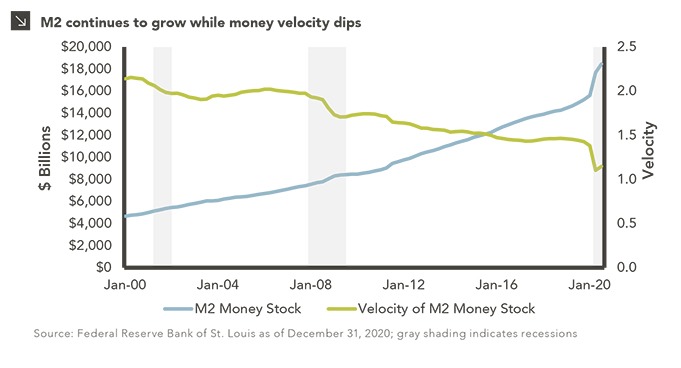
Inflation has remained well below 3% in the United States for nearly a decade despite a record economic expansion and supportive monetary policy. Even after unprecedented alterations to the macroeconomic landscape in recent months, investors have not seen the significant price level increases that might have been expected in theory. This puzzling situation may be at least partially explained by the current relationship between money supply and velocity.

When it comes to economic relief efforts in the U.S. during 2020, no entity has been more active than the Federal Reserve, which has increasingly relied on open market operations with short-term interest rates near zero. Since the start of the pandemic, the Fed has purchased $3.5 trillion in Treasuries, corporate bonds, and mortgage-backed securities, and recently announced its intention to press forward with $120 billion per month in additional bond buying. The central bank’s balance sheet has now ballooned to over $7 trillion. As a result, M2 ­— a measure of the total money supply that includes narrow money, cash equivalents, and short-term deposits — spiked by roughly 25% in 2020, a record year-over-year growth figure.¹ The recent M2 surge has been accompanied by a decrease in the velocity of money, calculated as the ratio of quarterly nominal GDP to the quarterly average of M2 money stock. Put simply, velocity denotes the rate of turnover in the money supply and is a gauge of economic health, as higher velocity is usually associated with more robust economic activity. Since the beginning of 2020, money velocity has fallen by more than 20%, indicating a strong preference for saving vs. spending on the part of the American consumer since the outbreak of COVID-19.

The relationship between money supply and velocity has significant implications for security markets going forward, particularly as it relates to inflation. Investors have long been confounded by the absence of inflation in the U.S. since low interest rates and M2 growth should lead to higher price levels all else equal. Part of the reason for the lack of inflation could be lower levels of money velocity, which has largely declined since 2000 amid three significant recessions in the United States. The recent plunge in velocity may signal to central bankers that expansionary efforts could be continued in the near term without the risk of significant price level increases. As the economic recovery continues, however, velocity will necessarily rise, which could lead to interest rate hikes and the tapering of the Fed balance sheet to prevent runaway inflation. Investors should be cognizant of the possibility of restrictive monetary policy in the coming years as the world lifts itself out of recession.

Print PDF > Is Velocity Stifling Inflation Amid Record Growth of Money Supply

¹As measured on November 30, 2020


The opinions expressed herein are those of Marquette Associates, Inc. (“Marquette”), and are subject to change without notice. This material is not financial advice or an offer to purchase or sell any product. Marquette reserves the right to modify its current investment strategies and techniques based on changing market dynamics or client needs.

Can TIPS Be an Effective Inflation Hedge for Portfolios?

With the COVID vaccine’s worldwide distribution and adoption starting last week, many investors are aiming to project an inflation outlook driven by the return of furloughed workers and impending economic recovery and adjust portfolios with inflation protection in mind.

In this newsletter, we examine how key asset classes in institutional portfolios behave in rising or declining inflation environments, and ultimately determine the best asset classes that serve as inflation hedges while also providing strong total return and efficiency ratios. In particular, we investigate if TIPS (Treasury Inflation-Protected Securities) offer superior inflation protection compared to other common portfolio constituents.

Read > Can TIPS Be an Effective Inflation Hedge for Portfolios?


The opinions expressed herein are those of Marquette Associates, Inc. (“Marquette”), and are subject to change without notice. This material is not financial advice or an offer to purchase or sell any product. Marquette reserves the right to modify its current investment strategies and techniques based on changing market dynamics or client needs.

Cash Balance Product Alternatives & Recommendations in the Current Ultra-Low Yield Environment

With short-term interest rates seemingly stuck at unprecedented low levels, a key challenge for investors today is how best to obtain compelling yields for cash balances as part of an overall portfolio while maintaining safety and principal protection.

In this newsletter, we examine the current ultra-low yield environment and what options investors may consider in their approach to structuring an optimal cash allocation.

Read > Cash Balance Product Alternatives & Recommendations in the
Current Ultra-Low Yield Environment


The opinions expressed herein are those of Marquette Associates, Inc. (“Marquette”), and are subject to change without notice. This material is not financial advice or an offer to purchase or sell any product. Marquette reserves the right to modify its current investment strategies and techniques based on changing market dynamics or client needs.

Why Will Yields Remain Low After COVID and What Can Investors Do About It?

As we head into the 2020 year-end holiday season on the heels of positive vaccine news and an all but formally concluded presidential election, investors are turning their attention to what the state of the world economy and financial markets might look like as we potentially return to normal in 2021 and beyond. One key question being asked is where interest rates and bond yields might be headed.

In this newsletter, we explore why we are in such an ultra-low yield environment as well as what key structural transformations need to take place for rates to meaningfully rise to higher levels. Last, we devise a recommended plan of action for how asset owners can address this persistent ultra-low yield environment — even after a COVID recovery — in order to achieve return or volatility targets.

Read > Why Will Yields Remain Low After COVID and What Can Investors Do
About It?


The opinions expressed herein are those of Marquette Associates, Inc. (“Marquette”), and are subject to change without notice. This material is not financial advice or an offer to purchase or sell any product. Marquette reserves the right to modify its current investment strategies and techniques based on changing market dynamics or client needs.

What Does the Biden Win Mean for Financial Markets?

On Saturday, November 7th, Joe Biden was declared the winner of the presidential election and will become the 46th president of the United States in January. Markets were surprisingly positive last week despite the uncertainty around results as multiple states were too close to call until all the votes had been tallied. While there is still pending litigation in certain states, it seems highly unlikely that these actions will reverse the election result. Thus, market participants have turned their attention to what the market can expect from a Biden-led White House coupled with a split Congress, while the coronavirus pandemic marches on.

In this newsletter, we tackle this question for each of the “traditional” asset classes: Fixed Income, U.S. Equities, and Non-U.S. Equities. The impact on alternative asset classes such as hedge funds, real assets, and private equity are more nuanced and will be covered in our 2021 market preview to be released in January.

Read > What Does the Biden Win Mean for Financial Markets?


The opinions expressed herein are those of Marquette Associates, Inc. (“Marquette”), and are subject to change without notice. This material is not financial advice or an offer to purchase or sell any product. Marquette reserves the right to modify its current investment strategies and techniques based on changing market dynamics or client needs.