All Eyes on Jackson Hole

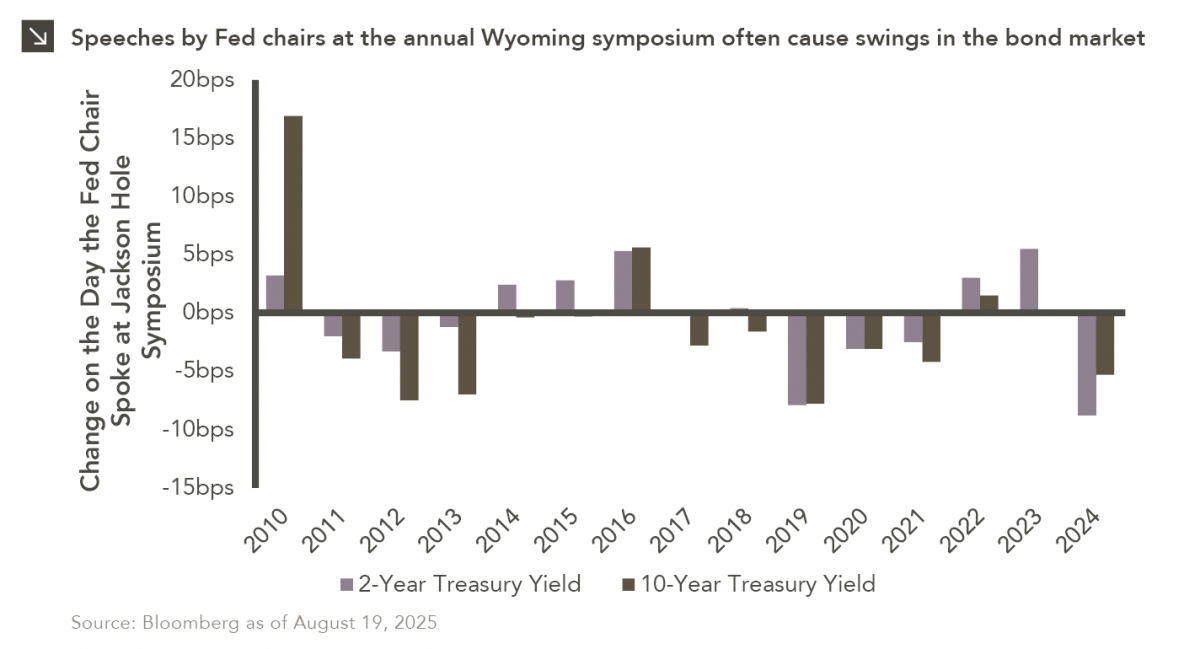
Predictions that the Federal Reserve is set to lower interest rates will be put to the test this week as Chair Jerome Powell prepares to outline his view of the economy at the central bank’s annual symposium in Jackson Hole, Wyoming. Most anticipate a more dovish tone from Powell in his remarks on Friday due to weakening labor market dynamics, though recent inflation figures have tempered some of that optimism. While a monetary policy decision will not be made at the Jackson Hole symposium, Powell’s comments are sure to provide insight into what might occur at the Fed’s September meeting, at which there is an 85% chance of a 25 basis point rate cut according to prediction markets. All told, the central bank has three remaining opportunities to make changes to its policy rate in 2025.

Comments from Fed chairs at Jackson Hole have proven significant in the past. For instance, Powell warned that controlling inflation would require economic pain in his speech three years ago, and these remarks sent short-term yields higher. Additionally, at last year’s symposium, he indicated that the Fed was prepared to lower borrowing costs from multi-decade highs, triggering a sharp drop in both the 2- and 10-year Treasury. Yields have retreated across most maturities in recent weeks following a lackluster July jobs report, with the 2-year yield now hovering around 3.75%, meaning a material reaction to Powell’s speech could send short-term yields to multi-year lows.

In the weeks ahead, attention will shift from Jackson Hole to the August jobs report, which could solidify expectations for an interest rate reduction in September. Investors should note, however, that monetary easing would come at a time when inflation remains above target and fiscal stimulus from the Trump administration’s recent spending package looms large. Those dynamics, combined with concerns about political interference at the Fed and recent changes in leadership at the Bureau of Labor Statistics, could lead investors to demand higher compensation for holding longer-dated Treasuries.

Treasury Market Creates a Balancing Act

Despite the U.S. economy’s impressive growth in recent decades, the federal government currently faces elevated borrowing costs to fund its persistent budget deficits. While current bid-to-cover ratios remain robust in absolute terms, a declining trend in shorter maturities could represent one early warning sign that the traditional investor base demand is waning.

This newsletter examines the Treasury’s challenge of balancing funding costs with market demand and potential fiscal and monetary policy implications.

Looking Across the Capital Stack

Despite allocations to various segments of corporate capital structures, most balanced portfolios have a degree of overlap when it comes to sector exposure across equities and fixed income. Still, key differences across the sector exposures of the U.S. equity and corporate bond markets are worth detailing. The extent to which the S&P 500 Index, which serves as a representation of the domestic large-cap stock market, is exposed to the Information Technology space has been described at length, with that sector comprising roughly one-third of the benchmark. This reflects the growth-oriented nature of the equity landscape, which Information Technology and similar sectors (e.g., Communication Services) have dominated due to higher earnings growth and extremely positive sentiment. In contrast, the Bloomberg Investment Grade Corporate Bond Index maintains a 34% weight to the Financials sector, with relatively balanced exposure to spaces like Health Care (11%), Utilities (10%), and Communication Services (7%). This dynamic reflects the capital-intensive nature of these sectors, which are comprised of companies that tend to issue more debt and are considered safer from a credit perspective. Finally, the Bloomberg High Yield Corporate Bond Index is most exposed to the Consumer Discretionary (23%) and Communication Services (15%) spaces, which are more sensitive to economic cycles and, thus, typically offer higher yields to compensate for higher risk.

The varied sector exposures for these indices are reflected in historical return correlation data. On a since-inception basis, the S&P 500 Index has exhibited correlations of 0.40 and 0.63 with the Investment Grade Corporate Bond and High Yield Corporate Bond indices, respectively. These figures suggest that while equities and bonds can move together at times, the asset classes often behave differently. Importantly, these correlations are not static. Rather, they tend to rise during periods of market stress when asset classes often move in tandem due to broad risk-off sentiment. Under normal market conditions, however, the differences in the sector compositions of these indices allow for diversification benefits in a balanced portfolio.

By combining equities with both investment grade and high yield corporate bonds, investors gain exposure to a broader mix of U.S. businesses across sectors and asset classes. This dynamic can help market participants mitigate the impact of sector-specific downturns, making a balanced portfolio more resilient in varying economic environments.

2025 Halftime Market Insights

This video is a recording of a live webinar held July 17 by Marquette’s research team analyzing the first half of the year across the economy and various asset classes as well as themes we’ll be monitoring through the rest of 2025.


Our quarterly Market Insights series examines the primary asset classes we cover for clients including the U.S. economy, fixed income, U.S. and non-U.S. equities, hedge funds, real assets, and private markets, with commentary by our research analysts and directors.

Featuring:
Greg Leonberger, FSA, EA, MAAA, FCA, Partner, Director of Research
Frank Valle, CFA, CAIA, Associate Director of Fixed Income
James Torgerson, Senior Research Analyst
Catherine Hillier, Senior Research Analyst
David Hernandez, CFA, Director of Traditional Manager Search
Evan Frazier, CFA, CAIA, Senior Research Analyst
Dennis Yu, Research Analyst
Amy Miller, Associate Director of Private Equity
Chad Sheaffer, CFA, CAIA Senior Research Analyst

Sign up for research alerts to be invited to future webinars and notified when we publish new videos.

If you have any questions, please send our team an email.

Policy Uncertainty Blurs the Outlook

As we enter the second half of the year, Liberation Day-induced market volatility seems like a distant memory with the S&P hitting another all-time high on July 10th and non-U.S. stocks significantly outpacing their U.S. counterparts through June 30th. Meanwhile, the One Big Beautiful Bill was signed into law by President Trump on July 4th with varying expectations on its impact to growth but a consensus view that it will push the deficit higher.

In this edition:

  • Tariff and policy uncertainty
  • Risk factors and market indicators
  • Equity market drivers
  • Currency and regional trends
  • What to watch in the second half

1Q 2025 Market Insights

This video is a recording of a live webinar held April 16 by Marquette’s research team analyzing the first quarter of 2025 (and recent weeks) across the economy and various asset classes as well as themes we’ll be monitoring in the coming months.

Our Market Insights series examines the primary asset classes we cover for clients including the U.S. economy, fixed income, U.S. and non-U.S. equities, hedge funds, real estate, infrastructure, private equity, and private credit, with presentations by our research analysts and directors.

Featuring:
Greg Leonberger, FSA, EA, MAAA, FCA, Partner, Director of Research
Frank Valle, CFA, CAIA, Associate Director of Fixed Income
Catherine Hillier, Senior Research Analyst
David Hernandez, CFA, Director of Traditional Manager Search
Evan Frazier, CFA, CAIA, Senior Research Analyst
Dennis Yu, Research Analyst
Hayley McCollum, Senior Research Analyst
Chad Sheaffer, CFA, CAIA Senior Research Analyst

Sign up for research alerts to be invited to future webinars and notified when we publish new videos.

If you have any questions, please send our team an email.


What’s Your Haven? | Who is the “Godfather” of the Bond Market?

No, you are not seeing double. This very special edition of our chart of the week series comes with an added bonus chart with the goal of highlighting key dynamics within fixed income markets that have been top of mind for investors in recent weeks. Read on and enjoy two charts for the price of one!


What’s Your Haven?

Fixed income has historically provided three benefits to investors: Income, diversification, and liquidity. U.S. Treasuries are a pure form of diversification given their limited risk with the 10-year Treasury serving as a bellwether, and these securities are viewed by many as safe havens during periods of market stress. Historically, Treasuries and equities have tended to exhibit low to negative correlations. However, much like returns and volatility, correlations are time-varying. For instance, the historical relationship between stocks and bonds broke down in the aftermath of the COVID-19 crisis, when accommodative monetary policy led to higher levels of inflation and the two asset classes moved in tandem. The same pattern took hold over the last few weeks amidst tariff-induced market volatility, with correlations between stocks and Treasuries increasing and hampering traditional diversification benefits. With Treasury rates recently trading like risk assets, there are other safe haven assets to which investors have turned for insulation against volatility.

Gold is often referred to as a safe haven asset given its status as a precious metal that is viewed as a store of value and a hedge against inflation. Over the last few years, gold has offered favorable diversification relative to risk assets with inflation running hot. It also tends to do well when fears are high. To that point, with the S&P 500 Index down more than 8% on a year-to-date basis, spot gold prices have risen from $2,625/oz to $3,312/oz.¹ All of this being said, gold is not necessarily a good investment as it does not provide cash flows and its price movements are largely driven by speculation. Additionally, the correlation of gold to equities fluctuates over time from somewhat positive to somewhat negative, with material variations over longer investment horizons.

Some currencies are also viewed as safe haven assets, with the classic example being the yen given Japan’s stable political system and ample liquidity. The yen has rallied with stocks down this year, moving from ¥157.20/$ to ¥142.66/$. Diversification benefits from the yen have historically been better than those provided by gold, but they have also waned somewhat in recent years. Currencies also suffer from some of the same issues as gold, including a lack of cash flows and price speculation. As such, most currencies are generally best used as tactical hedges as opposed to long-term portfolio constituents.

Diversification is a critical component of portfolio construction and while Treasuries have historically served as safe havens during market volatility, other assets have offered more compelling diversification benefits in recent weeks. However, the viability of these assets (i.e., gold and currencies) as outright replacements for Treasuries in portfolios is questionable given the points made above.

¹ Bloomberg as of April 16, 2025


Who is the “Godfather” of the Bond Market?

Current global trade tensions beg the question: Can foreign holders of U.S. debt manipulate the Treasury market? Indeed, some have speculated that China sold Treasuries to put upward pressure on yields last week to retaliate against the U.S. for its new tariffs (i.e., causing the U.S. to borrow at higher rates). This action, however, would likely be painful for China as well. If news of significant Treasury sales by China were to circulate, yields would likely spike, and the value of its remaining holdings would fall. The U.S. also has tools to combat such a move, including quantitative easing (i.e., bond purchases) designed to return yields to normal levels. Ultimately, a retaliatory Treasury sale would be a huge risk to China, not to mention the fact that China’s holdings tend to be of a shorter nature and recent pressure has mostly been on the long end of the curve (which sold off by around 50 basis points last week). Might another country be responsible for this movement?

While some Japanese politicians have lobbied for using its country’s Treasury holdings as a tool in trade negotiations, the ruling party has repeatedly emphasized that Japan should not sell its Treasuries to rile the United States. So, while Japan has indeed been a notable seller of U.S. Treasuries in recent weeks, these sales have likely been influenced by other factors. For instance, Japanese life insurers are major holders of long-dated U.S. Treasuries, and these entities could be rotating out of Treasuries given a cautious stance on U.S. policy. Another potential reason for recent sales is Japanese pension plans rotating into European bonds.

In summary, technical signals from non-U.S. investors can certainly influence the Treasury market, but it is unlikely that these players could engage in outright market manipulation. At the end of the day, the Federal Reserve can pull strings to combat Treasury-related turmoil and remains the godfather of the bond market.

Bracing for Stagflation

As markets swirl and stagflation fears mount, what should investors do?
Our newsletter last week outlined the broad context of President Trump’s new tariff policy as well as the most notable market impacts. Granted, the news seems to change daily, as does the market’s reaction; trying to pen a targeted newsletter is an almost worthless endeavor because by the time the ink has dried, markets have shifted due to another policy pivot. In the short term, the omnipresent cloud of uncertainty will continue to drive market volatility and investor sentiment. The best recipe for investors to weather this storm is patience and discipline, both of which can be difficult to come by in the current environment.

As we step back and take a longer-term view of the future, however, the threat of stagflation is becoming more realistic. Coined as a combination of the words “stagnation” and “inflation,” it is an economic backdrop characterized by high inflation, slow economic growth, and in some cases, high unemployment.

In this edition, we examine which asset classes are most exposed to stagflation and which can offer shelter.

Trade Turmoil: Assessing the Impact of Tariffs on Markets, the Economy, and Investors

The global trade landscape has been significantly reshaped by a series of aggressive tariffs initiated by President Donald Trump. These measures have elicited strong reactions from market participants and U.S. trade partners alike, leading to elevated levels of market volatility, souring economic sentiment, and strained diplomatic relations. While the situation is ongoing with major developments seemingly arising each day, this paper aims to summarize the events that have led to this point, detail the impact of the trade war on global markets, and provide commentary on what investors might expect in the months ahead.

The Debt and Deficit Dilemma

The new year brings a new political administration with fresh approaches and drastically different perspectives on topics ranging from immigration to foreign policy. As the Biden era exits and another Trump era begins, federal spending and the deficit persists. Borrowing began with financing the Revolutionary War, and it is as American as baseball and apple pie. The national debt clock in Manhattan has a massive figure of over $36 trillion that is owed by the government to holders of Treasuries. Talks of the deficit and debt ceiling emerge every year and politicians put off the issue rather than finding ways to reduce borrowing by increasing taxes and/or reducing spending. Will there ever be any repercussions to running such a high deficit?

While you will never see an explicit bill from the government with your family’s share due, there is a limit to the amount the U.S. can borrow without any consequences. This paper will give the reader an anatomy of the deficit and debt, consequences of running such a high deficit, and summary of the high-level solutions that have been proposed.