New Year, New President…Same Outlook?

From an investor’s perspective, the current environment feels lot like it did twelve months ago: U.S. equity markets returned over 20% the prior year, fixed income is (still) offering attractive yields, and overall portfolio performance was positive for most programs. Nevertheless, nothing lasts forever and sentiment can shift on a dime. It is also likely that some of President Trump’s policies will have an impact on markets, with the specific impact varying by the policy and asset class.

In this edition:

  • U.S. Economy and Policy Expectations
  • Fixed Income: “If you liked it last year, you’ll like it this year”
  • U.S. Equity: Concentration risk still looms
  • Non-U.S. Equities: Positive earnings outlook, policy uncertainty
  • Real Assets: Real estate bottoms, infrastructure demand robust
  • Private Markets: Private equity on the rebound, private credit still compelling

2025 Market Preview Video

This video is a recording of a live webinar held January 16 by Marquette’s research team analyzing 2024 across the economy and various asset classes as well as themes we’ll be monitoring in 2025.

Our Market Insights series examines the primary asset classes we cover for clients including the U.S. economy, fixed income, U.S. and non-U.S. equities, hedge funds, real estate, infrastructure, private equity, and private credit, with presentations by our research analysts and directors.

Featuring:
Greg Leonberger, FSA, EA, MAAA, FCA, Partner, Director of Research
Frank Valle, CFA, CAIA, Associate Director of Fixed Income
James Torgerson, Research Analyst
Catherine Hillier, Senior Research Analyst
David Hernandez, CFA, Director of Traditional Manager Search
Evan Frazier, CFA, CAIA, Senior Research Analyst
Dennis Yu, Research Analyst
Michael Carlton, Research Analyst
Chad Sheaffer, CFA, CAIA Senior Research Analyst

Sign up for research alerts to be invited to future webinars and notified when we publish new videos.

If you have any questions, please send our team an email.

Multi-Asset Credit: Taking Offense From Good to Great

Before the football season began, we authored a white paper that detailed offensive and defensive elements of a fixed income portfolio. For most investors, an aggregate (core) mandate provides defense while strategic allocations to high yield, senior secured loans, and emerging market debt (EMD) are the primary sources of offense. Relative to an aggregate benchmark, this structure has outperformed over market cycles. However, just as championship teams adjust and innovate throughout a season, so too should an investor’s portfolio.

Multi-Asset Credit (MAC) strategies are single portfolios that dynamically allocate across a broad range of global credit markets to provide higher levels of income and a diversity of fixed income exposures. These mandates can serve as a single-solution credit allocation or as a credit alpha overlay in the context of a broader credit portfolio. There is no perfect definition of MAC, but what they do offer is diversification, flexibility, and ease of access and operations. While these markets are not new, investors may be unfamiliar with the mechanics of a MAC strategy and its potential benefits.

This newsletter provides an overview of MAC, including the opportunity set, allocation structure and considerations, diversification benefits, and sample MAC manager performance.

3Q 2024 Market Insights

This video is a recording of a live webinar held October 23 by Marquette’s research team analyzing the third quarter of 2024 across the economy and various asset classes and themes we’ll be monitoring over the remainder of the year.

Our quarterly Market Insights series examines the primary asset classes we cover for clients including the U.S. economy, fixed income, U.S. and non-U.S. equities, hedge funds, real assets, and private markets, with commentary by our research analysts and directors.

Sign up for research alerts to be invited to future webinars and notified when we publish new videos.

If you have any questions, please send our team an email.

Are You Ready for Some Fixed Income?

As the leaves change to autumn and the authors cheer on their Fighting Leathernecks, fall is the perfect time for investors to reassess their fixed income portfolios. Fixed income is a hybrid security that offers both offensive and defensive properties. Much like a good football team, a fixed income portfolio needs to combine a strong offense with a solid defense.

Some strategies provide more offensive characteristics while others are more defensive. Portfolios with too much offense act like the Greatest Show on Turf. They do well when the economy is strong, but falter in down markets. Conversely, a fixed income portfolio that is overly reliant on defensive strategies will do well in a risk-off environment but will struggle in a strong economy like the Super Bowl Shufflin’ ’85 Bears.

While those were great teams, they were not a dynasty that stood up to the test of time. To build an all-weather fixed income portfolio that will perform in multiple market environments, an investor needs to balance offense and defense.
Fixed income has three primary objectives: income, diversification, and liquidity. Income, or yield, is what an investor is paid for loaning money to another entity. Fixed income helps to diversify portfolios primarily through duration. When risk assets are selling off, interest rates are generally falling. Duration is what drives fixed income prices higher in such scenarios. Finally, fixed income assets can be a source of liquidity. The weight of these qualities is dependent on if the strategy is more offensive- or defensive-minded.

This white paper outlines offensive and defensive fixed income characteristics and strategies and considerations for investors when building a “gameplan” for their fixed income allocation.

Keep Your Eye on the Ball

When it comes to baseball, successful hitters have little trouble hitting the ball when they know what pitch is coming. But when pitchers can vary the speed as well as the spin and curve of the ball, hitting becomes exponentially more difficult. An effective curveball can make even the most accomplished hitter look feeble.

As we look at the second half of 2024, we are reminding our clients to “keep their eye on the ball.” Indeed, the first half of the year has been pretty “hittable” as far as returns are concerned, with the majority of asset classes positive through June 30. However, curveballs such as Fed policy, equity index concentration, exchange rates, and a capricious election could quickly flip the script and send investors back to the dugout shaking their heads.

With that said, here is our scouting report for the second half of the year, organized by asset class. We share not only “down the middle” themes but also the curveballs that could flummox performance. A well-prepared investor is no different than a well-prepared baseball player: Insight and realistic expectations provide the foundation for a successful season!

2024 Halftime Market Insights

This video is a recording of a live webinar held July 23 by Marquette’s research team analyzing the first half of 2024 across the economy and various asset classes and themes we’ll be monitoring over the remainder of the year.

Our quarterly Market Insights series examines the primary asset classes we cover for clients including the U.S. economy, fixed income, U.S. and non-U.S. equities, hedge funds, real assets, and private markets, with commentary by our research analysts and directors.

Sign up for research alerts to be invited to future webinars and notified when we publish new videos.

If you have any questions, please send our team an email.

The Capital Structure Shuffle

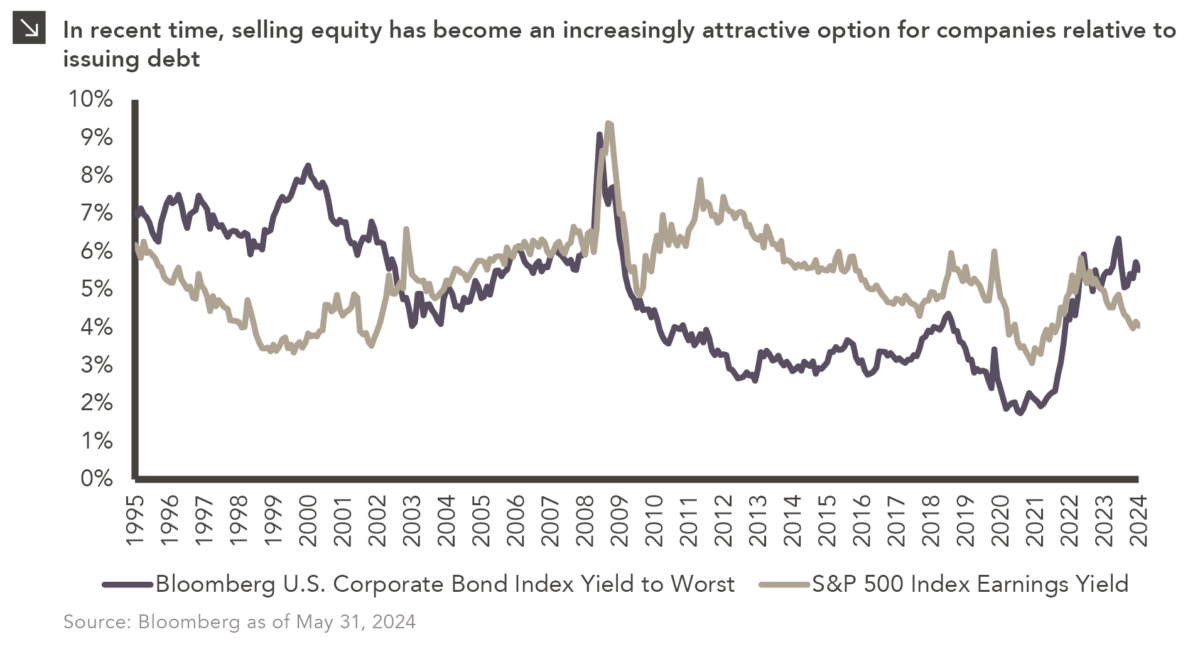
In the years following the Global Financial Crisis, issuing new debt was an easy decision for companies looking to raise capital given an environment of historically low interest rates. That said, decisions related to the composition of corporate capital structures are now less straightforward due to seismic shifts in monetary policy that have taken place in recent time. To that point, this week’s chart compares the yield-to-worst of the Bloomberg U.S. Corporate Bond Index, a proxy for the cost of debt, to the earnings yield of the S&P 500 Index. The earnings yield is calculated by dividing earnings-per-share by the price of the index and is used as a proxy to determine the costs companies face when it comes to new equity share issuance (i.e., the lower the earnings yield, the cheaper it is to sell shares and vice versa). As readers can observe in the chart above, this yield now sits below the yield-to-worst of the fixed income index.

Companies generally prefer issuing debt over equity due to the tax shield associated with this financing (i.e., interest expenses are typically tax-deductible), which still renders debt the more cost-efficient option for many companies in the current environment. Further, equity issuance is often viewed negatively by market participants due to the dilution of per-share earnings that arises as a result.  There are, of course, additional factors beyond the costs of debt and equity that CFOs must consider when making decisions related to capital structure dynamics. That said, in light of the trends outlined above, many companies may begin to view equity issuance as a more attractive option when it comes to raising capital.

1Q 2024 Market Insights Video

This video is a recording of a live webinar held April 25 by Marquette’s research team analyzing the first quarter of 2024 across the economy and various asset classes and themes we’ll be monitoring in the coming months.

Our quarterly Market Insights series examines the primary asset classes we cover for clients including the U.S. economy, fixed income, U.S. and non-U.S. equities, hedge funds, real assets, and private markets, with commentary by our research analysts and directors.

Sign up for research alerts to be invited to future webinars and notified when we publish new videos. If you have any questions, please send us an email.

Mind the Gap

Any ride on the London Tube reminds riders to mind the gap: Beware the space between train car and platform as you board and depart the train. A recent trip to London brought this phrase back to me and it seemed like a perfect description of how to look at financial markets this year, with the “gap” serving as the difference between expectations and reality, most particularly in terms of interest rate cuts.

In our market preview, we identified the Fed pivot as a primary driver of financial markets this year, most especially how expectations of cuts would line up with actual Fed policy. Going into the year, the market had priced in at least five cuts, which helped fuel a furious fourth quarter rally and investor optimism for 2024. One quarter in, however, those expectations have been turned on their head. Hotter than expected inflation and jobs reports in March have created a “higher for longer” narrative with the market expecting no more than two cuts during the second half of the year. Some economists have taken an even more bearish stance, suggesting there will not be any cuts. Overall, rates rose across the curve during the quarter as current U.S. debt levels sustained the long end of the curve while the short end was relatively unmoved.

Intuitively, many investors would expect such a big change in rate expectations to weigh heavily on markets, both equities and bonds. In that sense, equity performance was surprising during the first quarter, as the upward trend from 2023 continued. Predictably, bonds suffered as rates rose, but below investment grade sectors were profitable. To be fair, though, it should be noted that equities have endured a difficult start to this month, down 4.6% through April 22 as the higher for longer narrative has gained momentum.¹

Going forward, what should we watch for from asset classes as we venture into a market environment that looks much different than what we were expecting only three months ago?