The Currency Conundrum

The U.S. dollar is the strongest it has been in a generation. The U.S. dollar index is up almost 11% this year against a basket of global reserve currencies with the greenback reaching parity with the euro last week for the first time since 2002. Like many things in financial markets, interest rates tend to be one of the most significant drivers of currency valuation, specifically the interest rate differentials between global central banks. As the Federal Reserve has pivoted to a more hawkish stance to tame decades-high inflation, other central banks, including the ECB and BOJ, have been slower to respond. When capital can flow freely, investors tend to flock to higher-yielding assets as interest rates rise, which leads to appreciation of the higher-interest rate country’s financial account and increases demand for the domestic currency — in this case, the U.S. dollar.

The Japanese yen is down roughly 16% year-to-date and is the worst performing major currency relative to the U.S. dollar. In an effort to fight decades-long deflation, the Bank of Japan has committed to holding down short-term interest rates, resulting in significant currency devaluation. Japan is the largest foreign holder of U.S. Treasuries, with $1.3 trillion as of January 2022. As the U.S. dollar strengthens, it becomes more expensive for Japan to continue to purchase on-the-run Treasury issuances, which could put further upward pressure on U.S. rates at the same time the Fed is lifting the benchmark fed funds rate and engaging in quantitative tightening. The question of what will happen when the two largest buyers of U.S. Treasuries — the Federal Reserve and the Bank of Japan — both remove liquidity from the market is another unknown that could add to market volatility in the near term.

Print PDF > The Currency Conundrum


The opinions expressed herein are those of Marquette Associates, Inc. (“Marquette”), and are subject to change without notice. This material is not financial advice or an offer to purchase or sell any product. Marquette reserves the right to modify its current investment strategies and techniques based on changing market dynamics or client needs.

Halftime Market Outlook: A Mixed Bag

Last week, we hosted our “Halftime” Market Insights Webinar. As the host, my job was to introduce the analyst for each section and then summarize his or her comments before moving to the next speaker. After the fourth section, I found myself using the term “mixed bag” for the third time; it was at that moment that I knew I had my title for this letter!

Of course, “mixed bag” is an overused and unoriginal cliché to describe a perspective that features both positive and negative elements. If we focus solely on the first half of the year, it is hard to find much good news at all between negative economic growth, historically high inflation, and hefty losses in both the equity and bond markets. Even the good news is rooted in how bad things are…after all, how much longer can inflation stay above 9%? Could the equity market REALLY drop another 20% the second half of the year? Alas, our “mixed bag” descriptor admittedly relies on the assumption that conditions should improve at least somewhat for the remainder of the year, though likely not enough to reverse the damage inflicted during the first half. On an absolute and relative basis, growth and return figures should be better, but it is naïve to think that all of the bad news is behind us.

In this edition:

  • Inflation expectations
  • Consumer and business sentiment
  • The S&P 500’s worst six-month start to a year since 1970
  • Recession probability
  • The Agg’s worst start to a year ever
  • Bonds go back to being bonds

Read > Halftime Market Outlook: A Mixed Bag


The opinions expressed herein are those of Marquette Associates, Inc. (“Marquette”), and are subject to change without notice. This material is not financial advice or an offer to purchase or sell any product. Marquette reserves the right to modify its current investment strategies and techniques based on changing market dynamics or client needs.

2022 Halftime Market Insights Video

This video is a recording of a live webinar held July 20th by Marquette’s research team, featuring in-depth analysis of the first half of 2022 and risks and opportunities to monitor in the coming months.

Our Market Insights series examines the primary asset classes we cover for clients including the U.S. economy, fixed income, U.S. and non-U.S. equities, hedge funds, real estate, infrastructure, private equity, and private credit, with presentations by our research analysts and directors.

Sign up for research alerts to be notified when we publish new videos and invited to future webinars.
For more information, questions, or feedback, please send us an email.

Fair or Free?

While developed economies across the globe are struggling with historical levels of inflation, the European Union and its 27 constituent nations are facing extraordinary economic challenges related to energy costs and security amid the ongoing Russia–Ukraine conflict. Against this backdrop, Germany posted its first monthly trade deficit in more than 30 years. Following the adoption of the euro in 2002, Germany built its economy around the cheap common currency, using its relative cost advantage to grow via exports. The country’s trade surplus expanded over the next several years, hitting a peak of more than 7% of GDP in 2017. Today, in the face of higher prices for vital imports like food and energy, and with supply chain disruptions impacting trade, that trade surplus has collapsed to a deficit. The Russia–Ukraine war has changed longstanding dynamics in the region and will likely have far-reaching implications, with one in four jobs in Germany reliant on the export market. With central banks around the world focused on controlling inflation, the risk of recession has continued to rise, with the outlook in Germany and broader Europe even more challenged following this latest data point.

Print PDF > Fair or Free?


The opinions expressed herein are those of Marquette Associates, Inc. (“Marquette”), and are subject to change without notice. This material is not financial advice or an offer to purchase or sell any product. Marquette reserves the right to modify its current investment strategies and techniques based on changing market dynamics or client needs.

Flirting With a Bear Market: How Did We Get Here, and What Comes Next?

Quite simply, this has been the worst start to a year since the 1930s:

  • One of only 19 quarters since 1976 when both bonds and stocks posted negative returns;
  • One of only six of those quarters when bonds have underperformed stocks;
  • The worst four-month return for the S&P 500 since 1939.

2022 to date has featured a myriad of macroeconomic factors coming to a head: inflation at its highest level since the 1980s, the Federal Reserve responding with aggressive rate hikes, and increasing concerns about the health of the consumer leading to a possible recession. An evolving pandemic, a war in Eastern Europe, and draconian lockdown policies in the world’s second-largest economy and largest manufacturing hub have further added to the problem and complicated the solution. With these macro headwinds and uncertainties driving markets year-to-date, Marquette’s fixed income, U.S. equities, and non-U.S. equities teams discuss the impacts on their asset classes and weigh in on the outlook from here.

Read > Flirting With a Bear Market: How Did We Get Here and What Comes Next?


The opinions expressed herein are those of Marquette Associates, Inc. (“Marquette”), and are subject to change without notice. This material is not financial advice or an offer to purchase or sell any product. Marquette reserves the right to modify its current investment strategies and techniques based on changing market dynamics or client needs.

Looking for Sunshine

Here in Chicago, it has been a harsh spring. Below-average temperatures. Unrelenting rain. Snow flurries. Incessant clouds. Not the spring anyone was hoping for.

Investors would tell you the same thing, for different reasons. Stock market down 10% year to date.¹ Inflation at 8.5%, the highest in over 30 years. Bonds — the safe haven play in times of market volatility — down 9.5% year to date.² The ongoing conflict in Ukraine increasingly looks like a grinding war of attrition. Temporary yield curve inversion. Fed policy designed to slow inflation, though potentially at the expense of growth; either way, interest rates have more room to run. Not a lot of sunshine, indeed.

However, as April turns to May… hope springs eternal. Not all is lost for the year, and while most would agree that equity markets have not fully re-priced yet, there are hints — not unlike perennials sprouting each spring — that the worst of the market drop is behind us. Over time, markets have proven resilient and while the exact timing of market reversal is impossible to precisely call, one can look for signs of optimism. Here are some of the most compelling hints that we see.

In this edition:

  • Inflation
  • Yield curve inversion
  • War-driven market volatility
  • Earnings estimates
  • Opportunities for active managers

Read > Looking for Sunshine

Watch our Q1 2022 Market Insights Video for an in-depth analysis of the first quarter’s performance by Marquette’s research team.


The opinions expressed herein are those of Marquette Associates, Inc. (“Marquette”), and are subject to change without notice. This material is not financial advice or an offer to purchase or sell any product. Marquette reserves the right to modify its current investment strategies and techniques based on changing market dynamics or client needs.

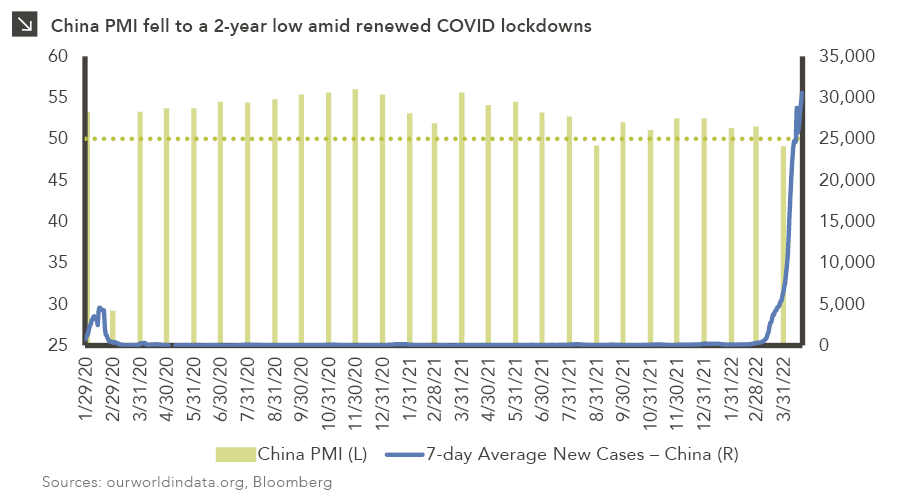
Lockdowns Lead to Slowdown

COVID cases have been on the rise in China over the last ten weeks, surpassing February 2020 highs by 800%. The seven-day rolling average has moved from 110 new cases at the end of January 2022 to a high of 30,500 on April 21st. Since the beginning of the pandemic, China has operated with a zero-COVID policy, combining testing and tracing with the use of lockdowns to prevent the spread of the virus. These measures have resulted in an extremely low case count compared to the rest of the world. The country’s recent high near 30,000 is still well below the U.S. seven-day average peak of 800,000 in January 2022.

China’s aggressive use of lockdowns to control the spread of the virus has impacted the country’s economic activity. March’s Purchasing Managers Index (PMI) reading was 48.8, below the neutral 50 mark, indicating a contraction in economic activity. Several Chinese cities are feeling the pressures of the recent lockdown, including Shanghai, a key finance and manufacturing hub. Many investors expect Chinese authorities to step in with supportive policies to help the country navigate the current downturn. Ultimately, however, China may need to choose between two of its seemingly opposing agenda items — its zero-COVID policy and its 5.5% target growth rate — with the choice likely to have material implications for equity markets for the rest of 2022.

Print PDF > Lockdowns Lead to Slowdown


The opinions expressed herein are those of Marquette Associates, Inc. (“Marquette”), and are subject to change without notice. This material is not financial advice or an offer to purchase or sell any product. Marquette reserves the right to modify its current investment strategies and techniques based on changing market dynamics or client needs.

Q1 2022 Market Insights Video

This video features an in-depth analysis of the first quarter’s performance by Marquette’s research team, reviewing general themes from the quarter and risks and opportunities to monitor in the coming months.

 Our Market Insights series examines the primary asset classes we cover for clients including the U.S. economy, fixed income, U.S. and non-U.S. equities, hedge funds, real estate, infrastructure, private equity, and private credit, with presentations by our research analysts and directors.

Sign up for research alerts to be notified when we publish new videos here.
For more information, questions, or feedback, please send us an email.

Could Conflict Spur an Energy Revolution?

Now one month into the Ukrainian crisis, investor concerns about the knock-on effects of war, higher energy costs, and generally prolonged, heightened inflation have hit a crescendo. Europe’s natural gas benchmark, the Dutch TTF, has been extremely volatile, at one point spiking to more than ten times last spring’s levels. The European Union relies heavily on Russian natural gas. According to the International Energy Agency, in 2021, the EU imported 155 billion cubic meters of natural gas from Russia, comprising roughly 45% of European Union gas imports and close to 40% of total gas consumption. Russia’s invasion of Ukraine has underscored the risks of Europe’s dependence on Russian gas imports and prompted the European Commission to take action.

Beyond halting approval of Nord Stream 2, a set of offshore natural gas pipelines from Russia to Germany, at the outset of the conflict, the European Commission has now vowed to curtail the EU’s usage of Russian natural gas, with a target of reducing imports by two thirds by the end of the year. To make up the difference, the Commission will increase gas and liquefied natural gas (LNG) imports from other countries and phase in alternative gases like hydrogen and biomethane. The U.S. has answered this call, with the Biden administration authorizing additional exports of LNG from two major facilities on the U.S. Gulf Coast. The Commission is also looking to accelerate the transition to renewable energy. In particular, the EU will accelerate its “Fit for 55” rule, deploying a massive campaign of electrification, expansion of renewables and electricity storage, development of green hydrogen tech, and investment in energy efficiency measures. While these longer-term initiatives will take several years to come to pass, the composition of energy sources, at least in Europe, should have a stronger, greener future as a result.

Print PDF > Could Conflict Spur an Energy Revolution?


The opinions expressed herein are those of Marquette Associates, Inc. (“Marquette”), and are subject to change without notice. This material is not financial advice or an offer to purchase or sell any product. Marquette reserves the right to modify its current investment strategies and techniques based on changing market dynamics or client needs.

The Rising Possibility of Recession

Over the last several weeks, the risk of an economic downturn in the United States has increased with inflation continuing higher, Russia’s invasion of Ukraine triggering unprecedented sanctions, and the Fed beginning its rate hiking cycle. While inflation and the anticipation of rising rates have been driving markets for several months, the invasion of Ukraine in February and the resultant economic sanctions on Russia have added a new dynamic to the equation, driving up commodity inflation and making the Fed’s job of controlling pricing pressures without triggering an economic slowdown even trickier. With many U.S. stock indices dipping into correction territory this year, every new data point and indicator will be heavily scrutinized.

In this newsletter we examine these dynamics and try to provide perspective as it relates to the current market environment.

Read > The Rising Possibility of a Recession


The opinions expressed herein are those of Marquette Associates, Inc. (“Marquette”), and are subject to change without notice. This material is not financial advice or an offer to purchase or sell any product. Marquette reserves the right to modify its current investment strategies and techniques based on changing market dynamics or client needs.