An Investor’s Holiday Wish List

Hopefully not another year of coal
In the spirit of holiday fun — and an effort to put 2022 investment returns behind us — we have put together our investor wish list for 2023. We have broken the wish list into two categories: the “must-haves,” which carry the most weight and are most observable, and the “stocking stuffers,” which may not be headline grabbers but are nonetheless impactful across economies and markets. Predictably, the “must-have” items focus on a reversal of the major trends that drove the markets this year; we “must have” a better outlook across at least some of these topics. The “stocking stuffers” category is a variety of topics that either directly impact the major trends from 2022 or are more targeted with their impact on specific asset classes. And while we recognize this is not an exhaustive list, we feel strongly that if these wishes come true we can all feel better about market returns in 2023.

This year’s must-haves:

  • Lower inflation
  • Less aggressive Fed policy leads to fewer interest rate hikes in 2023
  • Avoid a deep recession
  • Resolution of geopolitical conflicts

And stocking stuffers:

  • Broad-based earnings in the U.S. stock market
  • A weaker U.S. dollar
  • Credit defaults start to flatline
  • Slowdowns in hiring and wage growth
  • Favorable news out of China
  • History repeats itself

Read > An Investor’s Holiday Wish List


The opinions expressed herein are those of Marquette Associates, Inc. (“Marquette”), and are subject to change without notice. This material is not financial advice or an offer to purchase or sell any product. Marquette reserves the right to modify its current investment strategies and techniques based on changing market dynamics or client needs.

International Equities: Waitin’ on a Sunny Day

In recent years, international stocks have underperformed their domestic counterparts by a significant margin. Specifically, the MSCI ACWI ex-US index has compounded annual returns at just 3.3% over the last decade through the end of October, compared to an annualized return of 12.8% for the S&P 500 index. This current stretch marks the longest period of relative outperformance on a trailing 5-year basis for either index since the early 2000s.

This newsletter examines a host of factors that have contributed to this pattern of performance, including differences in composition between U.S. and international equity indices, currency movements, and geopolitics and analyzes the diversification benefits of international equity allocations within portfolios despite performance challenges.

Read > International Equities: Waitin’ on a Sunny Day


The opinions expressed herein are those of Marquette Associates, Inc. (“Marquette”), and are subject to change without notice. This material is not financial advice or an offer to purchase or sell any product. Marquette reserves the right to modify its current investment strategies and techniques based on changing market dynamics or client needs.

Emerging Markets: Why Your Active Manager May Be Underperforming

2022 has been a challenging year for investors as both bonds and equities have produced substantial losses. This unusual environment is the product of a kaleidoscope of macro headwinds that have unfolded throughout the year. Against this backdrop, active emerging markets equity managers have generally failed to protect to the downside, with the average manager underperforming the index year to date through September.

There are several potential reasons why active managers have struggled in 2022. The Russian invasion of Ukraine in February caught most market participants off guard and resulted in substantial losses. China’s underperformance relative to the broader index has also served as a headwind for many investors. China is the largest exposure in the MSCI EM Index at 31% and has been challenging for managers to navigate this year given the country’s Zero-COVID Policy, property sector struggles, and negative investor sentiment amid geopolitical tensions. And lastly, the factor environment has dramatically shifted this year, with both Growth and Quality underperforming the broad benchmark. This newsletter further explores the impact that the underperformance of Quality has had on active manager returns this year.

Read > Emerging Markets: Why Your Active Manager May Be Underperforming


The opinions expressed herein are those of Marquette Associates, Inc. (“Marquette”), and are subject to change without notice. This material is not financial advice or an offer to purchase or sell any product. Marquette reserves the right to modify its current investment strategies and techniques based on changing market dynamics or client needs.

Chinese Equities Down 17% in October

2022 has been a difficult year for Chinese equities, which are now down 43% year-to-date through October. In comparison, the MSCI Emerging Markets (EM) ex China Index is down 23% over the same period, while the MSCI World Index, a developed markets benchmark, is down 20%. It has been a seesaw year so far as Chinese equities underperformed in the first quarter, down 14% while the EM ex China index lost 3%. In the second quarter, China was one of the few countries to generate a positive return (+3%) as the EM ex China benchmark declined 18%. In the third quarter, the China index was down sharply again – -22% – with the sell-off carrying into October as other markets globally rebounded. China was down 17% in October – the worst month for the country benchmark in 11 years.

Over the course of the year there have been three key challenges to Chinese equities: 1) continuation of the zero-COVID policy, 2) property sector troubles, and 3) geopolitical issues. For most of the year, markets have reacted to various news and events centered on these three topics. More recently, markets turned sharply negative following the country’s Party Congress where President Xi Jinping was elected to an unprecedented third term and further consolidated power within the newly elected governing body. While there were hopes that the focus would shift to the economy following the Party Congress, President Xi went on to reaffirm China’s zero-COVID policy, casting a shadow over future economic growth. Chinese equities fell 8% the day after the Party Congress concluded, ending the month down 17%. Trailing and forward price-to-earnings multiples now sit close to twenty-year lows. From here, markets are likely to remain choppy, presenting both risks and opportunities to investors, until there is additional clarity regarding China’s zero-COVID policy and property sector, as well as broader geopolitical issues and China’s intentions.

Print PDF > Chinese Equities Down 17% in October


The opinions expressed herein are those of Marquette Associates, Inc. (“Marquette”), and are subject to change without notice. This material is not financial advice or an offer to purchase or sell any product. Marquette reserves the right to modify its current investment strategies and techniques based on changing market dynamics or client needs.

Q3 2022 Market Insights Video

This video is a recording of a live webinar held October 27th by Marquette’s research team, featuring in-depth analysis of the third quarter of 2022 and risks and opportunities to monitor in the coming months.

Our Market Insights series examines the primary asset classes we cover for clients including the U.S. economy, fixed income, U.S. and non-U.S. equities, hedge funds, real estate, infrastructure, private equity, and private credit, with presentations by our research analysts and directors.

Sign up for research alerts to be invited to future webinars and notified when we publish new videos.
For more information, questions, or feedback, please send us an email.

It’s Always Darkest Before the Dawn

Diversification has been said to be the only free lunch in investments. Since the inception of the Lehman/Barclays/Bloomberg Aggregate index,¹ there have been only 18 of 187 quarters (9.6% frequency) with negative returns in both the bond and equity markets, as measured by the Aggregate and S&P 500 indices, respectively. Comparable results are seen in the monthly data: Of 561 months, only 83 times did both the fixed income and equity markets deliver a negative total return (15.2% frequency). Over the last 45+ years, there has never been a calendar year that recorded negative returns in both indices, though that looks likely to change this year.

This newsletter analyzes 2022’s equity and bond market performance and the importance of diversification and discipline amid such negative momentum.

Read > It’s Always Darkest Before the Dawn

¹Actual data goes back to 1986; backfilled data back to 1976


The opinions expressed herein are those of Marquette Associates, Inc. (“Marquette”), and are subject to change without notice. This material is not financial advice or an offer to purchase or sell any product. Marquette reserves the right to modify its current investment strategies and techniques based on changing market dynamics or client needs.

Fighting Fire with Oil

Lower oil prices, primarily via lower gasoline prices, were a key contributor to headline CPI moving off peak in July and August. Since late September, however, oil and gasoline prices have started to rise again. In early October, OPEC+ — comprised of the 13 OPEC members and 10 additional major oil-exporting countries, including Russia — agreed to steep oil production cuts, decreasing supply in an already stressed market. The total production cut is estimated to be around 2 million barrels per day (bpd), approximately 2% of global supply and the biggest production cut since the start of the COVID pandemic.

The move is expected to prop oil prices back up — as similar production cuts have done historically — after the commodity had fallen considerably over the last three months amid fears of a global recession, the stronger dollar, and higher interest rates. Higher energy prices would weigh on European countries, which are more heavily reliant on Russian oil and already facing recession, as well as the U.S. consumer, with oil accounting for roughly half of the retail price of gasoline. Earlier this year Federal Reserve Chair Jerome Powell quantified the impact of higher oil prices, noting every $10 per barrel increase in the price of crude raises inflation by 0.2% and sets back economic growth by 0.1%. The decision also adds to already heightened geopolitical tensions, with President Biden pursuing consequences for Saudi Arabia, the de facto leader of OPEC, following the announcement. This evolving situation is one more unknown variable to monitor as we look for macroeconomic clarity.

Print PDF > Fighting Fire With Oil


The opinions expressed herein are those of Marquette Associates, Inc. (“Marquette”), and are subject to change without notice. This material is not financial advice or an offer to purchase or sell any product. Marquette reserves the right to modify its current investment strategies and techniques based on changing market dynamics or client needs.
Livestream Videos: 2022 Investment Symposium

The presentations by our research team from Marquette’s 2022 Investment Symposium livestream on September 23rd are now available. Please feel free to reach out to any of the presenters should you have any questions.

View each talk in the player above — use the upper-right list icon to access a specific presentation.


The opinions expressed herein are those of Marquette Associates, Inc. (“Marquette”), and are subject to change without notice. This material is not financial advice or an offer to purchase or sell any product. Marquette reserves the right to modify its current investment strategies and techniques based on changing market dynamics or client needs. Past performance is not indicative of future results. For full disclosure information, please refer to the end of each presentation. Marquette is an independent investment adviser registered under the Investment Advisers Act of 1940, as amended. Registration does not imply a certain level of skill or training. More information about Marquette including our investment strategies, fees and objectives can be found in our ADV Part 2, which is available upon request.

Geopolitics: The Final Frontier

Geopolitical risk has shifted center stage as evolving international dynamics have driven asset allocators to reassess risk exposures and market opportunities. While the Russia-Ukraine conflict has dominated headlines, a number of recent events in the Asia-Pacific region have also led to heightened volatility, directly impacting global markets.

China-Taiwan: Tensions have escalated following House Speaker Pelosi’s visit to Taiwan, with the Fourth Taiwan Strait Crisis now in its fourth week. Taiwan seems to be at the center of a series of ongoing territorial disputes within the first island chain. China’s growing influence and military footprint within the first island chain could create considerable headwinds for investors as trade relations and global supply chains are forced to adapt.

Xinjiang: The situation in Xinjiang continues to draw western criticism, with the U.S., Canada, U.K., and E.U. imposing sanctions on Chinese officials — further stressing diplomatic and economic relations in the wake of the recent Sino-American trade war.

China-India: At the same time, the Sino-Indian border disputes have been ongoing since May 2020, and violent flare-ups persist as one of the most apparent obstacles for Indian and Chinese markets and the BRICS alliance. Developments in Sino-Indian relations could be significant as an increase in trade between China and India would likely generate tailwinds for emerging markets.

Myanmar and Sri Lanka: The conflicts in Myanmar and Sri Lanka may also have broad implications for emerging markets. Myanmar’s internal conflict presents economic and humanitarian issues for neighboring states. China recently announced the China-Myanmar Economic Corridor (CMEC) Plus initiative. While improved stability and infrastructure could bolster global investment, parallels may be drawn to Sri Lanka, where economic conditions deteriorated due to unproductive and unsustainable sovereign debt — approximately 10% of which was Chinese-owned infrastructure loans. Facing default, Sri Lanka relinquished control of Hambantota International Port and 15,000 acres of adjacent land in a 99-year lease to China Merchants Port, a Chinese state-owned enterprise. On August 19th, a Chinese surveillance vessel docked in Sri Lanka reigniting western concerns that Chinese-owned emerging market debt could be leveraged to expand its military footprint.

Taken together, China’s relations with Taiwan, India, and Myanmar and the situation in Xinjiang are additional macro factors that allocators should understand and consider as they evaluate different investment opportunities and risks.

Print PDF > Geopolitics: The Final Frontier


The opinions expressed herein are those of Marquette Associates, Inc. (“Marquette”), and are subject to change without notice. This material is not financial advice or an offer to purchase or sell any product. Marquette reserves the right to modify its current investment strategies and techniques based on changing market dynamics or client needs.

Recession Redefined

The National Bureau of Economic Research (NBER) is widely considered the official judge on what is and is not a recession. The academic organization’s traditional definition of a recession is a “significant decline in economic activity that is spread across the economy and lasts more than a few months.” This definition can be subjective and, to help avoid the need for revisions, the committee does not typically call the start of a recession, or the end of a recession, until well after the fact.

Another commonly accepted definition of a recession is at least two consecutive quarters of negative GDP growth. Given the last two GDP prints of -1.6% in the first quarter and the advance estimate of -0.9% in the second quarter, the U.S. economy would be in a technical recession. Recently, both the White House and Federal Reserve Chairman Jerome Powell have argued that this interpretation does not accurately reflect the current state of our economy, specifically given the still-strong labor market.

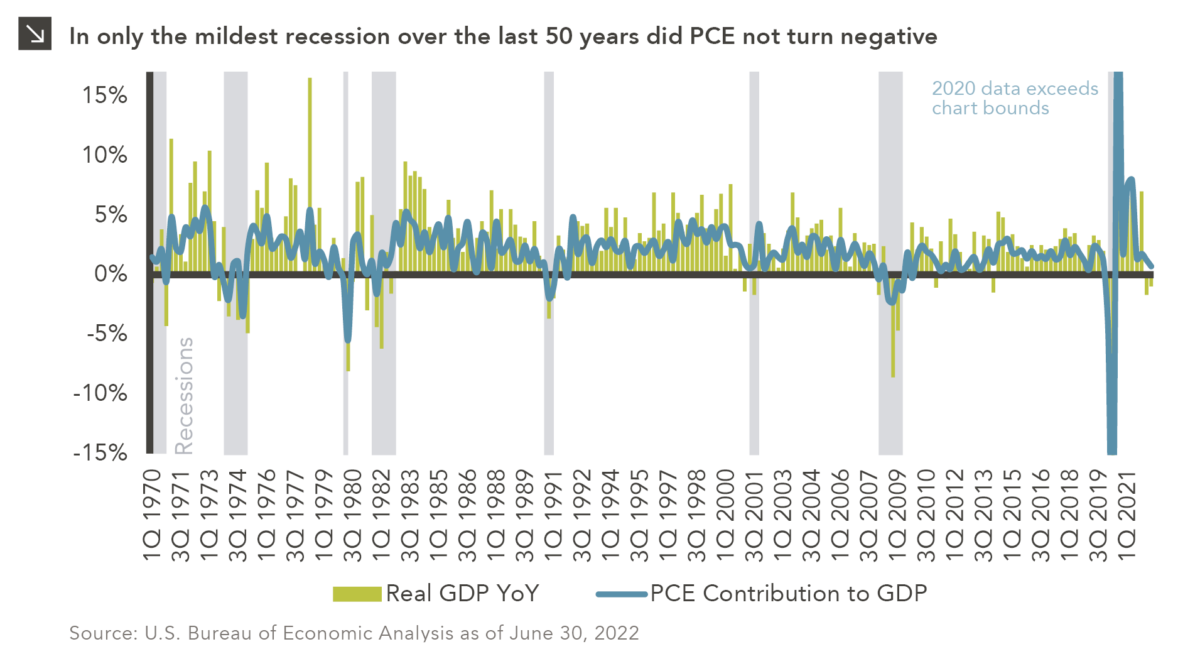
Another economic indicator to consider is consumer spending, specifically the contribution to GDP from Personal Consumption Expenditures (PCE). Consumer spending comprises 70% of GDP and is traditionally a much less volatile component than investment and net exports, the primary contributors to the year-over-year declines in the first half of the year. The strength of the U.S. consumer will dictate the country’s path from here, as healthy balance sheets and a hot labor market contend with decades-high inflation and rising rates. PCE contributed a positive 1.2% and 0.7% to first and second quarter GDP, respectively. In only one of the last eight recessions over the last 50 years — the relatively mild downturn in 2001 — has PCE not turned negative. One month into the third quarter, the highly-regarded Atlanta Fed GDPNow tracker is projecting positive PCE and overall GDP growth for the quarter. The current macro situation is complex, with a healthy U.S. consumer facing a number of headwinds, and, in this case, understanding those underlying dynamics is just as important as the “are we or aren’t we” debate.

Print PDF > Recession Redefined


The opinions expressed herein are those of Marquette Associates, Inc. (“Marquette”), and are subject to change without notice. This material is not financial advice or an offer to purchase or sell any product. Marquette reserves the right to modify its current investment strategies and techniques based on changing market dynamics or client needs.