Profits and Employment: A Balancing Act

Following last week’s preliminary annual benchmark review from the Bureau of Labor Statistics that suggested U.S. job growth has been weaker than initially estimated, investors have been closely monitoring the labor market for signs of strain. Corporate profit margins may be particularly important to watch as they directly impact the labor market and have historically served as a leading indicator of layoffs and economic frailty.

Using the quarter-over-quarter percentage increase in average initial jobless claims as a proxy for changes in employment, this week’s chart highlights the relationship between the labor market and pre-tax corporate profit margins. Over the past three decades, corporate profit margins have generally trended higher and sit at approximately 12.2% today. While current margins are down slightly from recent cycle peaks, they remain elevated compared to historical levels. This signals that corporate profitability remains relatively robust. Despite challenges caused by higher rates and inflationary pressures, these higher margins have allowed companies to avoid significant layoffs by tapping into other cost-control measures as needed. Given that workforce reductions are often seen as a last resort for companies due to the high costs associated with obtaining, training, and retaining employees, significant layoffs typically do not occur until corporate profit margins have declined precipitously from cycle peaks. The orange line illustrates this point by showing sharp increases in initial jobless claims during economic downturns, including the Dot-Com Bubble, the Global Financial Crisis, and the COVID-19 pandemic, during which quarter-over-quarter jobless claims spiked by an astonishing 165%.

While there were certainly other dynamics at play during each of these recessionary periods, significant increases in layoffs generally coincided with slower growth and material declines in corporate profitability. These trends underscore the importance of monitoring these indicators in tandem.

The State of the American Consumer

The U.S. economy has long been driven by consumers, with consumption constituting more than two-thirds of GDP growth: As the consumer went, so went the economy. More recently, robust consumer spending has fueled positive domestic GDP growth and helped buoy the prices of financial assets. That said, there are now signs that these trends may be shifting. For instance, delinquency rates across various consumer loan types have ticked up, as have debt burdens as a share of overall household income. Additionally, personal savings rates in the U.S. have now dropped below long-term averages. From a big picture perspective, what do these trends mean for the overall health and growth of the economy?

This newsletter examines long-term tailwinds and emerging headwinds for the American consumer and expectations for both consumers and overall GDP growth going forward.

Keep Calm and Carry On

U.S. equity markets began last week on a volatile note, with the S&P 500 Index experiencing its biggest daily drop (-3%) since 2022. The factors behind this sharp decline were outlined in last week’s publication, “Volatility Pops as Equities Drop.” In recent days, however, investors appear to have been appeased by more favorable economic data and carry trade exposures that are now much less significant. To that point, the S&P 500 experienced its largest daily gain since 2022 just a few days after Monday’s drop, rising 2.3% last Thursday, August 8. This week’s chart illustrates the most significant daily changes in the S&P 500 since 2020 in an attempt to compare recent market swings to those of previous years. Based on the information above, it is clear that last Monday’s 3% decline was much less severe than the most extreme daily losses exhibited by the index in 2020 and 2022. Interestingly, the largest daily loss of 12% for the S&P 500 in 2020, which came in response to the COVID-19 outbreak, was followed later that same week by the benchmark’s largest daily gain for the year (+9%).

The significant price movements within equity markets exhibited last week and more broadly illustrate two important points. First, market action can sometimes be driven by “animal spirits,” a term popularized by economist John Maynard Keynes that describes the emotional factors that occasionally supersede logic in investment decision making. Animal spirits are important for investors to keep in mind, as they help explain that many market swings are not indicative of a permanent shift in the economic landscape, but rather stem from human emotions such as fear or hope, which can be fickle. The second point is that adverse reactions to market selloffs can result in even more pain for investors since significant daily losses are often followed closely by large gains. To that point, an investor who allocated to the S&P 500 Index in the 1990s and missed the five best days of index performance would have seen a roughly 37% reduction in their final investment value relative to one who missed zero days (through the end of last week). Put simply, keeping calm and carrying on is often the best prescription for bouts of market turmoil.

Volatility Pops as Equities Drop

Recent days have proved quite challenging for equity investors. On the international front, the Nikkei 225 — which tracks the performance of large, public companies in Japan — dropped by more than 12% in Monday’s trading session. This figure represents the most significant single-day drawdown for that index in more than 35 years. Other non-U.S. equity benchmarks have exhibited similar pullbacks: The MSCI EAFE and MSCI EM indices are both down roughly 6% on a month-to-date basis as of the time of this writing. Performance has been similarly challenged for domestic stocks, with the S&P 500 and Russell 2000 indices down around 6% and 10%, respectively, over that same period. Perhaps unsurprisingly, the CBOE Volatility Index (“VIX”) reached a level not seen in more than four years during Monday’s trading session as investors grappled with broad market turbulence. Despite some moderation throughout the Monday session, the VIX remains well above its 10-year average after a prolonged period of muted volatility. These dynamics can be observed in the chart above.

As is often the case during market downturns, there is not a single force driving recent performance but rather a variety of factors at play. Some of the factors in this case include the following:

  • Friday’s lackluster jobs report, which detailed a higher U.S. unemployment rate (4.3% in July vs. 4.1% in June) and monthly nonfarm payroll gains for the last month that came in well below expectations (114,000 realized vs. 185,000 estimated). These and other souring economic data points may be leading investors to question the extent to which a soft economic landing can truly be achieved in the months ahead.
  • Waning enthusiasm surrounding the artificial intelligence trade, which has led to historically high concentration risk within many indices. Price drops of many large index constituents, many of which have benefitted from AI-related fervor, have exacerbated pressures on U.S. equity benchmarks in particular.
  • Technical factors, particularly related to a popular carry trade featuring the Japanese yen. A stronger yen and an unwinding of global yen carry trades, wherein investors borrowed in the low-yielding currency and reinvested the proceeds elsewhere, have created a negative feedback loop that has led to equity price pressures.

The dynamics described above have further clouded the future. As recently as last month, market participants expected roughly two rate cuts from the Federal Reserve for the remainder of 2024; now that figure sits at around five, with two 25 basis point cuts forecasted at the next FOMC meeting in September. To that point, the yield on the 2-Year Treasury, which closely tracks expectations surrounding Fed policy, briefly sank below 3.7% on Monday before pulling back to around 3.9% later in the trading session.

It is important to remember that the current market decline is not unprecedented. Investors should recall that equity indices are prone to corrections, with the S&P 500 Index exhibiting a drawdown of 10% or greater in 19 of the last 30 calendar years. As always, we encourage investors to maintain a long-term outlook related to their portfolios and not overreact to short-term volatility. A disciplined portfolio rebalancing policy coupled with a long-term strategic asset allocation is the most proven method to achieve risk and return objectives.

Keep Your Eye on the Ball

When it comes to baseball, successful hitters have little trouble hitting the ball when they know what pitch is coming. But when pitchers can vary the speed as well as the spin and curve of the ball, hitting becomes exponentially more difficult. An effective curveball can make even the most accomplished hitter look feeble.

As we look at the second half of 2024, we are reminding our clients to “keep their eye on the ball.” Indeed, the first half of the year has been pretty “hittable” as far as returns are concerned, with the majority of asset classes positive through June 30. However, curveballs such as Fed policy, equity index concentration, exchange rates, and a capricious election could quickly flip the script and send investors back to the dugout shaking their heads.

With that said, here is our scouting report for the second half of the year, organized by asset class. We share not only “down the middle” themes but also the curveballs that could flummox performance. A well-prepared investor is no different than a well-prepared baseball player: Insight and realistic expectations provide the foundation for a successful season!

2024 Halftime Market Insights

This video is a recording of a live webinar held July 23 by Marquette’s research team analyzing the first half of 2024 across the economy and various asset classes and themes we’ll be monitoring over the remainder of the year.

Our quarterly Market Insights series examines the primary asset classes we cover for clients including the U.S. economy, fixed income, U.S. and non-U.S. equities, hedge funds, real assets, and private markets, with commentary by our research analysts and directors.

Sign up for research alerts to be invited to future webinars and notified when we publish new videos.

If you have any questions, please send our team an email.

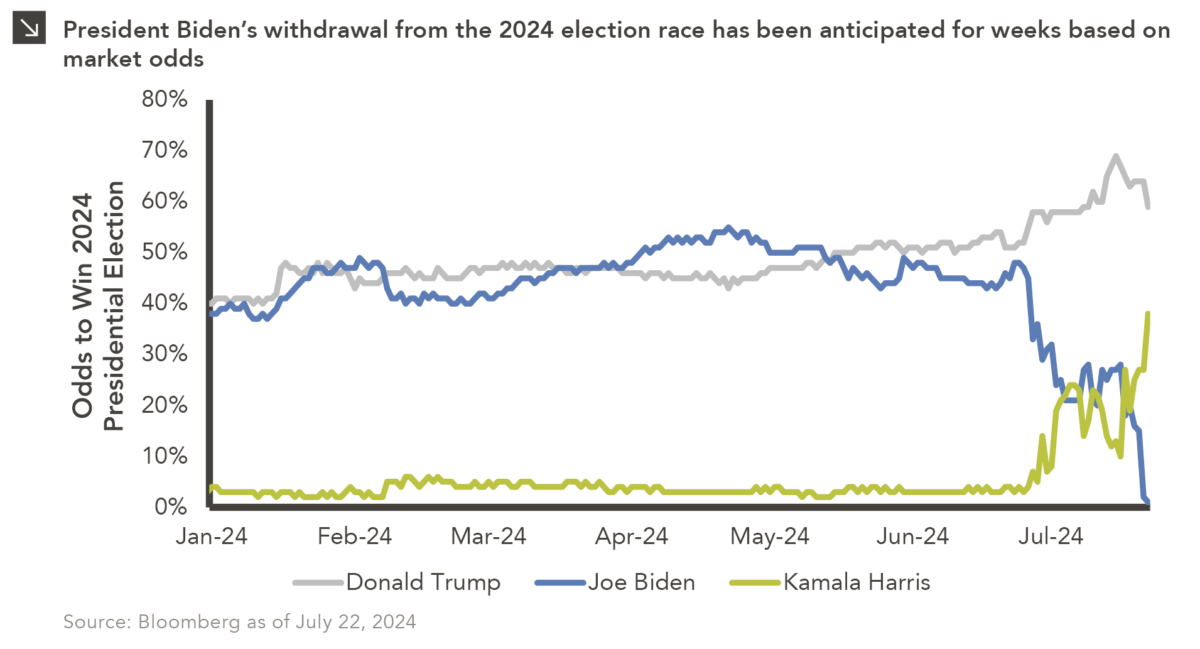
Say It Ain’t So, Joe!

President Joe Biden announced yesterday that he is dropping out of the presidential race and will not seek the Democratic nomination for president. The last time a sitting president declined to seek re-election was Lyndon Johnson in 1968. However, this move comes with little surprise to those who have been paying attention to the odds market. In fact, the market “priced in” this decision shortly after Biden’s shaky debate performance with former President Donald Trump just over a month ago.

The data series in this week’s chart tracks the implied probabilities available on the PredictIt website. For most of 2024, odds for Biden or Trump to win the election fluctuated between ~40–55%. Trump gained momentum leading up to the debate as questions surrounding Biden’s capacity to serve another term swirled. Biden’s disastrous performance accelerated Trump’s chances and sent the president’s odds of winning the election into a freefall.

Before this weekend’s announcement, recent expectations were that Vice President Kamala Harris had equal or better odds of winning the Democratic nomination than Biden. Reality now matches that expectation as she is the presumptive Democratic nominee after Biden gave her his endorsement. It remains to be seen whether Biden will finish out his term or if another candidate will challenge Harris at the upcoming Democratic National Convention. Even with the Democratic party throwing its support behind her, Harris has an uphill climb to overtake Trump. Her odds of winning in November currently stand at 38% versus 59% for Trump. The former president’s odds peaked after the assassination attempt on July 13 at 69% and have since fallen after the Republican National Convention and Biden’s withdrawal. This reflects the fact that it may be more difficult to defeat a candidate other than Biden.

How the stock and bond markets reacted to the shifting odds after the debate was predictable in hindsight. The Trump Trade — which includes a steepening of the yield curve, a rally in small-cap equities, and a rotation out of tech stocks into “old economy” sectors, among other trends — was back on. As Biden faltered, sectors and strategies benefitting from Trump and Republicans’ preference of looser fiscal policy, higher tariffs, more aerospace and defense spending, as well as weaker regulations saw tailwinds as investors piled into the Trump Trade. Now the market outlook is much less certain. While Trump still has favorable odds to win the election, Democrats almost certainly have a better chance to keep the White House without Biden. In addition, it is less likely that Republicans will also gain control of Congress.

Trump may not be as likely to beat a non-Biden candidate, which is causing investors to potentially recalibrate their bets on the Trump Trade. Which sectors ultimately benefit from the shakeup to the presidential race remains to be seen. As the odds show, Biden dropping out was expected. For investors wondering what to expect now, a word of advice: Between now and November only expect the unexpected.

What Does Elevated Index Concentration Mean for Active U.S. Equity Managers?

Indexing has risen in popularity over the last decade, particularly for U.S. equity investors. The fees are lower and indexing is perceived as less risky, with investors primarily seeking beta exposure to the market. However, these indices have evolved against an ever-changing economic and financial market backdrop. As a result, several unintended structural issues have emerged, particularly related to concentration risk. Understanding this evolution and how it could alter the overall exposures within a broader portfolio is critical, as these indices are not static. Notably, the composition of some indices alongside the increase in passive capital has created headwinds for active managers and helps to explain recent performance challenges.

This newsletter examines the progression of passive management, how and why U.S. equity index concentration has increased in recent years, and the effects and risks investors need be aware of across the market capitalization spectrum.

Disappointments to the Downside

Many readers likely know that when it comes to investor sentiment and market performance, economic results relative to forecasts can be just as important as the results themselves. To that point, the Bloomberg U.S. Economic Surprise Index currently sits at roughly -0.6, which represents its lowest level in nearly a decade. According to Bloomberg, this index is an objective and quantitative measure that aggregates the differences between actual economic data and the median forecast from surveys of economists. Said another way, the index measures the degree to which U.S. economic data releases surprise to the upside or downside relative to market expectations. The index compiles various U.S. economic indicators, including employment numbers, GDP growth, inflation rates, and consumer confidence, then each economic data release is compared to the consensus estimate and the difference is standardized. A positive index reading indicates that economic data have, on average, been better than expected, while a negative reading indicates that data have been worse than expected.

Recent data releases that have driven the Bloomberg Economic Surprise Index lower include U.S. manufacturing activity, which contracted for a third consecutive month in June as measured by the ISM Manufacturing PMI. Many economists expected this gauge to increase from the 48.7 figure exhibited in May to 49.1, but it instead fell to 48.5. Additionally, the U.S. ISM Services PMI, which measures the economic condition and performance of service-based companies, dipped to 48.8 in June. This represents the sharpest contraction for that index in more than four years, meaning forecasters who were expecting the June figure to be closer to 52.5 after a 53.8 reading in May were far off the mark.

Interestingly, equity markets seem to be largely unphased by these disappointments to the downside, as the S&P 500 Index has returned nearly 12% since the Bloomberg Economic Surprise Index fell into negative territory roughly 10 weeks ago. This is likely in part due to the fact that readings of inflation, perhaps the economic metric investors are currently watching most intently, have actually come in below consensus expectations over the last three months (as measured by CPI). That said, continued downside surprises could spell trouble for equities, as major stock indices have tended to display a material degree of correlation to the Bloomberg Economic Surprise Index over the last several decades. In the months ahead, investors should consider both the absolute levels of indicators, as well as releases relative to forecasts, in order to properly assess the impact of economic data on market performance.

“Renew” Your Opinion on Policy Bets

During election season, investors are often tempted to position their portfolios based on expectations related to potential changes in government policy. That said, market dynamics in the wake of various political events can be confounding and notoriously difficult to forecast. There is perhaps no better example to support this statement than performance of the energy space over the last seven years.

When Donald Trump assumed the presidency in 2017, his administration sought to rescind many environmental regulations and attain energy independence via the use of fossil fuels. His term saw the approval of multiple controversial oil pipelines, a large expansion of oil and gas leasing, and support for energy development on federal land. Since coming to office in 2021, however, Joe Biden has aimed to reverse many of the energy policies of his predecessor, as well as promote an agenda focused on the reduction of greenhouse gas emissions and the development of renewable energy sources. Based on this information, many readers might have expected robust performance of traditional energy companies during the Trump presidency, as well as more challenged returns for clean energy stocks. The policies of the Biden administration, on the other hand, might have been expected to lead to a reversal of these dynamics. Readers may be surprised to learn, however, that the Energy sector of the S&P 500 Index returned -29.6% during Trump’s term in office, compared to 136.1% since Biden assumed office. Conversely, the S&P Global Clean Energy Index returned 305.9% in the four years of Trump’s presidency but has notched a -54.0% gain during the Biden term.

There are many factors that can help explain these and other surprising performance trends. First, markets tend to be forward-looking in nature, meaning current prices of financial assets usually reflect investor expectations of what is to come in the (sometimes distant) future. Additionally, exogenous shocks can roil securities markets and lead to dynamics that would have otherwise been unexpected based on prevailing conditions and the agendas of those in political office. For instance, the COVID-19 pandemic upended supply chains and the 2022 Russian invasion of Ukraine led to increases in the prices of certain commodities, and these developments were largely conducive to positive performance from traditional energy companies despite a renewables-focused U.S. president. Finally, there is the question of natural business and economic cycles, which have tended to ebb and flow regardless of which party controls the White House. All of this is to say that market timing around an election or any other major political event can be a most difficult exercise. Given the upcoming presidential election in the U.S., investors should remain diversified across the asset class spectrum in order to capture market gains and insulate their portfolios against losses, both of the expected and unexpected kind.