Profits and Employment: A Balancing Act

Following last week’s preliminary annual benchmark review from the Bureau of Labor Statistics that suggested U.S. job growth has been weaker than initially estimated, investors have been closely monitoring the labor market for signs of strain. Corporate profit margins may be particularly important to watch as they directly impact the labor market and have historically served as a leading indicator of layoffs and economic frailty.

Using the quarter-over-quarter percentage increase in average initial jobless claims as a proxy for changes in employment, this week’s chart highlights the relationship between the labor market and pre-tax corporate profit margins. Over the past three decades, corporate profit margins have generally trended higher and sit at approximately 12.2% today. While current margins are down slightly from recent cycle peaks, they remain elevated compared to historical levels. This signals that corporate profitability remains relatively robust. Despite challenges caused by higher rates and inflationary pressures, these higher margins have allowed companies to avoid significant layoffs by tapping into other cost-control measures as needed. Given that workforce reductions are often seen as a last resort for companies due to the high costs associated with obtaining, training, and retaining employees, significant layoffs typically do not occur until corporate profit margins have declined precipitously from cycle peaks. The orange line illustrates this point by showing sharp increases in initial jobless claims during economic downturns, including the Dot-Com Bubble, the Global Financial Crisis, and the COVID-19 pandemic, during which quarter-over-quarter jobless claims spiked by an astonishing 165%.

While there were certainly other dynamics at play during each of these recessionary periods, significant increases in layoffs generally coincided with slower growth and material declines in corporate profitability. These trends underscore the importance of monitoring these indicators in tandem.

The State of the American Consumer

The U.S. economy has long been driven by consumers, with consumption constituting more than two-thirds of GDP growth: As the consumer went, so went the economy. More recently, robust consumer spending has fueled positive domestic GDP growth and helped buoy the prices of financial assets. That said, there are now signs that these trends may be shifting. For instance, delinquency rates across various consumer loan types have ticked up, as have debt burdens as a share of overall household income. Additionally, personal savings rates in the U.S. have now dropped below long-term averages. From a big picture perspective, what do these trends mean for the overall health and growth of the economy?

This newsletter examines long-term tailwinds and emerging headwinds for the American consumer and expectations for both consumers and overall GDP growth going forward.

Volatility Pops as Equities Drop

Recent days have proved quite challenging for equity investors. On the international front, the Nikkei 225 — which tracks the performance of large, public companies in Japan — dropped by more than 12% in Monday’s trading session. This figure represents the most significant single-day drawdown for that index in more than 35 years. Other non-U.S. equity benchmarks have exhibited similar pullbacks: The MSCI EAFE and MSCI EM indices are both down roughly 6% on a month-to-date basis as of the time of this writing. Performance has been similarly challenged for domestic stocks, with the S&P 500 and Russell 2000 indices down around 6% and 10%, respectively, over that same period. Perhaps unsurprisingly, the CBOE Volatility Index (“VIX”) reached a level not seen in more than four years during Monday’s trading session as investors grappled with broad market turbulence. Despite some moderation throughout the Monday session, the VIX remains well above its 10-year average after a prolonged period of muted volatility. These dynamics can be observed in the chart above.

As is often the case during market downturns, there is not a single force driving recent performance but rather a variety of factors at play. Some of the factors in this case include the following:

  • Friday’s lackluster jobs report, which detailed a higher U.S. unemployment rate (4.3% in July vs. 4.1% in June) and monthly nonfarm payroll gains for the last month that came in well below expectations (114,000 realized vs. 185,000 estimated). These and other souring economic data points may be leading investors to question the extent to which a soft economic landing can truly be achieved in the months ahead.
  • Waning enthusiasm surrounding the artificial intelligence trade, which has led to historically high concentration risk within many indices. Price drops of many large index constituents, many of which have benefitted from AI-related fervor, have exacerbated pressures on U.S. equity benchmarks in particular.
  • Technical factors, particularly related to a popular carry trade featuring the Japanese yen. A stronger yen and an unwinding of global yen carry trades, wherein investors borrowed in the low-yielding currency and reinvested the proceeds elsewhere, have created a negative feedback loop that has led to equity price pressures.

The dynamics described above have further clouded the future. As recently as last month, market participants expected roughly two rate cuts from the Federal Reserve for the remainder of 2024; now that figure sits at around five, with two 25 basis point cuts forecasted at the next FOMC meeting in September. To that point, the yield on the 2-Year Treasury, which closely tracks expectations surrounding Fed policy, briefly sank below 3.7% on Monday before pulling back to around 3.9% later in the trading session.

It is important to remember that the current market decline is not unprecedented. Investors should recall that equity indices are prone to corrections, with the S&P 500 Index exhibiting a drawdown of 10% or greater in 19 of the last 30 calendar years. As always, we encourage investors to maintain a long-term outlook related to their portfolios and not overreact to short-term volatility. A disciplined portfolio rebalancing policy coupled with a long-term strategic asset allocation is the most proven method to achieve risk and return objectives.

Keep Your Eye on the Ball

When it comes to baseball, successful hitters have little trouble hitting the ball when they know what pitch is coming. But when pitchers can vary the speed as well as the spin and curve of the ball, hitting becomes exponentially more difficult. An effective curveball can make even the most accomplished hitter look feeble.

As we look at the second half of 2024, we are reminding our clients to “keep their eye on the ball.” Indeed, the first half of the year has been pretty “hittable” as far as returns are concerned, with the majority of asset classes positive through June 30. However, curveballs such as Fed policy, equity index concentration, exchange rates, and a capricious election could quickly flip the script and send investors back to the dugout shaking their heads.

With that said, here is our scouting report for the second half of the year, organized by asset class. We share not only “down the middle” themes but also the curveballs that could flummox performance. A well-prepared investor is no different than a well-prepared baseball player: Insight and realistic expectations provide the foundation for a successful season!

2024 Halftime Market Insights

This video is a recording of a live webinar held July 23 by Marquette’s research team analyzing the first half of 2024 across the economy and various asset classes and themes we’ll be monitoring over the remainder of the year.

Our quarterly Market Insights series examines the primary asset classes we cover for clients including the U.S. economy, fixed income, U.S. and non-U.S. equities, hedge funds, real assets, and private markets, with commentary by our research analysts and directors.

Sign up for research alerts to be invited to future webinars and notified when we publish new videos.

If you have any questions, please send our team an email.

Credit Check

Interest in private credit has grown considerably in recent years and the asset class has moved from a relatively small or non-existent allocation in institutional portfolios to a multi-trillion dollar market accessed by a wide variety of investors. Demand for private credit remains high, but the rapid growth of this space has sparked debates about potential bubbles and whether underwriting standards have diminished given intense competition among lenders. However, recent survey results indicate that underwriting standards may actually be more conservative today than in prior years, highlighting increased caution with regard to both borrower leverage and required levels of equity within borrower capital structures.

Based on a survey conducted by Proskauer capturing responses from 178 senior-level private credit executives, lenders have reduced the maximum level of leverage they are willing to underwrite in private credit deals in recent years. In 2021, more than 68% of lenders to U.S. corporate borrowers were willing to underwrite deals with more than 6.0x leverage, as measured by borrower debt-to-EBITDA. That figure increased to over 82% of U.S. lenders in 2022 but has since fallen sharply, with now just 45% of lenders willing to underwrite highly leveraged deals. Today, more than 55% of private credit lenders cap deal-level leverage at 6.0x, indicating a shift towards more cautious standards in the current interest rate environment. At the same time, borrowers are now requiring more subordinated equity exposure in the deals they underwrite. Deal equity, often provided by private equity sponsors, represents the amount of equity subordination in a borrower’s capital structure and offers a degree of downside protection for the lender if stress arises for the borrower. In 2021 and 2022, those lenders requiring less than 35% equity in deals represented 18% and 22% of Proskauer survey respondents, respectively. However, the proportion of lenders willing to lend with less than 35% deal equity fell to 13% in 2023 and currently sits at approximately 12%. Conversely, lenders requiring at least 45% equity in deals increased from 25% to 55% over the last three years, again highlighting the trend towards more conservative deal structures.

In summary, given elevated interest rates, lenders are prudently reducing the amount of leverage they are willing to support for corporate borrowers and are also requiring more deal equity. These efforts are largely aimed at enhanced downside protection and reflect increased caution among lenders in response to broader economic conditions. At the asset class level, private credit remains an attractive opportunity set for investors, offering attractive yields, portfolio diversification, and downside protection.

The Capital Structure Shuffle

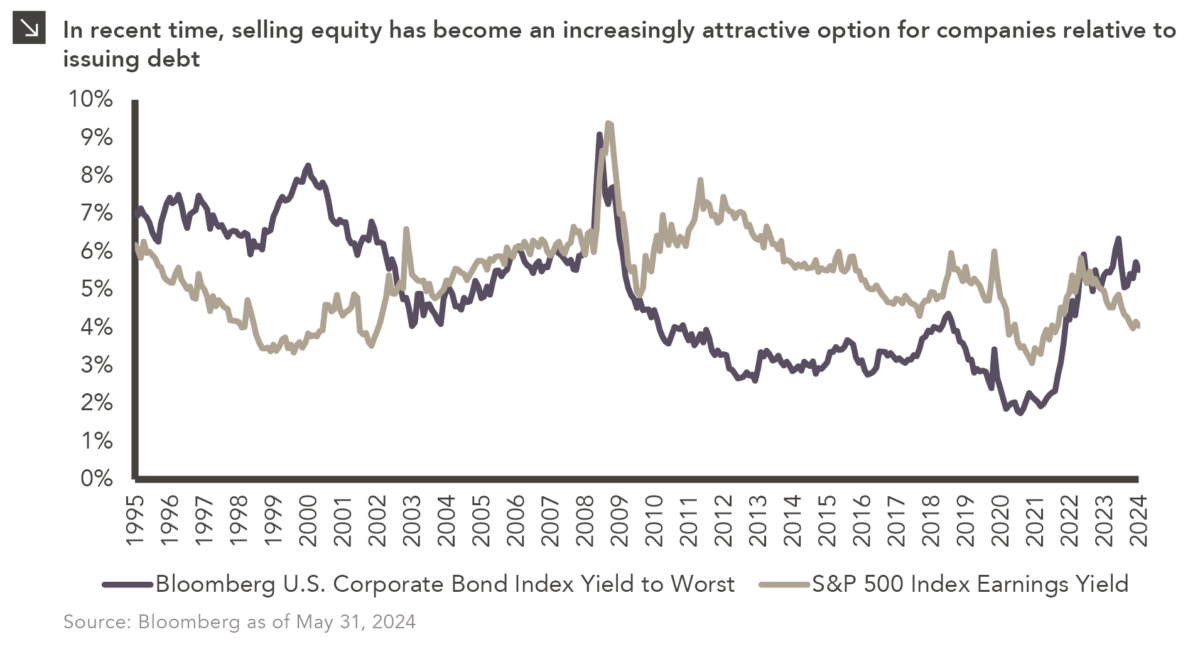
In the years following the Global Financial Crisis, issuing new debt was an easy decision for companies looking to raise capital given an environment of historically low interest rates. That said, decisions related to the composition of corporate capital structures are now less straightforward due to seismic shifts in monetary policy that have taken place in recent time. To that point, this week’s chart compares the yield-to-worst of the Bloomberg U.S. Corporate Bond Index, a proxy for the cost of debt, to the earnings yield of the S&P 500 Index. The earnings yield is calculated by dividing earnings-per-share by the price of the index and is used as a proxy to determine the costs companies face when it comes to new equity share issuance (i.e., the lower the earnings yield, the cheaper it is to sell shares and vice versa). As readers can observe in the chart above, this yield now sits below the yield-to-worst of the fixed income index.

Companies generally prefer issuing debt over equity due to the tax shield associated with this financing (i.e., interest expenses are typically tax-deductible), which still renders debt the more cost-efficient option for many companies in the current environment. Further, equity issuance is often viewed negatively by market participants due to the dilution of per-share earnings that arises as a result.  There are, of course, additional factors beyond the costs of debt and equity that CFOs must consider when making decisions related to capital structure dynamics. That said, in light of the trends outlined above, many companies may begin to view equity issuance as a more attractive option when it comes to raising capital.

A Jolt from JOLTS?

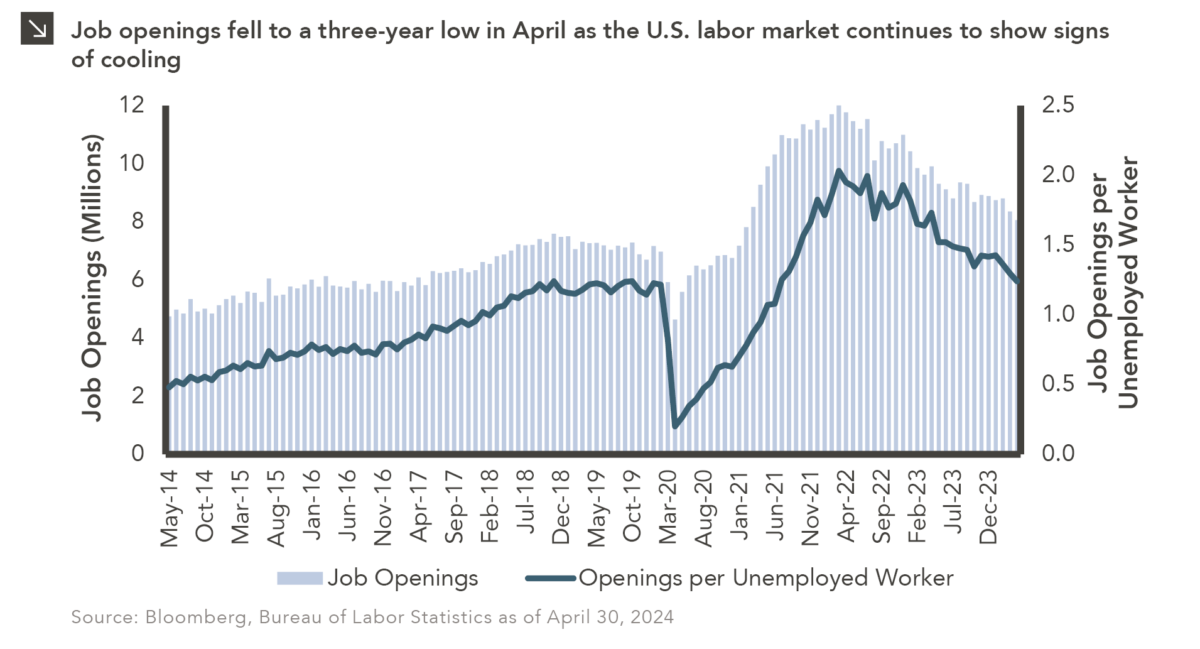
Throughout history, the state of the domestic labor market has typically served as a reliable indicator of the overall health of the U.S. economy. To that point, while the labor market has remained largely robust in the last few years, the most recent Job Openings and Labor Turnover Survey (JOLTS) from the Bureau of Labor Statistics may cause some observers to question the extent to which the employment landscape is deteriorating. Specifically, job openings in the U.S. decreased in April for the second consecutive month according to the report, falling by roughly 300,000 to just over 8 million. This figure represents the lowest level since February 2021 and equates to just over 1.2 job openings per unemployed individual (down from 1.3 in March). As can be seen in this week’s chart, April’s drop is part of a gradual decline in job openings that has been taking place for nearly two years. Interestingly, the rate at which individuals are voluntarily leaving jobs remains at a multi-year low, which could indicate a lack of confidence among labor market participants regarding the prospects of finding more attractive employment elsewhere. Not all of the April JOLTS data was negative, however, as the report stated that layoffs were unchanged on a month-over-month basis and remain low relative to historical averages.

Slowing job growth could indicate a weaker domestic economy, which makes the job of the Federal Reserve more challenging given its commitment to higher rates to combat elevated inflation. While the April JOLTS figures will likely not lead to a rate cut at next week’s FOMC meeting, further softening in the labor market could lead the central bank to weigh the employment picture more heavily when making policy decisions. Marquette will continue to monitor the impact of inflation and labor market dynamics on Fed policy and provide updates to clients accordingly.

The “Fix” Is In!

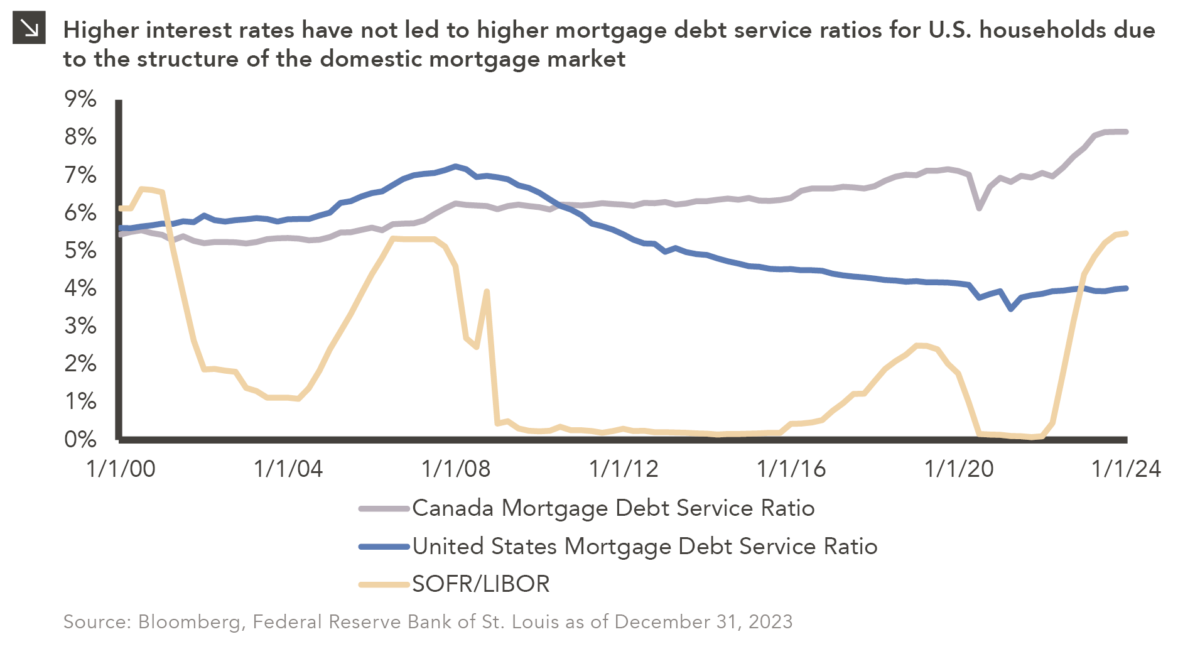
The strength of the U.S. economy over the last several quarters has surprised many investors, as consensus expectations from the recent past called for a recession due to rapid monetary tightening by the Federal Reserve. That said, consumer spending actually increased in 2023, and the labor market remained mostly strong as well. This divergence between the expected and realized impacts of higher interest rates has led many to look more closely at the channels through which monetary policy is connected to consumers. To that point, this week’s chart highlights one structural trend that has been shielding many U.S. households from the impact of higher interest rates.

Monthly mortgage payments and outstanding mortgage debt are often among the largest liabilities on the household balance sheets of the more than 60% of Americans who have mortgages. In the period following the Global Financial Crisis through the beginning of the most recent hiking cycle, long-term fixed-rate mortgages dominated the residential mortgage market in the U.S., making up more than 90% of originations in 13 out of the last 14 calendar years. As a result, many households have locked in relatively low long-term fixed rates on mortgage debt. As of the end of last year, the effective rate on outstanding mortgage debt in the U.S. was roughly 3.8%, while the market rate for a new 30-year fixed-rate mortgage was just below 7.0%. While this spread between new and existing mortgage rates has adversely impacted an already strained supply of housing and led to higher home prices, it has also stymied the housing channel of monetary policy transmission. Said another way, the high percentage of fixed-rate mortgages in the U.S. cushions consumers from Federal Reserve interest rate increases and, thus, limits the effectiveness of Fed policy. This is exemplified by the fact that the effective rate on outstanding domestic mortgage debt has only increased from around 3.3% to 4.0% during the current hiking cycle.

As a result of these dynamics, the U.S. household mortgage debt service ratio — which is the ratio of monthly mortgage principal and interest payments to disposable household income — has remained low, so more disposable income is available to Americans relative to individuals in other parts of the developed world. Indeed, the ability to lock in fixed rates on mortgage loans at terms of 20 or 30 years is somewhat unique to the United States in a way that is often overlooked. Canadian households, for instance, are already feeling pain from higher interest rates, evidenced by the recent increase in the nation’s mortgage debt service ratio relative to that of the U.S. To that point, Canada has shorter available mortgage terms from traditional lenders, with a maximum of five years prior to refinancing in most cases. This has left many Canadians grappling with the impact of higher rates, as most possess either fixed-rate mortgages with short-term resets or those with variable rates.

As the conversation over explanations for the surprising strength of the U.S. consumer continues, the characteristics of the domestic mortgage market are important to take into consideration. Indeed, higher interest rates have allowed many domestic households to benefit from an increased rate on assets while continuing to pay a low fixed rate on significant liabilities.

1Q 2024 Market Insights Video

This video is a recording of a live webinar held April 25 by Marquette’s research team analyzing the first quarter of 2024 across the economy and various asset classes and themes we’ll be monitoring in the coming months.

Our quarterly Market Insights series examines the primary asset classes we cover for clients including the U.S. economy, fixed income, U.S. and non-U.S. equities, hedge funds, real assets, and private markets, with commentary by our research analysts and directors.

Sign up for research alerts to be invited to future webinars and notified when we publish new videos. If you have any questions, please send us an email.