What’s It All Worth?

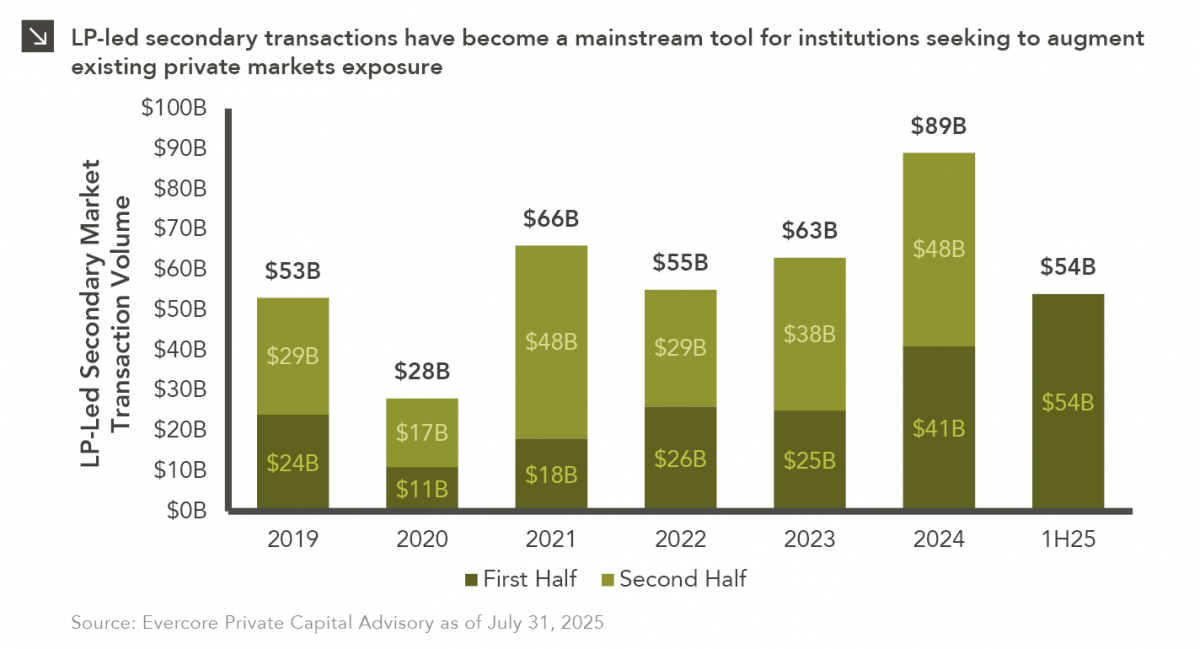
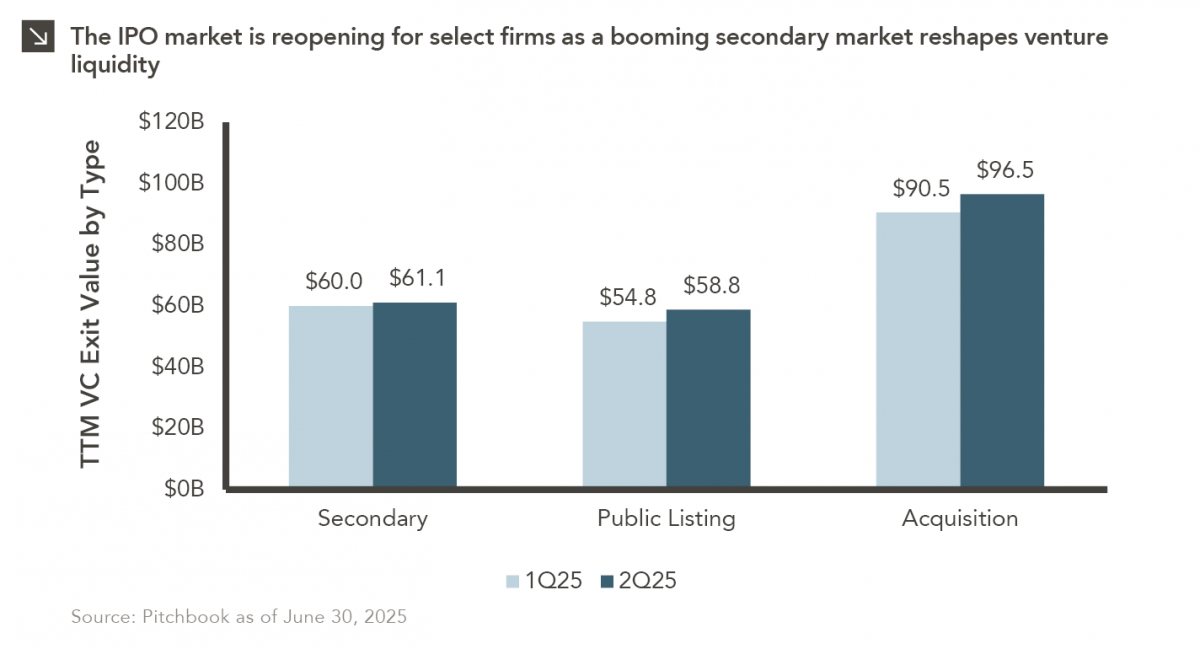
In private markets, secondary transactions have increasingly gained attention and acceptance as a viable liquidity option for both general partners (“GPs”) and limited partners (“LPs”). During the first half of 2025, secondary market volume reached record levels, surpassing $100 billion for the first time in history. Specifically, volume totaled $102 billion in the first six months of the year, with a nearly even split between LP-led (53%) and GP-led (47%) transactions. To put this in perspective, secondary transaction volume for the entirety of 2022 was $103 billion. Although dry powder has declined in recent months — from $216 billion in 2024 to $171 billion — fundraising is expected to more than offset this decrease, with $218 billion projected to be raised over the next year.

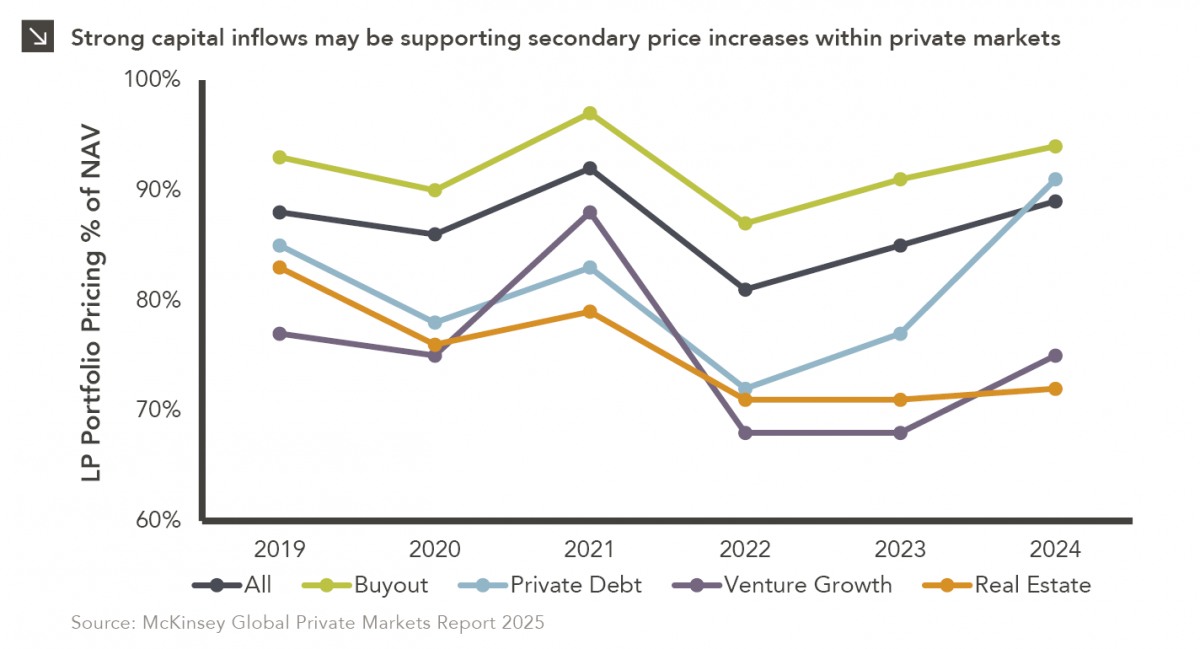
As is common with most asset classes, increased market participation leads to more capital being raised and deployed, which, in turn, drives asset prices higher. The secondary market follows this same trend. Typically, secondary transactions are priced at a discount to the net asset value (“NAV”) of the assets or stakes being sold. However, secondary pricing across all private asset classes increased in 2024, reaching 89% of NAV (up from 85% in 2023). Buyout secondaries saw the highest pricing last year, trading at 94% of NAV, while pricing of private debt secondaries jumped from 77% of NAV in 2023 to 91% in 2024. In contrast, real estate secondaries traded at the lowest percentage of NAV, settling at 72% in 2024. This figure is more consistent with the 71% trading value exhibited by real estate secondaries in 2022 and 2023.

This brings us to the central question of this piece: What’s it all worth? Simply put, whatever someone is willing to pay! But how do we value an asset purchased at a discount? Can we trust the original valuation? Historically, secondary buyers have tended to mark acquired assets up relative to the previous owner’s NAV shortly after the transaction closes, but is this a fair and accurate way to value an asset? If buyers conduct thorough due diligence, their own assessments of a company or portfolio will inform their willingness to pay market-clearing prices, meaning pricing is not determined solely by the current value of an asset. Indeed, buyer perspectives on future growth potential, exit opportunities, and comparable market transactions all influence secondary market pricing. Additionally, recent strong capital inflow for the asset class may be putting pressure on acquirers to put money to work, potentially contributing to the recent uptick in pricing.

The Impact of Artificial Intelligence on Markets

Over the last several decades, artificial intelligence (“AI”) has evolved from a theoretical concept into a transformative force across a variety of industries. The 1940s saw the advent of the digital computer, which was followed years later by the first artificial neural network, a computational model inspired by the structure of the human brain that consists of algorithms that attempt to recognize relationships in data. In more recent years, researchers have developed “deep learning” systems (i.e., neural networks with many layers) capable of increasingly complex tasks including image recognition, reading comprehension, and predictive reasoning. Given the advances in the space, it should not come as a surprise that the use cases of artificial intelligence are now vast, with AI tools now implemented across fields including health care, retail, finance, and entertainment. Researchers and corporate executives are not the only ones to have noticed the remarkable potential of AI, however, as investors have flocked to the space in droves over the last several years.

This newsletter outlines the growth of AI as an investment theme, including performance, valuations, and earnings growth of AI-related companies and equities, other segments of the market that may stand to benefit from advances in AI, and potential risks for investors.

2025 Halftime Market Insights

This video is a recording of a live webinar held July 17 by Marquette’s research team analyzing the first half of the year across the economy and various asset classes as well as themes we’ll be monitoring through the rest of 2025.


Our quarterly Market Insights series examines the primary asset classes we cover for clients including the U.S. economy, fixed income, U.S. and non-U.S. equities, hedge funds, real assets, and private markets, with commentary by our research analysts and directors.

Featuring:
Greg Leonberger, FSA, EA, MAAA, FCA, Partner, Director of Research
Frank Valle, CFA, CAIA, Associate Director of Fixed Income
James Torgerson, Senior Research Analyst
Catherine Hillier, Senior Research Analyst
David Hernandez, CFA, Director of Traditional Manager Search
Evan Frazier, CFA, CAIA, Senior Research Analyst
Dennis Yu, Research Analyst
Amy Miller, Associate Director of Private Equity
Chad Sheaffer, CFA, CAIA Senior Research Analyst

Sign up for research alerts to be invited to future webinars and notified when we publish new videos.

If you have any questions, please send our team an email.

What Has Private Equity Done to Small-Cap Stocks?

Private markets have grown exponentially over the last two decades, driven by attractive long-term returns, diversification benefits, and early-stage value creation. As companies stay private longer, much of their initial growth can be realized outside of public markets, which could challenge the small-cap premium and contribute to a shift in the composition of public markets. The following newsletter examines this dynamic and potential impact on small-cap stocks.

I Want a New Drug

The aging population in the United States has garnered increasing attention over the past two decades, coinciding with the retirement of the Baby Boomer generation and the associated rise in age-related chronic conditions such as arthritis, Alzheimer’s disease, and cancer. As of 2023, over 59 million individuals (17.7% of the U.S. population) were aged 65 or older, and this figure is projected to approach 80 million by 2040.¹ A central challenge associated with this demographic shift is ensuring adequate care, particularly through the effective management of chronic illnesses. One critical avenue for addressing this issue is through investment in the development of efficient and innovative pharmaceutical therapies.

Since 2015, pharmaceutical companies have experienced revenue losses totaling approximately $125 billion due to the expiration of patent exclusivities, with projections indicating nearly double that amount may be lost by 2030. While elevated interest rates and heightened regulatory scrutiny by the Federal Trade Commission contributed to a significant decline in merger and acquisition (M&A) activity in 2022 and 2023, the sector may be well-positioned for a resurgence.² Many drug manufacturers currently maintain robust balance sheets and hold over $180 billion in cash reserves, potentially fueling a new wave of strategic acquisitions.

Realizing a sustained M&A resurgence in research and development will require targeted investment within the biopharmaceutical sector, particularly in early-stage drug development and in the services and technologies that support these endeavors. These include start-ups advancing compact and automated manufacturing technologies, which help mitigate the impact of rising domestic labor costs and offer a competitive edge.

Beginning in the third quarter of 2024 and continuing through the first quarter of 2025, there has been a notable increase in M&A activity. Key transactions include:

  • Johnson & Johnson’s $15 billion acquisition of Intra-Cellular Therapies, focused on central nervous system (CNS) disorders
  • GSK’s $1 billion acquisition of IDRx, a developer of precision oncology therapies
  • AbbVie’s acquisitions of Aliada Therapeutics ($1.4 billion, CNS therapies) and Nimble Therapeutics ($200 million, immune-mediated disease therapies)

Following the first quarter of 2025, newly imposed tariffs have intensified the need for U.S.-based investment, as protectionist trade policies heighten the demand for domestic pharmaceutical production capacity and infrastructure. Couple that with the aforementioned demographic trends in the U.S., we have an investment environment poised for growth.

¹ America’s Health Rankings analysis of U.S. Census Bureau, Single-Race Population Estimates via CDC WONDER Online Database, United Health Foundation.
² Evaluate | Company Profiling search database

1Q 2025 Market Insights

This video is a recording of a live webinar held April 16 by Marquette’s research team analyzing the first quarter of 2025 (and recent weeks) across the economy and various asset classes as well as themes we’ll be monitoring in the coming months.

Our Market Insights series examines the primary asset classes we cover for clients including the U.S. economy, fixed income, U.S. and non-U.S. equities, hedge funds, real estate, infrastructure, private equity, and private credit, with presentations by our research analysts and directors.

Featuring:
Greg Leonberger, FSA, EA, MAAA, FCA, Partner, Director of Research
Frank Valle, CFA, CAIA, Associate Director of Fixed Income
Catherine Hillier, Senior Research Analyst
David Hernandez, CFA, Director of Traditional Manager Search
Evan Frazier, CFA, CAIA, Senior Research Analyst
Dennis Yu, Research Analyst
Hayley McCollum, Senior Research Analyst
Chad Sheaffer, CFA, CAIA Senior Research Analyst

Sign up for research alerts to be invited to future webinars and notified when we publish new videos.

If you have any questions, please send our team an email.


Bracing for Stagflation

As markets swirl and stagflation fears mount, what should investors do?
Our newsletter last week outlined the broad context of President Trump’s new tariff policy as well as the most notable market impacts. Granted, the news seems to change daily, as does the market’s reaction; trying to pen a targeted newsletter is an almost worthless endeavor because by the time the ink has dried, markets have shifted due to another policy pivot. In the short term, the omnipresent cloud of uncertainty will continue to drive market volatility and investor sentiment. The best recipe for investors to weather this storm is patience and discipline, both of which can be difficult to come by in the current environment.

As we step back and take a longer-term view of the future, however, the threat of stagflation is becoming more realistic. Coined as a combination of the words “stagnation” and “inflation,” it is an economic backdrop characterized by high inflation, slow economic growth, and in some cases, high unemployment.

In this edition, we examine which asset classes are most exposed to stagflation and which can offer shelter.

New Year, New President…Same Outlook?

From an investor’s perspective, the current environment feels lot like it did twelve months ago: U.S. equity markets returned over 20% the prior year, fixed income is (still) offering attractive yields, and overall portfolio performance was positive for most programs. Nevertheless, nothing lasts forever and sentiment can shift on a dime. It is also likely that some of President Trump’s policies will have an impact on markets, with the specific impact varying by the policy and asset class.

In this edition:

  • U.S. Economy and Policy Expectations
  • Fixed Income: “If you liked it last year, you’ll like it this year”
  • U.S. Equity: Concentration risk still looms
  • Non-U.S. Equities: Positive earnings outlook, policy uncertainty
  • Real Assets: Real estate bottoms, infrastructure demand robust
  • Private Markets: Private equity on the rebound, private credit still compelling

2025 Market Preview Video

This video is a recording of a live webinar held January 16 by Marquette’s research team analyzing 2024 across the economy and various asset classes as well as themes we’ll be monitoring in 2025.

Our Market Insights series examines the primary asset classes we cover for clients including the U.S. economy, fixed income, U.S. and non-U.S. equities, hedge funds, real estate, infrastructure, private equity, and private credit, with presentations by our research analysts and directors.

Featuring:
Greg Leonberger, FSA, EA, MAAA, FCA, Partner, Director of Research
Frank Valle, CFA, CAIA, Associate Director of Fixed Income
James Torgerson, Research Analyst
Catherine Hillier, Senior Research Analyst
David Hernandez, CFA, Director of Traditional Manager Search
Evan Frazier, CFA, CAIA, Senior Research Analyst
Dennis Yu, Research Analyst
Michael Carlton, Research Analyst
Chad Sheaffer, CFA, CAIA Senior Research Analyst

Sign up for research alerts to be invited to future webinars and notified when we publish new videos.

If you have any questions, please send our team an email.

Football is in Full Swing…and Private Equity Wants a Piece!

The 2024 National Football League regular season is at its midpoint, meaning employees in Marquette’s Chicago office are enduring another challenging season from the hometown Bears. While the growth of rookie Caleb Williams is not a viable topic for a Marquette newsletter, recent developments off the football field are worth exploring in greater detail. To that point, NFL owners recently approved a measure that will allow private equity firms to purchase small stakes in teams, marking a notable shift in the league’s ownership rules. This newsletter highlights the motivations, details, and implications of this recent change.