Sweet and High Up

Chocolate eggs and bunnies may have appeared more expensive to shoppers this Easter weekend, as the price of cocoa futures has surged by around 125% since the beginning of 2024. New York futures prices saw a roughly 50% increase in the month of March alone and now sit at an all-time high of just below $10,000 per metric ton. By comparison, copper futures prices sat at approximately $8,900 per metric ton as of this writing, meaning cocoa is currently more expensive than the bellwether industrial metal.

The drivers of this dramatic increase in cocoa prices involve difficulties faced by the two biggest growers of the commodity: Ivory Coast and Ghana. Specifically, both nations have seen production hampered by strong seasonal winds and a lack of rainfall, as well as a prevalent disease known as swollen shoot virus, which serves to kill cocoa trees and leads to a drop in yields. To make matters worse, the Ghana Cocoa Board, which depends on foreign financing to compensate domestic farmers, may soon lose access to a critical funding facility due to a lack of beans. Due to these challenges, experts currently expect cocoa production shortfalls ranging from 150,000 to 500,000 tons over the next few seasons.

As readers might imagine, these dynamics are creating turmoil within futures markets. Investors with short positions have been forced to either manage margin calls or purchase contracts to close out their shorts, which can exacerbate price action. Pain has not been limited to futures market participants, as consumers have been forced to stomach chocolate prices that have climbed by roughly 10% over the last year. Additionally, it is possible that more shelf price increases are on the way, as producers of chocolate often hedge their purchases of cocoa months in advance. All of this said, it is unlikely that these developments will have a material impact on capital markets broadly. In other words, a diversified portfolio is one of the best ways for investors to keep their returns sweet!

The Crystal Ball Has Clouded

Last month, Marquette published a Chart of the Week that highlighted the aberrational length of the current Treasury curve inversion. As outlined in that publication, a Treasury curve inversion occurs when short-term rates move higher than long-term rates, and a persistent inversion has historically served as a portent of an economic recession. To that point, an inversion preceded each U.S. recession by 18 months at the longest (usually less than a year) since the 1970s. That said, while the current inversion has persisted for nearly two years (and counting), an economic downturn has yet to materialize. Put simply, this time may be different. In fact, according to a recent Reuters poll of bond market experts, nearly two-thirds of respondents opined that the shape of the yield curve no longer maintains the predictive power it once held.

What could account for this shift? There are a few possible explanations, and the first relates to the long end of the curve. Specifically, long-dated bonds, or those with maturities of 10 years or greater, have experienced a multi-decade bull run due to strong demand from pension funds and insurance companies. These entities utilize longer-dated bonds to hedge liabilities, and demand from these plans helps prevent selloffs during periods of rate weakness. These dynamics have served to keep the long end of the yield curve relatively stable in recent time. Indeed, while the effective federal funds rate has climbed by over 5% since the Fed began its hiking cycle, the 30-year Treasury yield has risen by roughly half that amount over the same period. The second possible explanation is related to shorter-dated bonds, as 2-year Treasuries are quite sensitive to Fed policy. Given recent hiking and the central bank’s commitment to holding its policy rate higher for longer, yields on 2-year notes have been pulled higher and currently sit at elevated levels.

In order for the yield curve return to normalcy, short-term yields must fall more sharply than long-term yields. However, a resilient economy will likely keep short-term rates high, and strong technical factors have likely put a cap on yields on longer-dated securities. Given this situation and the changing market dynamics outlined in the previous paragraph, the historical relationship between yield curve inversions and recessions may not hold in the current environment.

Assessing the Likelihood of a Recession and Understanding the Impact on Portfolios

Is a recession coming to the U.S.? It’s a question that has been asked since 2022, as the Fed’s rapid rate hikes sparked concern that higher interest rates would lead to demand destruction and ultimately economic contraction. Nonetheless, here we are in the first quarter of 2024 and although the growth rate of gross domestic product has fallen, it is still positive. Unemployment remains at historic lows and inflation is falling. However, with the Fed unlikely to cut rates during the first half of the year and the full effect of the higher rate environment not yet settled, the recession threat still looms over the economy and markets. Given this background, the following paper presents three reasons for each side as to whether the U.S. may enter or avoid a recession in 2024, as well as recessionary implications across asset classes.

The Dynamic Duo

In 2023, investors were stunned by the robust performance of seven prominent mega-cap stocks deemed the “Magnificent Seven.” Largely beneficiaries of the AI craze, these seven companies comprised almost 28% of the S&P 500 at the end of 2023. This narrow breadth and concentration within the market posed challenges for active large-cap managers who struggled to keep pace with benchmarks without matching the weight of this group in their portfolios. While market breadth has started to improve among large caps, a similar trend is now emerging in the small-cap universe with just two stocks, Super Micro Computers and MicroStrategy — now the two largest companies and weights in the Russell 2000, spearheading the majority of the index’s returns this year.

Since the onset of 2023, Super Micro and MicroStrategy have posted remarkable returns of 1,093% and 936%, respectively, driving up their weights in the Russell 2000 to 1.94% and 0.85%. For perspective, prior to this year, the index’s most substantial single weight since 1985 was 1.45%, at the peak of the dot-com bubble. Like the Magnificent Seven, these two firms have profited from the proliferation of AI. MicroStrategy has also capitalized on the recent cryptocurrency surge over the past six months.

While the performance of these stocks captivates attention, they have become a pain point for active small-cap managers trying to outperform the Russell 2000. Leaving aside fundamental underwriting, many small-cap managers are constrained by prudent limits on market capitalization for the companies they can invest in, and these two outsized outperformers fall far beyond those. As of March 18, Super Micro had a market cap of $55.5 billion and MicroStrategy stood at $25.3 billion, both in large-cap territory. While the Russell 2000 maintains a $6 billion market capitalization threshold for small-cap stocks, the index is only reconstituted once annually, and both companies fell within the limit in April 2023 when FTSE Russell last evaluated index characteristics. Despite their stellar performance, many managers will be unable to allocate to these companies due to their size. Though managers with prior allocations may be able to hold their positions, it could prompt scrutiny regarding the discipline of their investment approach. This predicament mimics the struggles seen in the large-cap space last year, where a select few companies drove much of the market’s performance and active manager relative weights dictated attribution. With the next Russell reconstitution not slated until June 28 of this year, active small-cap managers may have to get creative in order to navigate these challenges.

Long and Variable Lags

The Federal Reserve has waged an aggressive campaign against elevated inflation in recent time, having raised its policy rate from near 0% to over 5% in just over one year. These actions represent the fastest pace of tightening in the history of the central bank. Since the Fed began hiking in the first half of 2022, readings of core CPI, which strips out more volatile components of the headline CPI calculation like food and energy prices, have retreated from a peak of over 6.5% to roughly 3.9% as of the time of this writing. While this moderation of core inflation has led to increased (and perhaps overly) positive sentiment on the part of many investors, it is important to remember that the battle against high price levels has not yet been won. The week’s chart attempts to underscore that point by highlighting the amount of time it has taken for peak inflation to reach more trough-like levels (i.e., those closer to the long-term median core CPI reading) over the last several decades. Readers may be somewhat disheartened to learn that it has taken an average of around two years for inflation to go from peak to trough, with the last two instances requiring roughly three years. For context, the peak figure from the current cycle came 17 months ago.

As it relates to the reason for these long-lasting campaigns against inflation, Fed Chair Jerome Powell has noted the “long and variable lags” with which monetary policy often acts. According to the Fed, one explanation of these lagged effects is that many economic transactions involve prices and quantities that are agreed upon months in advance by the buyer and seller. If these agreements occur in advance of significant changes in monetary policy, they will naturally not be influenced by new levels of interest rates. Additionally, the Fed has noted that lags may arise from the “inattentiveness” of business owners, who may set prices on an infrequent basis to avoid “menu costs,” or the costs associated with price updates. Such behavior would lead the current economic reality to be unreflective of the current monetary policy. Whatever the reasons for the lags detailed above, precedent clearly shows that it may take additional months for inflation to retreat closer to long-term average levels, which may lead to an environment of higher-for-longer interest rates.

Looking ahead, the CPI figure for February is scheduled to be released on March 12. This reading will likely prove informative as investors attempt to determine future actions of the Federal Reserve, which is currently expected to cut rates three to four times this year. Interestingly, market participants expected as many as six rate cuts in 2024 just a few months ago. Marquette will continue to monitor the macroeconomic landscape and provide updates to clients accordingly.

2024 Market Preview Video

This video is a recording of a live webinar held January 25 by Marquette’s research team analyzing 2023 across the economy and various asset classes as well as what trends and themes we’ll be monitoring in the year ahead.

Our quarterly Market Insights series examines the primary asset classes we cover for clients including the U.S. economy, fixed income, U.S. and non-U.S. equities, hedge funds, real assets, and private markets, with commentary by our research analysts and directors.

Sign up for research alerts to be invited to future webinars and notified when we publish new videos. If you have any questions, please send us an email.

2024 Market Preview: A 40 Degree Day

A former colleague once described his brother-in-law to me as a “40 degree day.” The puzzled look on my face revealed my unfamiliarity with the term, so he went on to ask me: “When does anyone get upset about a 40 degree day?” I laughed and shook my head — it was genius, the perfect way to describe something more forgettable than memorable…not especially good or bad, just average.

Given what markets have been through over the last four years — COVID, outsized returns both good and bad, record inflation, sky-rocketing interest rates, geopolitical conflict, and elevated volatility — I know I’m not alone in hoping that 2024 market returns will resemble a 40 degree day. Indeed, an “average” year of returns across markets will equate to positive portfolio performance for most asset allocations and allow investors to satisfy their risk and return goals.

Of course, there are potential stumbling blocks to a “normal” year. In particular, we will closely watch the Fed pivot and the disparity between expected and actual rate cuts, geopolitical conflicts, and the U.S. presidential election.

With that as background, we offer our annual outlook across asset classes, highlighting trends and themes for the year ahead. Happy reading and here’s to a year of normalcy!

Equities: Slow Down to Yield

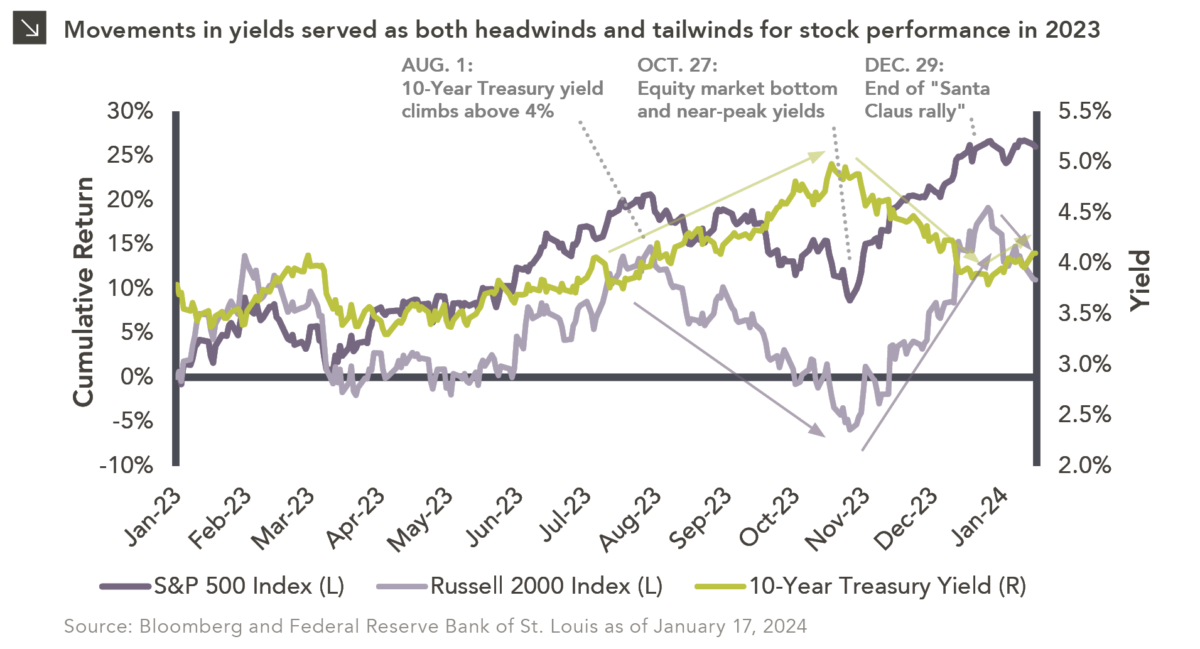
While robust equity market performance in 2023 was certainly in part spurred by the strength of mega-cap technology stocks, economic data and the movement of interest rates also played a critical role. To that point, a decline in Treasury yields to start last year helped fuel a low-quality rally in equity markets, though yields moderated over the next few months following the regional banking chaos that unfolded in February and March. Dynamics shifted in July, however, when yields began to surge as the U.S. Treasury announced new debt issuance to help fund a growing budget deficit. As the year progressed, the continued strength of the domestic economy, including a robust labor market and a resilient consumer, combined with hawkish Fed rhetoric caused yields to climb even further. The 10-Year Treasury yield notably rose to nearly 5% by mid-October, its highest level in over 15 years. Equity markets largely sold off in tandem with this spike in yields, with the Russell 2000 Index reaching an intra-year low on October 27, 2023. Market dynamics once again shifted in the final weeks of 2023, as cooling inflation data led to a more dovish tone from the Fed and widespread investor anticipation of near-term interest rate cuts. This changing sentiment supported a reversal in the 10-Year Treasury yield in late October. As a result of renewed optimism, equity markets exhibited a sustained rally to close the year, with the S&P 500 Index approaching all-time highs in late December. Small-cap equities, which were shunned by investors for much of 2023 amid an environment of higher rates, climbed nearly 25% from their October lows through year-end. Though this rally saw the reemergence of market breadth, as both cyclicals and growth-oriented equities notched strong returns, actively managed strategies struggled due to the outperformance of lower-quality stocks.

This “Santa Claus rally” that ended last year has ultimately tapered off, with equity markets declining to start 2024 amid slightly higher yields. While this trend could foreshadow further challenges for equities in 2024, it may also be a necessary correction. Specifically, given the sharp rise in stocks to close last year, investors may have priced in an overly optimistic probability of interest rate cuts and are just now beginning to consider the possibility that the Fed will not be as accommodative as expected in 2024. This recent correction may also provide some valuation support in the event of any missteps during this quarter’s earnings season, which is slated to kick off in the coming days. As 2024 progresses, policy decisions by the Federal Reserve and the movements in Treasury yields will likely continue to impact investor sentiment and market performance.

Great Expectations

After ending 2023 with a steep market rally, 2024 began on a more muted note, with Fed-pivot exuberance giving way to the details of execution. Of the many opportunities and risks facing markets this year, one of the most scrutinized will likely be how the Fed’s interest rate cuts compare to market expectations.

This newsletter analyzes current expectations for interest rate movements this year and potential scenarios that could influence the Fed’s policy decisions.

Many Happy Returns: A Look Back at 2023

After a challenging 2022, during which significant drawdowns were exhibited by equity and fixed income indices alike, last year saw resurgent performance from most areas of the public market landscape. U.S. stocks were higher in 2023, with the S&P 500 and Russell 2000 indices posting returns of 26.3% and 16.9%, respectively, during the year. Key themes within domestic equity markets in 2023 included increased investor interest in GLP-1 obesity drugs, which led to strong performance from large-cap healthcare companies like Eli Lilly, as well as advances within the field of artificial intelligence. These advances resulted in narrow market leadership for much of 2023 and helped fuel a strong 42.7% calendar year return for the Russell 1000 Growth Index, which is home to each of the “Magnificent Seven” companies (Amazon, Apple, Alphabet, Meta, Microsoft, Nvidia, and Tesla) that were ultimately some of the largest beneficiaries of AI-related fervor. Some may have expressed skepticism that U.S. equity markets would exhibit such robust calendar year returns in March of 2023, which saw a banking crisis that led to the shuttering of Silicon Valley Bank, Signature Bank, and First Republic Bank amid an aggressive monetary tightening campaign by the Federal Reserve and widespread runs on deposits. Fortunately, concerns about broader contagion were allayed when the Fed announced plans to protect uninsured deposits at the affected institutions, though performance of mid- and small-cap indices did suffer due to these events.

Non-U.S. equities posted gains in 2023 as well, with the MSCI EAFE and EAFE Small-Cap indices, which track developed market stocks, returning 18.2% and 13.2%, respectively. UK stocks, while still positive for the year, lagged the broad market due to economic stagnation and higher borrowing costs. Japanese equities, on the other hand, served as a bright spot within the developed market space given recent shareholder-friendly corporate governance reforms and monetary policy that continues to be accommodative. The MSCI Emerging Markets Index was positive for the year as well, notching a return of 9.8%. Companies domiciled in Latin American countries like Brazil and Mexico were some of the largest gainers within non-U.S. markets during the year, as many have benefited from a reconfiguration of global supply chains and favorable population demographics. Additionally, the Taiwanese company TSMC, which is the largest constituent of the MSCI EM Index, exhibited strong performance in 2023 thanks to the enthusiasm surrounding AI advances detailed above. Despite these positive outcomes, the 2023 return of the EM benchmark was hampered due to continued challenges faced by China, which was among the worst performing countries during the period. Indeed, a slump in its property sector, ongoing geopolitical issues, a weak job market, and widespread debt stress in the corporate space have spelled trouble for China’s economy in recent time, however, many believe the nation’s slowdown has bottomed.

Fixed income indices were also positive in 2023 after a dismal 2022, with falling inflation, a resilient economy, and expectations of interest rate cuts on the horizon leading to a bond market rally to end the year. To that point, the yield on the 10-year Treasury, which sat above 5.0% less than three months ago, has now dropped to below 3.9%. Thanks in part to these dynamics, the Bloomberg Aggregate Index notched a return of 5.5% in 2023, while high yield bonds (+13.4%) and bank loans (+13.0%) posted their best calendar year performance figures since 2019 and 2009, respectively.

It is important to note that private markets asset classes, including private equity and real estate, report performance on a lagged basis, meaning full calendar year returns for these spaces will not be available for some time. In the coming weeks, Marquette will be providing more detailed analysis related to both public and private market performance in 2023, as well as what investors might reasonably expect in the new year. We encourage clients, in tandem with their consultants, to review these analyses, as well as existing investment exposures and policy targets, to ensure the appropriate positioning of portfolios in 2024 and beyond. Finally, as it relates to the new year, we wish all readers many happy returns!


Benchmarks:
Core Bond: Bloomberg Aggregate Index
High Yield: Bloomberg High Yield Index
Bank Loans: CS Leverage Loan Index
Broad U.S. Equities: Russell 3000 Index
Large Cap: S&P 500 Index
Mid Cap: Russell Mid Cap Index
Small Cap: Russell 2000 Index
Broad Intl Equities: MSCI ACWI ex-USA Index
Intl Large Cap: MSCI EAFE Index
Intl Small Cap: MSCI EAFE Small Cap Index
Emerging Markets: MSCI Emerging Markets Index
Commodities: S&P GSCI