1Q 2026 Market Insights Webinar

This video is a recording of a live webinar held April 16 by Marquette’s research team analyzing the first quarter across the economy and various asset classes as well as themes we’ll be monitoring in the coming months.

Our quarterly Market Insights series examines the primary asset classes we cover for clients including the U.S. economy, fixed income, U.S. and non-U.S. equities, hedge funds, real assets, and private markets, with commentary by our research analysts and directors.

Featuring:
Greg Leonberger, FSA, EA, MAAA, FCA, Partner, Director of Research
James Torgerson, Senior Research Analyst
Fred Huang, Research Analyst
David Hernandez, CFA, Director of Traditional Manager Search
Evan Frazier, CFA, CAIA, Senior Research Analyst
Dennis Yu, Research Analyst
Hayley McCollum, Senior Research Analyst

Sign up for research alerts to be invited to future webinars and notified when we publish new videos.

If you have any questions, please send our team an email.


Buy High, Sell Low?

Warren Buffett once implored investors to “be greedy when others are fearful,” and this sage advice is certainly applicable to the high yield bond market. Bond investors (who have not been living under a rock) are likely aware that high yield spread valuations are extremely tight at present. Specifically, the OAS for the Bloomberg U.S. High Yield Corporate Index reached 250 basis points on January 22 of this year, which represents its lowest level in nearly two decades. Further, outside of brief periods of widening, high yield spreads have remained well below long-term averages for multiple years. These dynamics exist for several reasons (e.g., solid corporate balance sheets, a resilient U.S. economy, and the overall higher quality of the market) and there is no denying that there is currently minimal value to be found in high yield spreads. All this begs the question: When will spreads eventually widen and by how much?

Put simply, it is impossible to answer these questions without the ability to predict the future (if you can predict the future and happen to be reading this, please call me). Indeed, timing spreads is usually a fool’s errand, but this does not stop investors from trying. When conditions are tight, many postpone capital deployment until spreads are wider and have better value, which is actually a reasonable strategy if it can be executed properly. However, a major flaw exists in this approach: Human behavior. Significant widening of high yield spreads often coincides with major economic shocks and lower asset values across portfolios. Fearful and not wanting to “catch a falling knife,” most investors will again postpone allocation decisions until economic risks subside. Since spreads widen and peak quickly, these fears can, ironically, cause investors to miss the better value they were waiting for in the first place.

This week’s chart highlights seven of the most significant spread widening periods in the history of the Bloomberg U.S. High Yield Corporate Index, as well as the cumulative 2-year performance for the index immediately following those peaks in spreads. These periods all coincided with significant economic shocks that led to elevated fear among investors, which likely delayed investment decisions but also presented strong buying opportunities. Specifically, the average cumulative return for the index in the two years immediately following these shocks was more than 43%. It is important to note that this outsized performance would have been difficult to achieve, as, barring incredible luck, buying at the peak of spreads is highly unlikely. The more relevant takeaway here is as follows: The longer it takes to allocate, the more value that is missed (on average). To put this idea in numerical terms, an investor who waited six months to invest after the peak spread levels in the instances outlined above saw an average two-year performance reduction of nearly 20% relative to one who bought at peak levels.

To be clear, Marquette is not advocating the timing of spread levels, but the information detailed above does demonstrate that even when risks seem greatest, delaying an investment due to fear of losses can result in missed opportunities. In the case of high yield spreads, it is always helpful to remember that what goes up must come down.

Precious Metals Lose Their Luster… Perhaps

Precious metals have been going on a magnificent run in recent years. Specifically, gold moved from $1,898/ounce at the end of 2020 to $5,375/ounce on January 29 of this year, which represents a gain of 181%. During that same time, silver exhibited a more volatile but highly correlated return pattern, moving from $26/ounce to $116/ounce for a gain of 338%. Then came Friday, January 30. On that day, gold dropped more than 12%, its biggest intraday decline since the early 1980s. Silver plunged by a staggering 36%, a record intraday decline for the metal. The fall continued in February, with gold and silver falling to $4,661/ounce and $79/ounce, respectively. Markets have bounced back somewhat in recent days, with gold climbing by roughly 6% and 3% on Tuesday and Wednesday of last week, respectively. Silver advanced on those days as well. Despite this recent pop, many investors are asking the following question given the sharp decline in gold and silver: Have precious metals lost their luster?

To answer this question, it is worthwhile to first outline the reasons for the run-up in gold and silver over the last several years. A primary factor driving strong precious metal performance is global inflation and geopolitical instability (e.g., tensions between the U.S., Russia, China, and the Middle East) that has pushed investors to seek safety in more traditional stores of value. Tariffs and trade-related conflicts have exacerbated this flight to perceived safety. Additionally, developed economies continue to run significant budget shortfalls, leading investors to gold over bonds as governments continue to issue debt to fund deficits. Individual investors are not the only ones that are adding to their gold reserves, as central banks around the world have been purchasing record amounts of gold in recent years as part of a push toward tangible asset ownership. Finally, there have been tailwinds specific to silver, including a structural deficit, thinner trading markets, and its usage in AI infrastructure, data centers, electric vehicles, and solar panels.

After the rally came the fall on January 30, when the Trump administration tapped Kevin Warsh to lead the Federal Reserve. Traders viewed Warsh as the toughest inflation fighter among the finalists for the position, and his nomination increased expectations of U.S. dollar strengthening and weaker precious metals in dollar terms. The slide in precious metals may have been exacerbated by a gamma squeeze, in which dealers must sell positions as prices fall to maintain balanced portfolios.
Fast markets make commentary quickly obsolete, and it is possible that metals markets will exhibit additional volatility in the weeks ahead. This volatility, as well as potential storage costs and the speculative nature of the space, are drawbacks of precious metals investing, and investors should treat commodities like gold and silver with caution given these risks. Time will tell if gold and silver have indeed lost their luster.

K-Shaped Conundrum

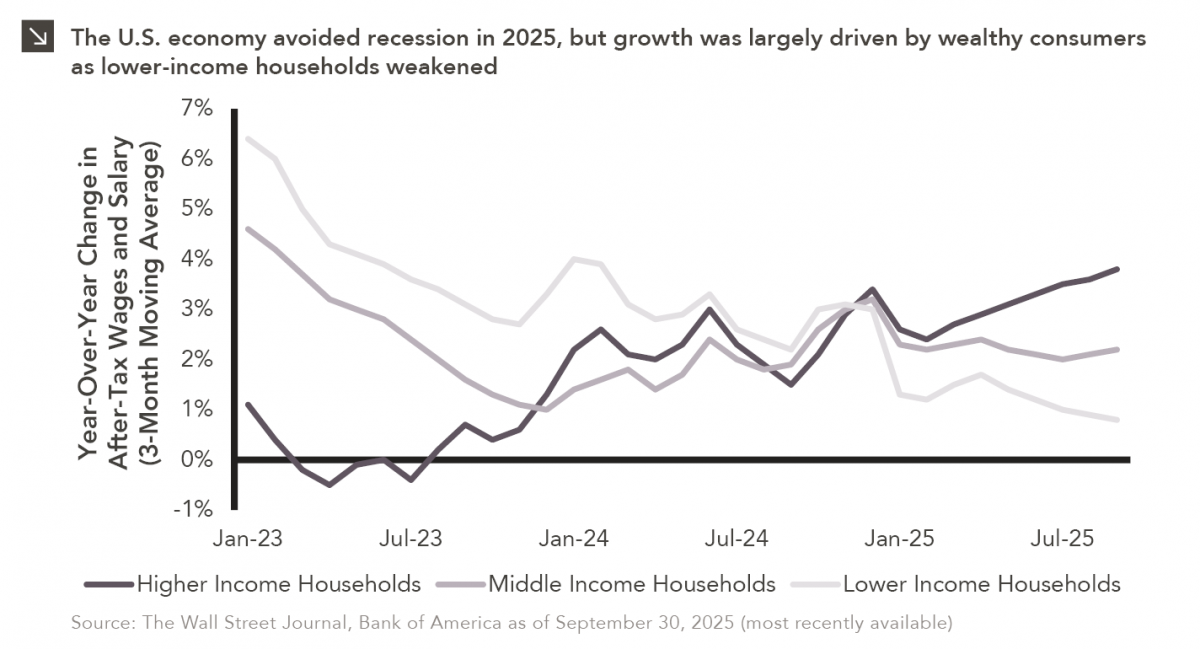
Macroeconomic forecasting is challenging in the best of times and proved downright impossible in 2025, which saw high levels of geopolitical instability and policy uncertainty. Many economists were cautiously optimistic about the state of the global economy at the start of last year, only to revise growth forecasts sharply downward after President Trump’s tariff announcements in April. By summer, markets and economists alike were still largely convinced that a recession was imminent, but this anticipated downturn did not materialize. On the contrary, high-level GDP and consumer spending data for 2025 suggest stable (albeit slowing) economic growth. Despite steady headline figures, however, concerns remain surrounding potential softening of the domestic labor market and slowing real-wage growth. As illustrated by the chart above, these effects are distributed unevenly across income brackets, with wages rising by 3.8% for the highest-earning households over the last year, compared to only 0.8% for lower-earning households. Consumption for lower-income households has also declined in recent time, with a Moody’s survey estimating that the top 10% wealthiest U.S. households now account for roughly half of all consumer spending. Equity market performance has exacerbated this inequality, as wealthier individuals tend to have a larger percentage of their net worth invested in financial assets.

Economic bifurcation, often referred to as a “K-shaped economy,” explains why strong GDP growth can occur in tandem with deteriorating consumer confidence. This dynamic has also challenged policymakers, as institutions like the Federal Reserve have been tasked in recent years with both cooling inflation and preventing further labor market deterioration. Moreover, as lower-income households struggle to finance essential purchases, it is possible that future GDP growth will be contingent on wealthier households spending at current or higher rates. It follows that an event that leads to a pullback in spending (e.g., an equity market downturn) could be detrimental to overall growth. While predicting the trajectory of the economy is certainly a challenge, understanding these dynamics offers some insight into the indicators to monitor in 2026.

Seventy-Five Horses and Two Pieces of Plastic

Anyone who has gone snowmobiling knows it can be simultaneously exhilarating and terrifying. Throttling across snow and through a forest powered by a 75-horsepower engine with two plastic skis to steer makes it hard to feel like one has complete control; 30 mph in the open air feels more like 100!

Nonetheless, operating a snowmobile is pretty straightforward: The throttle is a right-thumb button, the brake is a left-hand squeeze lever. Beyond those two controls, it’s up to the driver to effectively navigate the trail, with the critical concession that the terrain is out of anyone’s complete control. Which brings me to our 2026 market outlook.

The “throttles” for portfolios are the usual constituents: equities, below investment grade credit, and private markets. The “brakes” are investment grade fixed income, particularly Treasuries which can slow a portfolio’s losses if the market tumbles. The terrain is naturally the actual path that each of these asset classes will follow in 2026. Since 2022 the equity market ride has been mostly exhilarating, save for some of the terrifying moments like the market dip after Liberation Day. But that’s in the rearview mirror, and the focus is what is around the bend. Will the thrill continue, or should we ease up on the throttle?

2026 Market Preview

This video is a recording of a live webinar held January 15 by Marquette’s research team analyzing 2025 across the economy and various asset classes as well as themes we’ll be monitoring in 2026.


Our quarterly Market Insights series examines the primary asset classes we cover for clients including the U.S. economy, fixed income, U.S. and non-U.S. equities, hedge funds, real assets, and private markets, with commentary by our research analysts and directors.

Featuring:
Greg Leonberger, FSA, EA, MAAA, FCA, Partner, Director of Research
Frank Valle, CFA, CAIA, Associate Director of Fixed Income
James Torgerson, Senior Research Analyst
Catherine Hillier, Senior Research Analyst
David Hernandez, CFA, Director of Traditional Manager Search
Evan Frazier, CFA, CAIA, Senior Research Analyst
Dennis Yu, Research Analyst
Amy Miller, Associate Director of Private Equity
Chad Sheaffer, CFA, CAIA, Associate Director of Private Credit

Sign up for research alerts to be invited to future webinars and notified when we publish new videos.

If you have any questions, please send our team an email.

Brains Over Brawn?

The development of artificial intelligence is advancing along two largely distinct paths. The first centers on generative AI powered by large language models, with the long-term objective of creating systems that can reason across domains at levels superior to those of human beings. The second focuses on embodied intelligence (i.e., robotics). In this space, the objective is not abstract reasoning but rather the deployment of capable machines that can operate effectively in the physical world. Over the last five years, capital and attention have overwhelmingly gravitated toward companies involved in generative AI, with the Bloomberg Artificial Intelligence Index up a staggering 276% in that time. Robotics, by comparison, has been widely viewed as a longer-dated theme, with the Bloomberg Robotics Index up only 77% over that same period (even less than the S&P 500 Index return of 134%). These dynamics can be observed in this week’s chart.

Going forward, there are reasons to believe that this performance trend may shift in the years ahead. For instance, human-level general intelligence could be far more distant than markets currently assume, and language models may not prove sufficient to reach it. At the same time, practical robots (e.g., warehouse automation, humanoid assistants, etc.) appear closer to commercial reality than previously believed, particularly in aging societies facing persistent labor shortages. One possible accelerant for robotics companies in the years ahead is the use of advanced simulation. By training in virtual environments, robots can acquire motor skills and coordination far more rapidly than through physical trial and error alone, potentially pulling forward adoption timelines relative to current investor expectations. Importantly, transformative impact does not require robots to achieve artificial general intelligence but rather functional capability (i.e., the ability to move objects, operate safely, and sustain useful work with sufficient battery life). Commercial momentum in robotics is already building. In 2024, for example, Agility Robotics opened a manufacturing facility in Oregon with capacity to produce up to 10,000 humanoid units annually, and Amazon has now begun testing Agility’s robots in its warehouses. Additionally, companies like Tesla are showcasing humanoid prototypes performing increasingly fluid physical tasks, and BYD has signaled interest in future household robotics. While price points remain prohibitive for mass adoption today, several structural forces are converging to improve the economics of robotics. Manufacturing costs are declining as scaling drives down prices for components like sensors and actuators, while improvements in AI models are enhancing robotic perception and control. Taken in tandem with the fact that generative AI leaders are currently investing heavily in costly, power-hungry data centers, it is fair to say that a once slower-moving, less glamorous segment of the AI ecosystem may now benefit from relative capital efficiency.

Despite these developments, markets continue to assign a significant valuation premium to generative AI over robotics, which can also be observed in the chart above. Factor analysis helps explain part of the gap, as AI-heavy indexes skew toward momentum and growth while robotics-oriented benchmarks exhibit greater exposure to value, quality, and, in some cases, even dividend income. Further, the generative AI complex is dominated by large technology platforms including Alphabet, Microsoft, and NVIDIA, whereas robotics companies tend to be more industrial in nature (e.g., automation specialists, automakers, and emerging consumer-robotics firms). This valuation disconnect suggests that investors may be overemphasizing long-term breakthroughs in cognition while underappreciating near-term progress in physical automation, especially as physical robots transition from research environments into factories, homes, and hospitals. Indeed, while much of today’s excitement centers on artificial brains, it may ultimately be robotic brawn that drives the next leg of growth within the technology sector.


Glass Half Empty

While the holiday season was once marked by bustling bars, readers may notice that nightlife isn’t what it used to be. Indeed, alcohol-oriented companies, long considered stable components of the Consumer Staples sector thanks to recession-proof attributes, are struggling to regain momentum after a post-pandemic boom. As can be seen in this week’s chart, the Bloomberg Global Alcohol Index, which tracks over 50 of the world’s top listed beer, wine and spirits producers, has exhibited a roughly 46% decline since the summer of 2021. Shares of European giants such as Diageo, Pernod Ricard, and Remy Cointreau now hover near multi-year lows, with many global peers notching similar declines.

There are likely many factors contributing to these performance headwinds for alcohol-oriented businesses, including rising costs, post-pandemic societal shifts (i.e., higher levels of solitude), and healthier lifestyle choices being pursued by consumers. Interestingly, a recent Gallup survey indicates that alcohol consumption by U.S. adults sits at a staggering 90-year low, with members of the Millennial and Gen-Z cohorts increasingly viewing drinking as less fashionable. This change in behavior is compounded by the rise of GLP-1 drug use for weight loss, as early indicators suggest that these medications are catalyzing behavioral changes that have led to a greater emphasis on health and well-being. Additionally, the options for partygoers outside of alcohol have rapidly expanded in recent years, with global consumers increasingly turning to non-alcoholic beverages and cannabis to fuel their holiday cheer. While demand for alcohol is unlikely to disappear completely, alcohol-oriented businesses will surely need to innovate and diversify to meet changing consumer preferences based on the trends described above.

Big “Issues” for Big Tech

While technology-oriented firms have made their presence known in equity markets for several years, these companies have made waves in the fixed income space recently as well. Companies such as Alphabet, Meta, and Oracle, which in the past have funded initiatives via balance sheet cash, have increasingly turned to the bond market to finance the buildout of AI-related infrastructure. Specifically, a total of nearly $240 billion worth of investment-grade bonds have been sold by technology giants on a year-to-date basis through the end of November. Some notable deals in 2025 include Meta’s $30 billion bond sale, the largest in the U.S. high-grade market this year, Oracle’s $18 billion issuance in September, and Alphabet’s deal that raised $17.5 billion in the U.S. and another €6.5 billion (roughly $7.5 billion) in Europe.

This surge in supply carries meaningful implications for the broader investment-grade corporate market, which is one of the most heavily traded areas of fixed income. For instance, the sheer volume of new issuance from technology companies can put upward pressure on corporate spreads as investors demand slightly higher yields (despite the strong balance sheets and generally low leverage of these firms). There is also the question of the potential return on AI-related spending (or lack thereof). Indeed, a recent MIT study found that around 95% of companies have yet to see any meaningful payoff from their generative AI efforts. At the same time, investors and creditors are growing more cautious, increasing their use of derivatives designed to pay out if specific technology firms fail to meet their debt obligations. That said, investment in AI-related infrastructure seems likely to continue at full speed in the years ahead, meaning technology firms may continue to tap the investment-grade market for financing.

Small Caps: Unprofitables Lead, Active Managers Lag, But Can it Last?

At the start of 2025, very few could have predicted the wild ride that awaited equity markets. After a volatile period that culminated on April 8, U.S. equities achieved several new all-time highs, with small-cap equities reaching a first all-time high since November 2021. Absolute returns have been substantial, as the Russell 2000 rose nearly 42% off the market bottom through October 31. Despite renewed volatility in November as expectations for another Federal Reserve rate cut fluctuated, small-cap equities have led large-cap equities since April 8. As is expected in the first six months of a bull market, low quality, including residual volatility, short interest, non-earners, and beta, propelled the small-cap market. Conversely, active managers favor high quality companies, typically characterized by high returns on equity, strong balance sheets, and low leverage. As a result, this factor backdrop is a known headwind for many active managers across the small-cap universe, and this bull market is no different.