Attack on Saudi Oil and Market Implications

Over the weekend, half of Saudi Arabia’s oil production stopped due to a drone attack on the country’s major Saudi Aramco oil infrastructure which includes processing centers and oil fields. While a Yemeni militant group — the Houthi rebels — claimed responsibility for the attack, U.S. intelligence suspects Iran as the culprit.

This newsletter details the immediate developments and market implications of the attack, including a look at oil pricing and current supply, expectations for recovery, and potential effects on demand and geopolitical uncertainties.

Read > Attack on Saudi Oil and Market Implications

The opinions expressed herein are those of Marquette Associates, Inc. (“Marquette”), and are subject to change without notice. This material is not financial advice or an offer to purchase or sell any product. Marquette reserves the right to modify its current investment strategies and techniques based on changing market dynamics or client needs.


The Infamous September

When it comes to timing the stock market, one oft-heard saying is “Sell in May and go away,” which “warns” investors to try to avoid the underperforming summer months and re-enter the market sometime in October. While this might be little more than an anomaly, it is true that over the last 40 years these months do tend to have weaker performance. Most notable in underperformance is September, the only month to average a loss in the S&P 500.

Given the volatility and global growth trends we’ve seen recently, a disappointing September would hardly be surprising. Pairing this historical weakness with the results of last year’s fourth quarter — when equities were down 13.5% — it is understandable that many investors are nervous about the remainder of the year. Fortunately, performance has been positive with equities up 2.6% month-to-date at the time of writing. But what’s far more important is that despite some concerning headlines, the S&P 500 is still up over 21% year-to-date. Even if we do see some losses this month and 4Q disappoints, investors are still on track for a profitable year in their domestic stock portfolio.

Print PDF > The Infamous September

The opinions expressed herein are those of Marquette Associates, Inc. (“Marquette”), and are subject to change without notice. This material is not financial advice or an offer to purchase or sell any product. Marquette reserves the right to modify its current investment strategies and techniques based on changing market dynamics or client needs.

Catastrophe Bonds

Institutional investors are constantly searching for additional asset classes that may help diversify a portfolio and enhance returns. Catastrophe (“cat”) bonds may be such an asset class that could help diversify a portfolio’s interest rate, credit/equity and currency risk by providing non-correlating natural event risk. Cat bonds are typically issued by insurance companies that pool property and casualty policies. They pay coupons to the bondholder using the policy premiums received. When a natural event occurs — such as a hurricane or an earthquake — part of the principal of a cat bond may be used to pay the insurance claims on the pool of policies. In other words, the investor is paid to assume a part of the risk associated with natural events. Historically, cat bonds average 5% to 10% return annually.

This paper discusses the benefits of cat bonds and the mechanics of how they work, along with their market size. The characteristics of cat bonds and the types of cat bond strategies will also be examined. The paper will provide details about cat bonds’ merits and risks to help investors make informed decisions about whether to consider this asset class. It will conclude with a discussion of recent and long-term performance.

Read > Catastrophe Bonds White Paper

The opinions expressed herein are those of Marquette Associates, Inc. (“Marquette”), and are subject to change without notice. This material is not financial advice or an offer to purchase or sell any product. Marquette reserves the right to modify its current investment strategies and techniques based on changing market dynamics or client needs.


Low Volatility Takes a Bite out of FAANG

FAANG stocks have underperformed the broad market over the past year, a stark change from their previous multi-year run of outperformance. More recently, this high-flying group has been negatively affected by a slowing global economy, the U.S.-China trade war, and antitrust investigations. On the other hand, low volatility equity strategies — heavily allocated to defensive sectors of the market such as utilities, REITs, and consumer staples — are benefiting from concern that we are late cycle, slowing global economic conditions, and falling interest rates. As investors seek to mitigate downside risk within equities, low volatility investments have been the recent winner.

This week’s Chart of the Week shows the growth of $100 for the S&P 500 Low Volatility index, the S&P 500 index, and the NYSE FANG+ index over the past year. As of August 23rd, the S&P 500 Low Volatility index had a trailing one-year return of +15.3%. Over this same time frame, the S&P 500 index returned a meager +1.7% while the NYSE FANG+ index fell by -12.4%.

The basic premise of low volatility investing is winning by not losing. A focus on lower beta, lower volatility stocks provides downside protection and helps with the power of compounding over time. The low volatility trade isn’t entirely a free lunch since popularity in this investment style has driven up valuations. Across defensive sectors, valuations are well above their long-term historical averages and trade at a premium to the broad market. As of July month-end, the S&P 500 Low Volatility index had a trailing P/E ratio of 23x compared to 21x for the S&P 500 index. While valuation levels for low volatility indices are certainly elevated and may have an impact on future price appreciation, their lower beta nature should act to mitigate downside risk relative to the broad market.

Print PDF > Low Volatility Takes a Bite out of FAANG

The opinions expressed herein are those of Marquette Associates, Inc. (“Marquette”), and are subject to change without notice. This material is not financial advice or an offer to purchase or sell any product. Marquette reserves the right to modify its current investment strategies and techniques based on changing market dynamics or client needs.
The Good Old Days

It may be tempting for some investors to “time” the market in order to enhance returns in times of market volatility or to avoid exposure on days of anticipated losses in the equity market. However, this strategy can prove detrimental to a portfolio that compounds over time.

This week’s Chart of the Week shows the cumulative effect of missing out on the 5 best days and 10 best days of return for the S&P 500. If $1 were invested in October of 1988 and simply left alone, the investor would have $20.88 as of August 22nd, 2019. However, if out of a sample of 7,771 days, solely the 5 and 10 best days of return were missed as a result of not being invested in the S&P 500, the investor would have $13.95 and $10.50, respectively. Investors may be tempted to time the market in the short-term but making a wrong timing decision can drastically impact returns as shown in the chart above. It is nearly impossible to predict how the market will react on any given day and attempting to move in and out of the market incurs trading costs as well as the risk of losing out on a few crucial days of return. Compounding returns also widen the gap between the lines over time and exponentially affects the dollar value of a portfolio. This illustrates the importance of staying invested, especially through periods of high volatility when large swings in returns are more common.

Print PDF > The Good Old Days

The opinions expressed herein are those of Marquette Associates, Inc. (“Marquette”), and are subject to change without notice. This material is not financial advice or an offer to purchase or sell any product. Marquette reserves the right to modify its current investment strategies and techniques based on changing market dynamics or client needs.

All is Not Lost for 2019

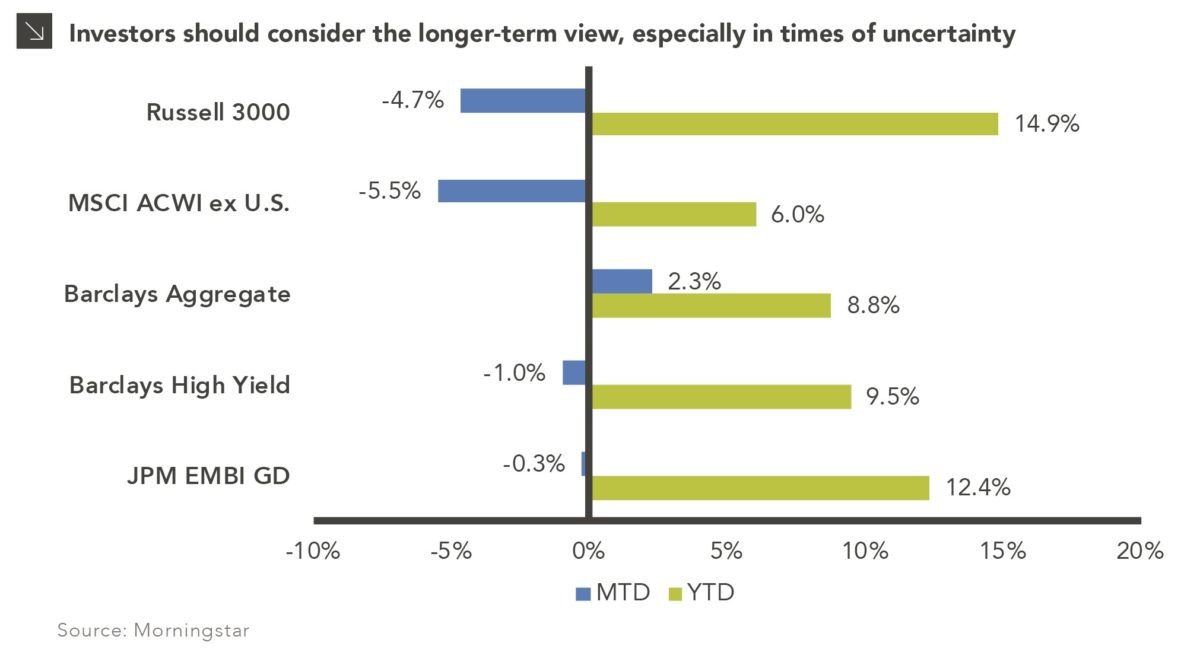
Given this week’s volatility driven by (brief) yield curve inversion, the ongoing U.S.-China trade dispute, disappointing economic data from Germany, and overall growing pessimism about future growth, investors’ growing concerns about portfolio returns are entirely justified. However, despite this week’s volatility and mostly negative news, almost all asset classes have delivered positive returns for the year, with the great majority of U.S. equity strategies up double digits. Furthermore, most fixed income strategies have profited from falling interest rates, as shown by positive returns from investment grade as well as below investment grade sectors. And for all the negative news out of the Eurozone and China, international equities — as represented by the ACWI ex-US index — are still up more than 6% through August 15th. While the rest of the year is likely to feature elevated volatility and lower returns, barring a major market correction most portfolios should remain in positive territory, despite what has transpired the first half of August. If nothing else, we encourage investors to take a long-term view of the markets and not overreact in times of market stress, as stepping back and taking a longer-term view of the markets indicates that 2019 has been a profitable year to date.

Print PDF > All is Not Lost for 2019

The opinions expressed herein are those of Marquette Associates, Inc. (“Marquette”), and are subject to change without notice. This material is not financial advice or an offer to purchase or sell any product. Marquette reserves the right to modify its current investment strategies and techniques based on changing market dynamics or client needs.

The Yield Curve Inverts: Time to Hunker Down?

This morning, the key range of the U.S. Treasury yield curve that is viewed as the bellwether of recessions — the 2-year versus the 10-year — inverted. The 10-year yield fell to 1.61%, below the 2-year’s 1.62%, as of the time of writing. The yield curve serves as a key indicator of market sentiment on future interest rates and therefore the future state of our economy. An upward sloping curve signifies a growing economy, while an inverted curve portends a contracting economy.

This newsletter details what investors should be aware of in light of the inversion, including the possibility of a recession, effects on the equity market, and other current events that may contribute to uncertainty and volatility.

Read > The Yield Curve Inverts: Time to Hunker Down?

The opinions expressed herein are those of Marquette Associates, Inc. (“Marquette”), and are subject to change without notice. This material is not financial advice or an offer to purchase or sell any product. Marquette reserves the right to modify its current investment strategies and techniques based on changing market dynamics or client needs.

August Off to a Difficult Start

Since peaking late in the third quarter of 2018, U.S. equities have experienced large swings in performance. Following the worst December performance since 1931, the S&P 500 staged a dramatic rebound logging its best quarterly return since the first quarter of 1998. Equities continued their march higher culminating with the S&P 500 reaching an all-time closing high of 3,025.86 on Friday, July 26th. The year-to-date rally is attributable to a multitude of factors, however, a dovish pivot by the Fed and optimism around U.S.-China trade relations were key macro drivers facilitating the rebound.

However, fortunes quickly changed last week as the S&P 500 logged its worst weekly performance so far this year with a 3.1% drop and the sell-off continued into Monday with a steep one-day drop of 3%. Recent market volatility centers around changing expectations with respect to the economic outlook, market participants reconciling a smaller rate cut than was priced in, and an escalation in the trade war with China. U.S. officials had hinted throughout the year that a deal was close ­— and progress was being made — however that trade deal optimism is now in doubt. An additional 10% tariff on $300 billion worth of Chinese goods was announced last week and is set to take effect on September 1st. China retaliated by telling its state-owned companies to suspend U.S. agricultural imports and allowing its currency to fall to decade lows against the U.S. dollar.

Volatility is likely to stay elevated over the near-term as the economic and trade outlooks remain uncertain. Historically, August is a volatile month and on average the third quarter produces muted returns. It is worth noting that the S&P 500 still has a double-digit year-to-date return and is trading nearly 5% below all-time highs; whether or not the index remains in positive territory for the duration of 2019 will no doubt depend at least partly on how the U.S.-China trade issues play out over the next 5 months.

Print PDF > August Off to a Difficult Start

The opinions expressed herein are those of Marquette Associates, Inc. (“Marquette”), and are subject to change without notice. This material is not financial advice or an offer to purchase or sell any product. Marquette reserves the right to modify its current investment strategies and techniques based on changing market dynamics or client needs.

The Fed’s First Post-Recession Economic Stimulus

The Federal Reserve’s two central aims are to keep unemployment below a 5% threshold and inflation near a 2% constant. This week’s chart looks at how the Federal Reserve addressed these aims as they cut interest rates on Wednesday, July 31st, 2019, for the first time since the 2008 Financial Crisis from a fed funds target rate of 2.25%–2.5% to 2.0%–2.25%. This well-telegraphed and long-expected 25 basis point cut signals a shift in the Fed’s monetary policy towards one of dovish1 stimulus after a period of hawkishness from 2015 to 2018 that saw the Fed raise the fed funds target rate nine times from 0–0.25% to 2.25%–2.5%. In conjunction with this rate cut, the Fed also halted the run-off of their balance sheet by restarting their reinvestment in government bonds, effectively infusing more cash into the economy to provide further support.

As shown in the chart, this latest interest rate cut occurs with unemployment well below their 5% threshold — which by itself shows that stimulus is not necessary, while inflation is lower than their 2% target — which by itself shows that some stimulus would not hurt. The reasons for the Fed’s cut include a persistently slow global economy, weak business earnings environment, high U.S. rates relative to low and negative rates2 set by other central banks, the fact that low unemployment has not been driving inflation higher, and potential threats to global growth including Brexit and the tariff escalation between the U.S. and several countries, such as China.

For more information, please reference our full newsletter on the topic.

Print > The Fed’s First Post-Recession Economic Stimulus

1 Dovishness is a term used to describe central banks and central bankers who want to provide economic stimulus to keep unemployment low by reducing interest rates, which makes it easier for businesses to borrow and therefore hire people because of greater economic activity. This is in contrast with hawkishness, which describes central banks and central bankers who want to slow the economy down in order to contain inflation by raising interest rates, which makes it tougher for businesses to borrow and therefore restrains prices because of less economic activity.
2 Negative interest rates have recently become more prevalent among German and Japanese short term bonds as those economies continue to languish and their governments continue to provide more stimulus.

The opinions expressed herein are those of Marquette Associates, Inc. (“Marquette”), and are subject to change without notice. This material is not financial advice or an offer to purchase or sell any product. Marquette reserves the right to modify its current investment strategies and techniques based on changing market dynamics or client needs.

Venture Capital Benefits from Mega IPOs

The first half of 2019 has produced a number of high profile IPOs including Uber, Slack, Pinterest, Zoom, Beyond Meat, and Lyft. These IPOs have made it a very successful year for U.S. venture capital exits. While the absolute number of exits has remained slightly below the pace of recent years, this year’s exits have been larger, generating nearly $190 billion through the first half of 2019. This year’s second-quarter exit value alone has exceeded the annual amounts for the venture industry going back to 2006. IPOs have accounted for nearly 83% of the cumulative exit value so far in 2019.

This strong exit environment is likely to allow U.S. venture capital to repeat 2018 as the strongest area of performance within the broadly defined private equity market. While we expect the first quarter to provide strong returns, the second quarter is where we will see a significant increase in performance as IPO offerings ramped up in the spring/early summer. With a robust remaining pipeline of potential IPOs scheduled for the second half of 2019 and 2020 including Airbnb, Palantir, Robinhood, Postmates, and WeWork, we do not see this market cooling off much in the near-term. Regardless of which of these remaining high profile IPOs materialize this year, 2019 is likely to be remembered by investors as the year of mega IPOs.

Print PDF > Venture Capital Benefits From Mega IPOs

The opinions expressed herein are those of Marquette Associates, Inc. (“Marquette”), and are subject to change without notice. This material is not financial advice or an offer to purchase or sell any product. Marquette reserves the right to modify its current investment strategies and techniques based on changing market dynamics or client needs.