Lower Oil Prices a Tailwind for Airline Stocks

Our chart of the week examines how the fall in the price of oil – despite its recent impact on the overall stock market – has benefitted the airline industry and should continue to do so in the near future.

Our chart of the week examines how the fall in the price of oil – despite its recent impact on the overall stock market – has benefitted the airline industry and should continue to do so in the near future.

The chart shows how oil prices have steadily declined since June to roughly $56/barrel as of December 16th. Over the same period, U.S. equities — as represented by the S&P 500 — have marched higher, led by stronger than expected earnings and an increasingly favorable jobs market. Given the drop in oil prices, it may not be entirely surprising that airline stocks as a group have been one of the strongest performers in 2014, gaining 34% so far this year. Since one of the largest expenses for any airline is fuel, the recent decline in prices coupled with both the large volume of travelers in the fourth quarter and rise in airline ticket prices should translate to one of the most profitable quarters for a sector already flying high. The nosedive in oil prices may not be the best news for the overall market (seen at the very end of the graph) but should bode well for airlines and the managers who choose to invest in this soaring sector.

Real Assets: The State of Commodities

December 2014 Investment Perspectives

Commodity market investors received a ray of hope in the early months of 2014. After several years of consecutive declines, commodities, as measured by the Bloomberg Commodity Index, began the year on strong footing and posted a gain of 7.1% in the first half of the year. By the end of the third quarter, however, commodities entered negative territory, and the year-to-date return through November for the Bloomberg Commodity Index had fallen to -10.2% (Exhibit 1). In this newsletter, we examine the recent developments in the commodity markets and evaluate their prospects for the coming quarters.

Download PDF

When Will Rates Rise in 2015?

As investors turn the calendar to 2015, one of the big uncertainties for the coming year is Fed policy and its impact on interest rates. In October, the Fed formally wrapped up its quantitative easing program, which saw the size of the central bank’s balance sheet grow from a pre-crisis $800 billion to almost $4.5 trillion. Now, the Fed can once again focus on the more traditional policy tool of manipulating short-term interest rates.

As investors turn the calendar to 2015, one of the big uncertainties for the coming year is Fed policy and its impact on interest rates. In October, the Fed formally wrapped up its quantitative easing program, which saw the size of the central bank’s balance sheet grow from a pre-crisis $800 billion to almost $4.5 trillion. Now, the Fed can once again focus on the more traditional policy tool of manipulating short-term interest rates. Against a backdrop of steadily improving economic fundamentals and low inflation, the Fed has pledged to keep the Fed Funds rates low for a “considerable” period of time. Investors have loosely interpreted such Fed-speak to mean that the first rate hike is likely to occur sometime in the second half of 2015.

For a more precise estimate of the market’s interpretation, we can turn to the futures market for potential guidance. As of November 28, the futures market was predicting that the effective Fed Funds rate will rise from its current level of 0.10% to 0.25% by August of 2015, reaching a level of near 0.50% by the end of 2015. Unfortunately, as our chart of the week shows, the futures market has historically been a poor predictor of future interest rates. Since the 2008 Financial Crisis, futures contracts on the effective Fed Funds rate have serially overestimated the actual level of interest rates. So while 2015 is supposed to finally be the year that interest rates rise off historic lows, the futures market cannot be counted on to accurately predict the timing and magnitude of any increase.

Better Prospects for Future Income?

One of the most notable economic metrics that has not yet recovered from the recent recession is income and wage growth. This is not surprising: given the high level of unemployment, employers have been able to successfully hire without having to pay a material premium in wages. This trend has been supported by the level of wage growth, which has averaged close to 2%, significantly below its pre-recession average of 3.5%.

One of the most notable economic metrics that has not yet recovered from the recent recession is income and wage growth. This is not surprising: given the high level of unemployment, employers have been able to successfully hire without having to pay a material premium in wages. This trend has been supported by the level of wage growth, which has averaged close to 2%, significantly below its pre-recession average of 3.5%.

However, as the unemployment rate has abated, this trend appears to be reversing itself, at least in terms of future wages expectations on behalf of workers. Our chart this week shows the growing level of workers who expect their incomes to actually increase in the coming years (blue line in the graph). Predictably, the number of workers who expect their incomes to decrease is dropping (red line). Collectively, these patterns suggest a growing confidence that wages will increase, which should translate into more disposable income for consumers. Given that the U.S. economy is one driven by consumption, higher wages should translate into a notable tailwind for economic growth.

A Closer Look into the U.S. Job Market

On October 7th, the Bureau of Labor Statistics released the August Job Openings and Labor Turnover Survey (JOLTS), which showed that the number of job openings waiting to be filled in the United States rose to 4.84 million. The 4.84 million vacant jobs in August is the highest number of job openings in the U.S. since January 2001, and is the third highest number of job openings on record since the inception of the JOLTS survey in 2000.

On October 7th, the Bureau of Labor Statistics released the August Job Openings and Labor Turnover Survey (JOLTS), which showed that the number of job openings waiting to be filled in the United States rose to 4.84 million. The 4.84 million vacant jobs in August is the highest number of job openings in the U.S. since January 2001, and is the third highest number of job openings on record since the inception of the JOLTS survey in 2000. The number of open jobs in the U.S. grew by 910,000 for the 12 month period ending August 31, which is the largest year-over-year increase in job openings since the JOLTS survey began. The large and growing number of open jobs in the U.S. indicates that the strong employment growth experienced recently is likely to continue into 2015.

The fact that there are a near-record number of vacant jobs in the U.S. while the unemployment rate is above the long-term average is a sign that employers are having difficulty finding qualified candidates for open positions. However, if this trend continues it will eventually start to put upward pressure on wages, which could be a bit of a double-edged sword. Higher wages would be a positive development for the overall economy, as the low level of wage growth the past several years has been a significant drag on consumer spending, which is the single largest contributor to GDP in the U.S. However, increased wage growth has the potential to put upward pressure on the inflation rate, which would likely force the Fed to raise interest rates more rapidly than the market currently anticipates, and this has the potential be a drag on the equity markets.

Volatility Index Spikes in August

This week’s chart of the week takes a closer look at the CBOE volatility index (“VIX”) and the German implied volatility index (“VDAX”) in light of recent geopolitical events. Volatility indices are often describes as “fear indices” that tend to increase with market uncertainty.

This week’s chart of the week takes a closer look at the CBOE volatility index (“VIX”) and the German implied volatility index (“VDAX”) in light of recent geopolitical events. Volatility indices are often described as “fear indices” that tend to increase with market uncertainty.  As uncertainty increases, investors typically prefer the safety of U.S. Treasuries, driving up bond prices and pushing yields lower.

• On August, 1st, President Obama announced sanctions on Russia; VIX and VDAX reached their highest levels in more than five months over concern of Russian retaliation.
• On August, 7th, President Obama authorized a targeted strike against Iraq; triggering the VDAX to reach the highest level of the year as concern over global equity markets lead investors to push the 10-Year Treasury yield to 2.43%.
• Finally, August, 15th marked the fall of the 10 Year-U.S. Treasury yield to the lowest in 14 months at 2.34%, due in part to the global tension in Ukraine and conflict in the Middle East.

After spiking in early August on geopolitical worries, the VIX has returned to more normal levels seen throughout most of the year. However, with many of the geopolitical hotspots right on Germany’s doorstep, German market volatility has remained elevated. While U.S. investors may have put the latest crisis behind them, it is worth noting that markets closer to the epicenter of the conflict are not as sanguine.

Uneven Labor Market Recovery

This week’s Chart of the Week examines how total employment has changed by sector since the beginning of the recession. Recently, nonfarm employment recovered the total net jobs lost during the recession, but as the chart shows not all industries have fared equally during the recovery

This week’s Chart of the Week examines how total employment has changed by sector since the beginning of the recession. Recently, nonfarm employment recovered the total net jobs lost during the recession, but as the chart shows not all industries have fared equally during the recovery. It comes as little surprise that construction and manufacturing have been among the hardest hit, dropping about 20% and 12% respectively, for a combined loss of 3.1 million jobs. Additionally it should be noted that this does not account for population growth, making these losses more significant.

When the overall landscape of the economy changes so dramatically multiple issues can arise. First and most importantly, workers who lost jobs in sectors hit hardest have not seen their jobs return. As a result they must change careers and find work in a different industry, or risk being unemployed for the long-term. However, even if they are willing to make this career change they might not have the skills necessary to find a job in another industry. Similarly, expanding sectors may have difficulty finding qualified workers for their newly created positions. Both of these issues are inefficiencies that cause a drag on economic growth.

Service Sector of U.S. Economy Strengthens

This weeks’ Chart of the Week looks at the state of the service sector in the U.S., as measured by the Institute for Supply Management (ISM) Non-Manufacturing Index. On August 5th, the ISM released July data for the ISM Non-Manufacturing Index, which posted a reading of 58.7 (a reading greater than 50 indicates expansion in the service sector while a reading below 50 indicates contraction).

This weeks’ Chart of the Week looks at the state of the service sector in the U.S., as measured by the Institute for Supply Management (ISM) Non-Manufacturing Index. On August 5th, the ISM released July data for the ISM Non-Manufacturing Index, which posted a reading of 58.7 (a reading greater than 50 indicates expansion in the service sector while a reading below 50 indicates contraction). This was the highest reading since December 2005 and is one of the highest on record for the index (which dates back to July 1997). This index is important because it serves as a gauge of the overall strength of the service sector of the U.S. economy, and considering that the service sector is the single largest component of U.S. GDP (representing 45.7% of GDP as of 2Q 2014), it has fairly significant implications for the broad economy.

A deeper look into the underlying constituents of the ISM Non-Manufacturing Index points to continuing strength in the service sector. The new orders component, which reflects the level of new orders from customers, posted a reading of 64.9 in July. This was the highest reading of the new orders index since August 2005 and is also one of the highest on record. The employment component of the Non-Manufacturing Index also showed strength in July, posting a reading of 56.0. This was higher than the 54.4 reading in June but it is still lagging the broad Non-Manufacturing index. Given that the new orders index has increased significantly from 50.4 in December 2013 to 64.9 in July, we could see significant growth in service sector employment during the second half of the year if companies start to hire additional employees in order to keep pace with the increased demand.

Favorable Relative Valuation for U.S. Large-Cap Stocks

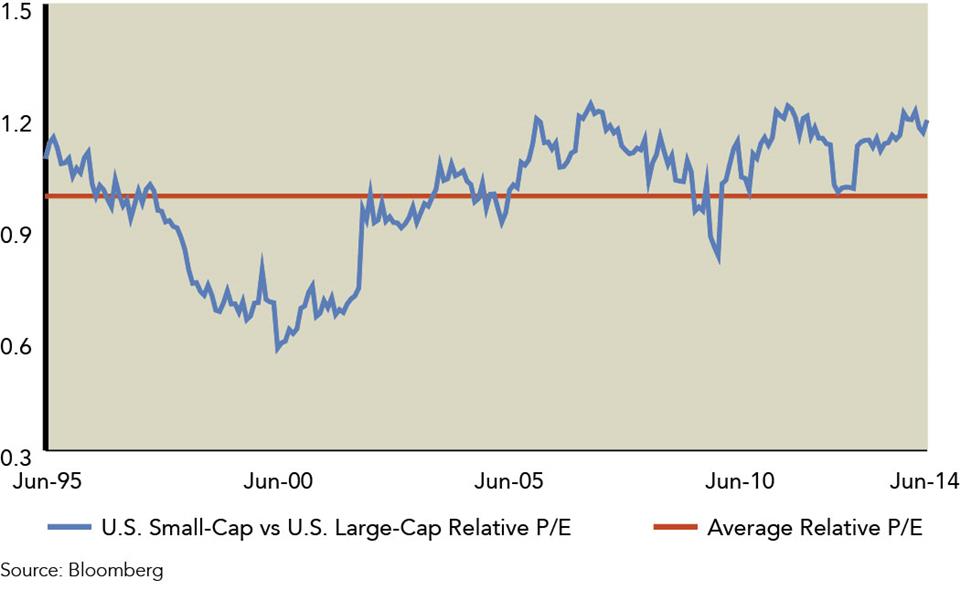
This week’s Chart of the Week examines the historical valuation premium of U.S. small-cap stocks (as represented by the Russell 2000 index) relative to U.S. large-cap stocks (based on the Russell 1000 index). A line above 1.0 indicates a higher relative valuation for the Russell 2000 compared to the Russell 1000. As of June 30th, 2014, the small-cap index carried an 18.7% premium relative to the large-cap index

This week’s Chart of the Week examines the historical valuation premium of U.S. small-cap stocks (as represented by the Russell 2000 index) relative to U.S. large-cap stocks (based on the Russell 1000 index). A line above 1.0 indicates a higher relative valuation for the Russell 2000 compared to the Russell 1000. As of June 30th, 2014, the small-cap index carried an 18.7% premium relative to the large-cap index. Investors should typically expect small-caps to command a larger P/E multiple relative to large-caps given that small-cap stocks tend to have higher expected earnings growth rates assigned to them. Despite this, the chart above indicates that small-caps are currently at the upper end of their historical relative valuation premium. This suggests a more favorable entry point for large-cap stocks versus small-cap stocks.

With U.S. equity markets over 5-years into the current recovery and major indices trading near all time highs, small-cap stocks are facing a few headwinds. As the Fed winds down its asset purchasing program and as the market begins to anticipate a rise in interest rates, small-cap performance will be more linked to the health of the U.S. economy and face a greater sensitivity to a rise in interest rates versus large-caps. In addition, large-cap stocks derive a larger percentage of their revenues outside of the U.S. and would be poised to benefit to a greater extent over small-caps from higher expected growth rates outside of the U.S. With relative valuation levels between small-caps and large-caps currently at a high level, a better risk/reward trade-off exists for U.S. large-cap stocks.

Projecting the Increase in the Fed Funds Rate

On July 9, the Federal Reserve released the minutes from the June FOMC meeting which indicated that it is planning to continue the taper of its bond buying program at the current pace and expects to end the bond purchases entirely in October. With the Fed’s bond buying program (more formally known as quantitative easing) coming to an end, the next step for the Fed will likely be an increase in the fed funds rate.

On July 9, the Federal Reserve released the minutes from the June FOMC meeting which indicated that it is planning to continue the taper of its bond buying program at the current pace and expects to end the bond purchases entirely in October. With the Fed’s bond buying program (more formally known as quantitative easing) coming to an end, the next step for the Fed will likely be an increase in the fed funds rate. In order to illustrate the market’s expectations for the timing of the increase in the fed funds rate, this week’s Chart of the Week shows the implied fed funds rate derived from the fed funds futures market. As the chart indicates, the market currently expects the fed funds rate to remain within the current target level of 0.00–0.25% (0–25 basis points) throughout 2014 and expects the first rate hike to occur at the June 2015 meeting. From there, the market is currently pricing in a series of gradual hikes in the second half of 2015 and throughout 2016 and 2017.

It should be noted that while the fed funds futures market has historically been fairly accurate at predicting near term movements in the fed funds rate (i.e., six months and in), it has a fairly poor track record of predicting longer-term movements (i.e., greater than six months out) especially during periods of transition in Fed policy. Nonetheless, it is important to be aware of what the fed funds futures market’s current expectations are, as changes in these expectations have the potential to significantly impact the broad markets.