The National Bureau of Economic Research (NBER) is widely considered the official judge on what is and is not a recession. The academic organization’s traditional definition of a recession is a “significant decline in economic activity that is spread across the economy and lasts more than a few months.” This definition can be subjective and, to help avoid the need for revisions, the committee does not typically call the start of a recession, or the end of a recession, until well after the fact.
Another commonly accepted definition of a recession is at least two consecutive quarters of negative GDP growth. Given the last two GDP prints of -1.6% in the first quarter and the advance estimate of -0.9% in the second quarter, the U.S. economy would be in a technical recession. Recently, both the White House and Federal Reserve Chairman Jerome Powell have argued that this interpretation does not accurately reflect the current state of our economy, specifically given the still-strong labor market.
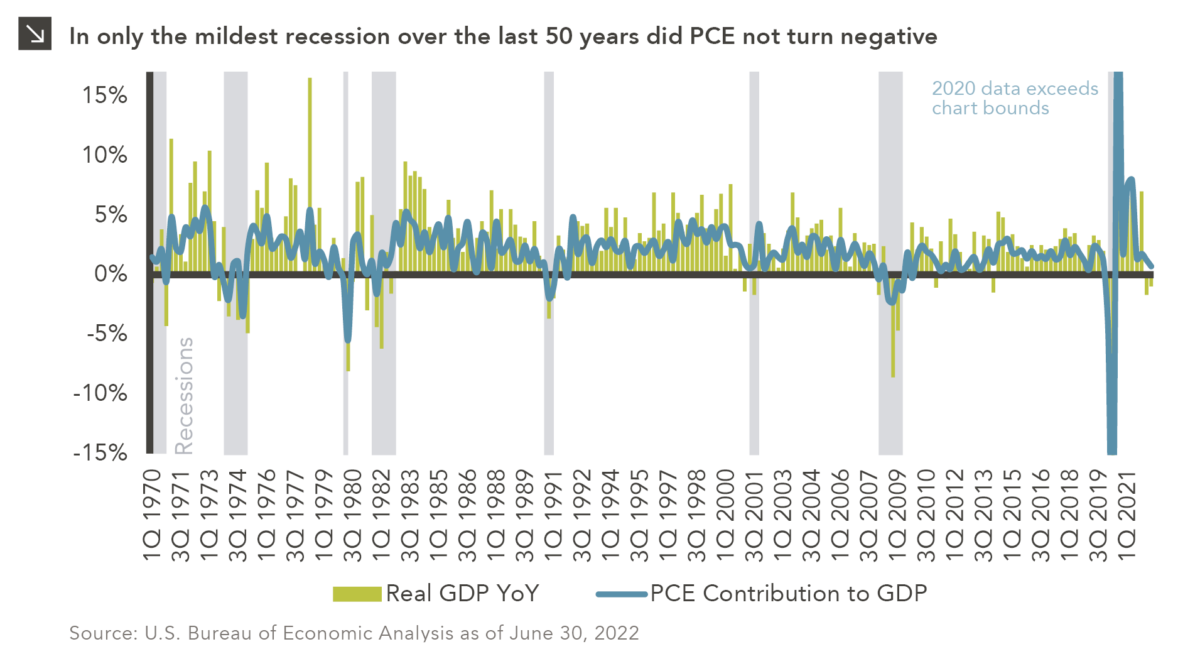
Another economic indicator to consider is consumer spending, specifically the contribution to GDP from Personal Consumption Expenditures (PCE). Consumer spending comprises 70% of GDP and is traditionally a much less volatile component than investment and net exports, the primary contributors to the year-over-year declines in the first half of the year. The strength of the U.S. consumer will dictate the country’s path from here, as healthy balance sheets and a hot labor market contend with decades-high inflation and rising rates. PCE contributed a positive 1.2% and 0.7% to first and second quarter GDP, respectively. In only one of the last eight recessions over the last 50 years — the relatively mild downturn in 2001 — has PCE not turned negative. One month into the third quarter, the highly-regarded Atlanta Fed GDPNow tracker is projecting positive PCE and overall GDP growth for the quarter. The current macro situation is complex, with a healthy U.S. consumer facing a number of headwinds, and, in this case, understanding those underlying dynamics is just as important as the “are we or aren’t we” debate.
Print PDF > Recession Redefined