Hedging Rising Inflation and Interest Rates

Rising inflation and interest rates have not been real issues for investors for several years, but both have remained popular topics of concern. While inflation does not appear to be an immediate risk given still depressed GDP and elevated unemployment, the size of the latest proposed $1.9 trillion COVID relief package has many thinking about future implications. Stimulus did not lead to inflation following the Global Financial Crisis, but there are a number of reasons, beyond the sheer size of this effort, that we could see greater inflationary pressures this time: more pent-up consumer demand, well-capitalized banks and healthy consumer balance sheets, de-globalization, and higher operational costs associated with the virus. And while the Federal Reserve has committed to maintaining its ultra-accommodative monetary policy until long-term inflation hits 2% (with shorter-term inflation allowed to rise moderately above 2% for some time), unless the Fed changes its stance on negative rates, rates can only go in one direction from here: up.

Like all things market-related, we do not recommend trying to time inflation or interest rates. In this newsletter, we analyze equity long/short hedge funds as an option for investors to potentially optimize their portfolio for this dynamic environment.

Read > Hedging Rising Inflation and Interest Rates


The opinions expressed herein are those of Marquette Associates, Inc. (“Marquette”), and are subject to change without notice. This material is not financial advice or an offer to purchase or sell any product. Marquette reserves the right to modify its current investment strategies and techniques based on changing market dynamics or client needs.

Prospects of Dollar Depreciation in the COVID Recovery & Impact on Asset Classes

As vaccine distribution continues in full force and the global economy’s recovery from the COVID pandemic gains momentum, investors are concerned about depreciation of the U.S. dollar and how this phenomenon might affect various asset classes within a portfolio.

In this paper, we examine the mechanics of dollar depreciation and its subsequent impact on traditional asset classes. We begin by exploring the macroeconomic factors that drive dollar strength or weakness and then examine the impact of dollar depreciation on the fixed income, U.S. equities, and non-U.S. equities asset classes both by covering the potential effects of a stronger or weaker dollar and by assessing historical performance.

Read > Prospects of Dollar Depreciation in the COVID Recovery & Impact on Asset Classes


The opinions expressed herein are those of Marquette Associates, Inc. (“Marquette”), and are subject to change without notice. This material is not financial advice or an offer to purchase or sell any product. Marquette reserves the right to modify its current investment strategies and techniques based on changing market dynamics or client needs.


Should Investors Be Concerned About Stagflation?

The coronavirus pandemic has disrupted everyday life and caused a devastating impact on the global economy. At the peak of the outbreak, the U.S. unemployment rate reached 11.1% and real GDP growth fell by 9.0%, which marked the second worst economic crisis since the Great Depression. On the bright side, the COVID relief programs and expansionary economic policies projected an air of optimism; as of January 2021, the unemployment rate came down to 6.3% and real GDP growth has started to recover since cratering during the first half of 2020. However, these figures are still at concerning levels, and an emerging fear is that the magnitude of economic stimulus may create a surge in inflation, in spite of middling economic growth. This week’s chart examines the nature of stagflation and how the markets perform under this condition.

The term “stagflation” comes from “stagnation” and “inflation” and can be identified as a period of slow economic growth, high unemployment, and high inflation. An example of stagflation was in the 1970s as shown in the chart. The inflation and unemployment rates (blue and orange lines) stayed in a 10–15% range when the economic growth (purple line) was slow or negative. The typical cause of stagflation is an external shock that breaks the inverse relationship between the inflation and unemployment rate; the high inflation usually indicates that the demand for goods and services is high, the economy is expanding and unemployment is low. In this case, the supply shock of oil was the main contributing factor for driving prices higher, discouraging consumption, and resulting in a recession. Stagflation is not only detrimental to the economy but also difficult to address. For example, contractionary policies such as increasing interest rates to reduce inflation may make unemployment even worse.

As shown at the bottom of the chart, the U.S. stock, international stock, bond, real estate, and commodity markets held up well during stagflation in the 1970s. The S&P GSCI commodity index returned 54.3% per year and the other markets returned 25% to 28% per year. The international stock market outperformed the U.S. stock market. The commodity market performed best but highly fluctuated with a 0.72 correlation with inflation.

The economic crisis from the pandemic coupled with the aid to boost the economy may seem like a recipe for stagflation. However, impending stagflation is unlikely. The current inflation of 1.3% is well below the central bank’s 2% target, oil prices are stable, the personal consumption expenditure is down but has recovered to 96% of its pre-pandemic level, vaccines are becoming more accessible and IMF projections are generally positive (dotted lines). As the economy further re-opens later this year, the threat of stagflation should dissipate as attention turns toward renewed economic growth.

Print PDF > Should Investors Be Concerned About Stagflation?


The opinions expressed herein are those of Marquette Associates, Inc. (“Marquette”), and are subject to change without notice. This material is not financial advice or an offer to purchase or sell any product. Marquette reserves the right to modify its current investment strategies and techniques based on changing market dynamics or client needs.

The Big Squeeze

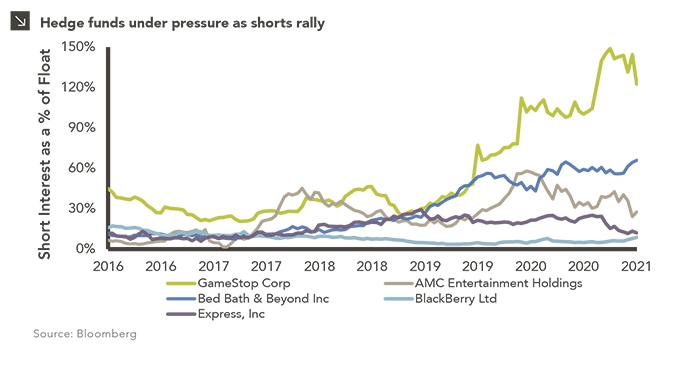
A group of small-cap stocks made big waves last week as retail day traders collaborated online to drive up certain stock prices in order to “squeeze” hedge funds with short positions. The influence of the retail investor has been building for over a year, facilitated by reduced trading fees, new brokerage platforms, and the time and money freed up by COVID lockdowns, but the Reddit-documented campaigns to manipulate GameStop and others brought forth entirely new dynamics.

Hedge funds take short positions when they expect stock prices to fall, generally for fundamental reasons. Short positions are inherently more risky than long positions — the downside is theoretically unlimited and short positions will increase in size as the stock moves against you, but prudent long/short managers understand these risks and typically run short portfolios that are more diversified, with smaller position sizes and tighter risk management parameters. Market sentiment and positioning is a key part of their analysis, especially on the short side. Stocks with high short interest have been red flags for many managers well before the term “Gamestonk” existed.

GameStop, AMC, Bed Bath & Beyond, and other stocks being irrationally bid up have fundamentally struggled for years. Outdated business models have led to earnings declines and multiple compression, and the impact of COVID has pulled forward bankruptcy concerns. At the same time, short interest has increased, and profitably — for the three years ending June 30th, 2020, the five stocks in the chart above lost on average 59% of their value. Over the last seven months, through the end of January, the worst performer of the group has almost tripled, and GameStop is up more than 7,000%, despite a largely unchanged fundamental outlook.

A number of hedge funds holding these higher short interest stocks were significantly impacted. At the center of the drama, Melvin Capital was reportedly down more than 50% for the month. While many hedge funds did not have direct exposure, the broader issue for the group and investors is the related de-grossing — long selling and short covering — as managers look to reduce exposure to the volatility. While de-grossing is not unusual (seen most recently in March 2020, September 2019, the fourth quarter of 2018), it has been especially rapid over the last week with hedge funds coming into the year with above average levels of gross and net leverage. While this has a created a tough backdrop for hedge fund alpha, especially coming off a record year in 2020, year to date losses have been modest. Through January, the average U.S. long/short fund was down just 2.3%,¹ relative to the S&P 500 -1.0%.

While Melvin Capital and others have publicly stated that they have fully closed out short positions on GameStop, the damage has been done, and these funds will likely face ongoing investor scrutiny over their risk management processes. But the majority of long/short funds should be able to make up any early year losses, with 2021 set up to be a good year for stock pickers. Prudent managers are re-underwriting their short positions, reducing exposure to potential targets and names with higher short interest, and many are patiently planning for the inevitable next leg. Stocks do not typically remain this severely disconnected from fundamentals for long, and at these valuations could present strong short opportunities.

Print PDF > The Big Squeeze

¹ Morgan Stanley Prime Brokerage


The opinions expressed herein are those of Marquette Associates, Inc. (“Marquette”), and are subject to change without notice. This material is not financial advice or an offer to purchase or sell any product. Marquette reserves the right to modify its current investment strategies and techniques based on changing market dynamics or client needs.

Fundamental Disconnect: Understanding the Nature and Impact of Recent Frenzied Trading

In recent years, most major brokerage firms have participated in a “race to the bottom” with respect to commissions on equity purchases and sales, as well as options trades. This phenomenon, in tandem with the rise in popularity of app-based trading platforms like Robinhood, has afforded retail investors greater access to capital markets. While the democratization of the investment world is beneficial in many respects, it can also lead to irrational behavior and a decoupling of asset prices and fundamentals.

In this newsletter, we analyze the recent frenzied trading activity that has grabbed the headlines, including a summary of what has happened so far and a look at the impact and implications of this behavior.

Read > Fundamental Disconnect: Understanding the Nature and Impact of Recent Frenzied Trading


The opinions expressed herein are those of Marquette Associates, Inc. (“Marquette”), and are subject to change without notice. This material is not financial advice or an offer to purchase or sell any product. Marquette reserves the right to modify its current investment strategies and techniques based on changing market dynamics or client needs.

Record Flows: Another Headwind for Active Management

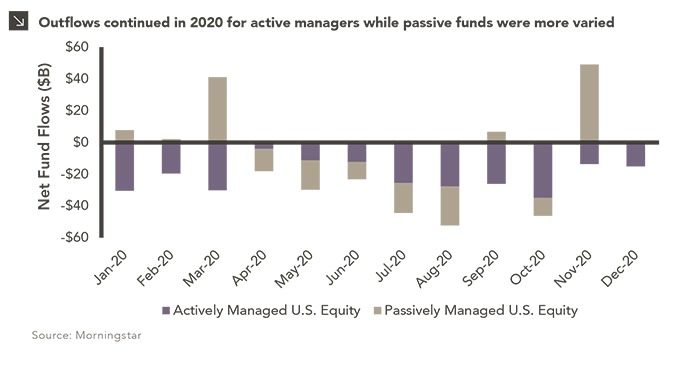
Fund flows, which measure the net movement of assets into and out of investment vehicles like mutual funds and exchange-traded funds (“ETFs”), can provide a window into investor behavior and are often an indication of investor sentiment. Strong inflows can indicate optimism within a particular asset class or investment style, while outflows may suggest pessimism on the part of investors. That said, a robust market is not always supported by investor inflows, as underlying fund flows and market index performance frequently deviate. This phenomenon was on display in 2020 and merits further evaluation.

The S&P 500 index posted a double-digit return in 2020 and closed the year at an all-time high, despite record-breaking outflows from U.S. equity funds. Nearly $241 billion flew out of domestic equity funds in 2020, a figure that is more than four times the previous calendar year record set in 2015. Perhaps unsurprisingly, these outflows centered predominately around actively managed products, a trend that has been persistent since 2014. Active funds saw net outflows in every month of 2020, while passive funds enjoyed bursts of investor interest, with extreme net inflows in both March (after the market bottomed) and November (due to positive coronavirus vaccine news). Investor preference for ETFs over mutual funds is particularly noteworthy. ETFs have risen in popularity as a lower-cost alternative to mutual fund investing and carry little-to-no investment minimum with real-time pricing. In November, passive ETFs saw a staggering net inflow of more than $54 billion, which is $12 billion more than the last monthly record set in December of 2016. This historic net inflow provided a tailwind to an already optimistic investor base and propelled indices like the Russell 2000 index, which tracks the U.S. small-cap market, to post its strongest returning month on record.

Hefty inflows for passive vehicles, like those in November, can have unfortunate implications for active investment managers. Many of these investment professionals are constructing a relatively small basket of securities with the intent to outperform a benchmark, often with less risk, over the long term. Commonly, these managers focus on quality metrics like top line growth, gross margins, earnings, and lower debt levels to drive outperformance. When a wave of inflows hits passive products, we see a “rising tide lifts all boats” phenomenon that is largely detached from underlying stock fundamentals. This can cause a short-term price dislocation and distortion of investor sentiment. Ultimately, the immediate impact of fund flows is temporary, but the continued trend away from active management may pose a greater threat to the asset management industry if portfolio managers fail to improve benchmark-relative performance.

Print PDF > Record Flows: Another Headwind for Active Management


The opinions expressed herein are those of Marquette Associates, Inc. (“Marquette”), and are subject to change without notice. This material is not financial advice or an offer to purchase or sell any product. Marquette reserves the right to modify its current investment strategies and techniques based on changing market dynamics or client needs.

Bubble, Bubble, Toil, and Trouble

In Shakespeare’s Scottish play Macbeth, three witches prophesize the protagonist’s imminent rise and fall. This week, Deutsche Bank released its mid-January survey highlighting 627 global market professionals’ feelings of the market’s current state. The survey’s arguably most somber statistic showed that 89% of respondents believe there are currently bubbles in the financial markets. As seen in previous events, we know that bubbles have dire consequences for financial markets. In particular, U.S. tech stocks and Bitcoin were the two assets that respondents believe are the most likely bubbles waiting for a correction. As of January 19th, Bitcoin has soared over 320% and the Nasdaq index is up over 43% in the past year. Due to digital currencies’ nascency, particularly Bitcoin, it is almost impossible to glean any insight from past performance.

Moreover, much of Bitcoin’s future value will be driven by its overall acceptance by financial institutions and its finite supply. Alternatively, investors have decades of Nasdaq data and have experienced market bubbles such as the Dot-com Bubble and the Global Financial Crisis. If history is our guide, the Nasdaq’s current PE ratio of approximately 26 is mild relative to a P/E ratio of 70 seen in 2006 and a fraction of its peak of 175 witnessed in 2000.¹ While a P/E ratio is not a perfect gauge for market bubbles, neither is recent strong performance. Since 1975, of the ten years that the Nasdaq has eclipsed a 30% positive return, only two of the years was the index negative the following year, 1981 and 2000.

If the Deutsche Bank survey is correct, this might be the most well-forecasted bubble in financial history, and if we have learned anything from previous financial bubbles, we know they are tough to predict. Macbeth’s witches were able to predict the future down to the smallest details with powers not held by financial market harbingers. Regardless, surveys give investors powerful insight into the mood and sentiment of financial professionals, but it is up to them to plan accordingly. Much has been learned over the past year as 2020 will remain front of mind for investors for years to come. Since the market bottom in March, many asset classes have benefited from a swift and steady rally, posting strong gains in 2020. Furthermore, the market has felt disconnected from the overall economy, which continues to struggle with the fallout of the COVID pandemic and has caused investors to question, “How long can this continue?” Driven by record-low interest rates, investors allocating to risk assets should remain mindful of future return expectations and potential volatility at current valuation levels.

Print PDF > Bubble, Bubble, Toil, and Trouble

¹ Bloomberg


The opinions expressed herein are those of Marquette Associates, Inc. (“Marquette”), and are subject to change without notice. This material is not financial advice or an offer to purchase or sell any product. Marquette reserves the right to modify its current investment strategies and techniques based on changing market dynamics or client needs.

2021 Market Preview

2020 was a year like no other and has left investors across the world wondering what the future looks like. Will vaccines prove effective in halting a pandemic that spread like wildfire across the globe? What will the impact of a new administration in Washington be on economies and markets? How much additional stimulus will be injected into the economy? And most broadly, will things ever get back to “normal”? While there are no easy answers to these questions, 2021 promises to be another volatile year, most especially until there has been sufficient roll-out and distribution of vaccines to contain the COVID-19 outbreak that continues to haunt economic growth across the globe.

Remarkably, 2020 ended up as a positive year for financial markets despite a massive sell-off in the equity and credit markets during February and March. Paradoxically, 2021 may be a less eventful year but at the same time a lower overall return environment, given that much of the optimism about economic re-openings and stimulus has already been priced into the markets. Nonetheless, there are a variety of factors worth monitoring over the next year which will directly impact market returns. Similar to past years, we offer our 2021 market preview newsletters for each of the primary asset classes we cover, with in-depth analysis of last year’s performance as well as trends, themes, opportunities, and risks to watch for in 2021.

We hope these materials can assist you and your committees as you plan for the coming year and beyond. We have also produced a 2021 Market Preview video if you would like to hear a high-level summary of the market previews. Should you have any questions about anything related to these materials, please feel free to reach out to any of us for further assistance. Here’s to a return to normalcy in 2021!

U.S. Economy: Are Better Days Ahead?
by Brandon Von Feldt, CFA, Research Analyst

Fixed Income: Poised for Further Recovery with Undertones of Exuberance
by Ben Mohr, CFA, Director of Fixed Income

U.S. Equities: Birth of a New Market
by Samantha T. Grant, CFA, CAIA, Assistant Vice President,
Colleen Flannery, Research Analyst, U.S. Equities, and
Evan Frazier, CAIA, Research Analyst, U.S. Equities

Non-U.S. Equities: Constructive but Cautious
by David Hernandez, CFA, Senior Research Analyst, Non-U.S. Equities, and
Nicole Johnson-Barnes, CFA, Senior Research Analyst, Global Equities

Hedge Funds: Poised for Another Record Year?
by Joe McGuane, CFA, Senior Research Analyst, Alternatives
and Jessica Noviskis, CFA, Senior Research Analyst, Hedge Funds

Real Estate: Finding the New Normal
by Will DuPree, Senior Research Analyst, Real Assets

Infrastructure: An Evolving Opportunity Set, but an Essential Allocation
by Will DuPree, Senior Research Analyst, Real Assets

Private Equity: Both Quality and Growth Shine Brightly in 2020
by Derek Schmidt, CFA, CAIA, Director of Private Equity

Private Credit: Two Steps Forward, One Step Back
by Brett Graffy, CAIA, Research Analyst

Download the combined files > Traditional and Alternatives


The opinions expressed herein are those of Marquette Associates, Inc. (“Marquette”), and are subject to change without notice. This material is not financial advice or an offer to purchase or sell any product. Marquette reserves the right to modify its current investment strategies and techniques based on changing market dynamics or client needs.

2021 Market Preview Video

This video coincides with our 2021 Market Preview newsletters and provides a high-level summary of each, including analysis of last year’s performance as well as trends, themes, opportunities, and risks to watch for in 2021.

Our Market Insights series examines the primary asset classes we cover for clients including the U.S. economy, fixed income, U.S. and non-U.S. equities, hedge funds, real estate, infrastructure, private equity, and private credit, with presentations by our research analysts and directors.

Sign up for research alerts to be notified when we publish new videos here.
For more information, questions, or feedback, please send us an email.

Tech Bubble Revisited? Contrasting the Current Landscape with the Dot-Com Boom and Bust

Continued strong performance of technology-oriented stocks through disparate economic environments, elevated valuations, and increasing concentration within the growth space have caused many to draw parallels between present-day conditions and those of the late 1990s. Some feel as though investor exuberance surrounding innovative companies is irrational, and that 2021 could bring with it a paradigm shift in terms of sentiment and market leadership.

This newsletter seeks to assess the extent to which the current equity landscape mirrors the Dot-com Bubble with an analysis of performance, sector concentration, profitability fundamentals, and valuations.

Read > Tech Bubble Revisited? Contrasting the Current Landscape with the Dot-Com Boom and Bust


The opinions expressed herein are those of Marquette Associates, Inc. (“Marquette”), and are subject to change without notice. This material is not financial advice or an offer to purchase or sell any product. Marquette reserves the right to modify its current investment strategies and techniques based on changing market dynamics or client needs.